
I’m Doing it For [Fill in the Blank]

Something beautiful is happening, my friends. I’m seeing it in my own area, here in Western Massachusetts, but I know it’s happening elsewhere, too. I’m seeing people stepping up big time. They are taking steps that may be inconvenient or upsetting to them personally, or disruptive to their lives or their livelihoods, for the sake of those around them.

            Here’s one example from my own experience that sums up what I am witnessing right now. The yoga studio I attend has shut down until April 1st, at least. My teacher sent out an email that starts this way: “It is out of deep respect for our little Yin community that I have decided to suspend my classes until the COVID-19 crisis has passed. Indeed, we at AYN have all decided that the best way we can be of service is to temporarily close the studio.”  Reading this brought tears to my eyes.  The teachers are working out how to offer classes via Zoom, but the fact remains: They made the choice to prioritize the health of our yoga community, even though this decision placed the studio’s ongoing existence in jeopardy. They acted out of love, because they knew that if they didn’t close, they could be jeopardizing the health and lives of our community members. 

            Seeing this and other examples of selfless acts, of deep concern for others, motivated me to seriously consider how I should be moving through the world right now.  And reading two articles about the necessity of social distancing to help slow the pace of infections gave me the final push: I’ve decided to self-isolate for the next two weeks, at least.  (See below the post for links to these articles.)

            After I made this decision yesterday morning, and began cancelling various get-togethers I’d planned for the next week, I began feeling very selfish. After all, I don’t seem to be sick at the moment (but we all know by now that I might just be asymptomatic, but still contagious), and that means I could potentially be out helping others who are at greater risk than I.  I really struggled with this feeling that I was somehow letting people down by staying home, instead of helping them. Then I went and reread one of those articles, in which the author wrote, “There are probably hundreds or thousands of cases in your community already. Every day that there isn’t social distancing, these cases grow exponentially.” Okay. That reminded me of why I’m doing this.

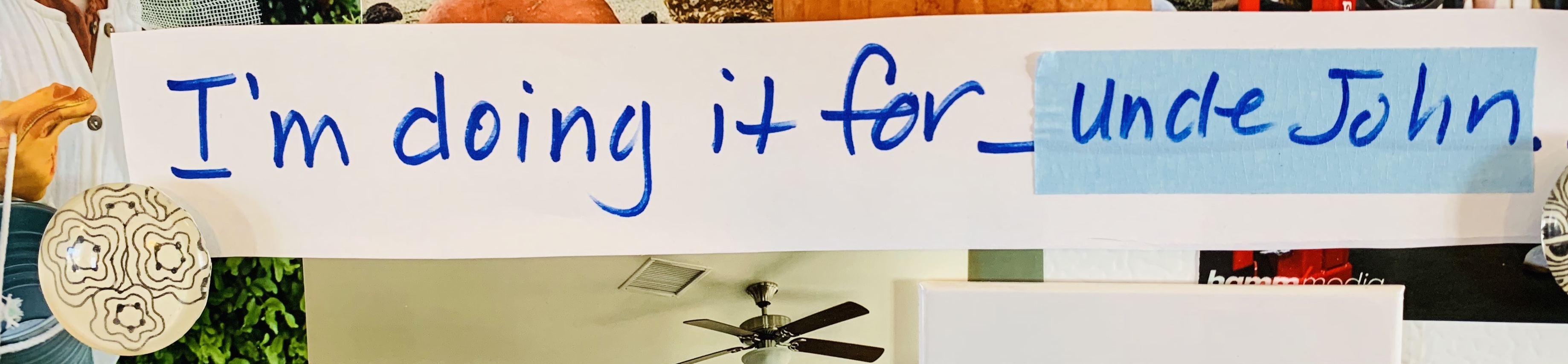
            Then, last night, I came up with another way to remind myself, in coming weeks, of why I’ve committed to self-isolation. I took a sheet of paper, and wrote on it, “I’m doing this for ______________”. This morning I took some blue painter’s tape and wrote on it “Uncle John”. That’s my 99-year-old uncle who lives in California.  I haven’t seen him in person in years, but we are in touch through occasional emails and rare phone calls – and through our heart connection, too. I wrote his name on the piece of tape, stuck that to the strip of paper, and put it up on my fridge, where I will see it dozens of times a day.  That will remind me that by doing my part to slow transmission of this virus, I am helping keep Uncle John alive – as well as thousands of others I don’t even know. And I’ve decided that each day, I’ll write a new name on a new piece of tape, the name of a friend, relative, or acquaintance who’s elderly or at risk in another way, and stick it to the paper, atop the name that’s already there.  I have enough names to last weeks. In fact, I have enough to last as long as this pandemic lasts.  I bet you do, too. 

            Much love to you all.
undefined

Articles to check out: “Act Today or People Will Die” , “Flatten the Curve”

Enter your email address to subscribe to this blog and receive notifications of new posts by email.

Don’t Let the Coronavirus Drive Us Apart

The coronavirus is on everyone’s lips – even as we don masks to keep it from passing our lips. The great majority of the world’s population is still free of the virus at this point, but many, many of us are infected with fear. And this fear of catching the potentially deadly virus is leading us to distance and isolate ourselves from our fellow human beings – at a time when we need each other more than ever.

            It’s our positive connections to others that help us get through life.  Maybe it’s the 30-second conversation we have when we order a coffee at our favorite cafe.   Maybe it’s a heart-to-heart chat with our best friend over that cup of coffee. No matter where they take place, and with whom, these interactions are essential to our well-being, not just emotionally, but physically, too.  Research has shown that people who have these type of connections live longer than those who don’t.

            What does this mean for us, then, living as we are now, in the time of coronavirus? When we may already be avoiding going out of the house in an attempt to avoid germs? When events that might draw large crowds are being cancelled? When towns are announcing that they might need to close schools? As we make these kinds of adjustments in an attempt to protect ourselves from this virus, we are taking steps to safeguard our bodies. But what are we doing to protect our hearts from the terrible – even deadly – consequences of isolating ourselves from the humans who bring joy and life to our lives?

            I got together with a friend for coffee the other day. As we spoke about the coronavirus, we both remarked that we were feeling more aware than usual of the fragility of life. And this awareness left us both feeling very grateful for our friendship, and for the precious connections we have with our other friends and loved ones.

            It just so happens that another friend and I are reading Gabriel Garcia Marquez’s novel, Love in the Time of Cholera together. One thing that has struck us in the novel is the characters’ devotion to each other, to love, and the necessity they feel to establish and maintain close contact with each other. They pursue these connections in a way that seems both obsessive and entirely natural.  These characters know, without reading any scientific research on the topic, that they will perish without love.  Because we don’t die only from cholera or coronavirus or some other disease. We really can die from lack of human connection and love.  At the same time, the search for loving connection is so clearly tied in the novel to the possibility of death: these characters have no doubt that love might just as easily kill them as save them.

            As I see it, the coronavirus has presented us with a similar conundrum: Leading our lives in the way that feels most satisfying to our hearts –  in frequent contact with those whose company nourishes and satisfies and supports us – means placing ourselves in grave danger: We might end up taking in an invisible pathogen that may sicken or kill us. Certainly, we humans have faced this kind of challenge before.  The Spanish Flu, Ebola, and SARS come to mind from the last 100 years alone.  Not to mention HIV/AIDs, which highlights the potential lethality of a loving connection with such poignancy that it could have sprung from the pages of Márquez’s novel.  

            Coronavirus, though, is the pathogen of this moment. When news stories detail who is most at risk of getting sick, we might be tempted to relieve our fears by contrasting ourselves with members of these populations. “I’m young,” we’ll think. Or, “I don’t live in China.” Or, “I’m not immune-compromised.”  One problem with separating ourselves from others in this way is that we are, in fact, all vulnerable, despite what we may tell ourselves. Another problem is that when we see certain categories of other people as most at risk of contracting this virus, we can easily shift to seeing these same people as a risk to us. Then maybe we start avoiding elderly folks, or our acquaintances who are immune-compromised, or Chinese restaurants, as happened in the town where I live. Maybe we start not just avoiding others, but lashing out against them: Just this morning, I read that an Asian man in London was brutally attacked by four people who shouted that they didn’t want the coronavirus in their country. This is how a pathogen like the coronavirus begins to insidiously drive us apart. As each of the other diseases I mentioned has done, the coronavirus tempts us to view our fellow humans not as people who are vital in some way to our well-being, but, rather, as threats. This, in turn, can cause us to fear interacting with others at the very time when we need the resilience and true comfort that only our connections to each other can give us.

            How, then, do we live “in the time of coronavirus”, given the threat it presents to our physical and heart health? I do believe that washing our hands and minimizing our exposure to already-infected folks are prudent courses of action to take to safeguard our bodies.  But, personally, I’m also striving to not view everyone around me as a potential disease vector. We are all human beings who want to get through this alive. So, let’s all also put as much energy as we can into strengthening and increasing the loving connections between us. Because we need each other!  Maybe we’ll have to talk on the phone more often, instead of getting together in person.  Even just emailing and texting each other are great ways to avoid becoming isolated in fear and loneliness. And this is key, because, although keeping to ourselves might protect our physical health, it’s maximizing our contact with those we love that will keep our hearts happy and healthy. A bonus is that striving to maintain loving connections – with loved ones and strangers alike – supports our bodies’ immune systems, too. In fact, I’m going to go so far as to say that it’s our love for each other that will keep us alive. So, keep in touch, dear ones. Keep in touch.

Enter your email address to subscribe to this blog and receive notifications of new posts by email.