Last Wednesday, I took a walk along the route I usually follow near my house. The afternoon and evening before, Hurricane Isaias had barreled through the Pioneer Valley in Massachusetts, where I live. But by the time it got to us, it brought only tropical storm-force winds. Although people across town from me lost power, and many trees were downed, I didn’t notice much out of order in my neighborhood on my walk, at first: only a few small branches lay on or along the road here and there. But then I came up alongside the big cornfield that lines a long stretch of my walking path.
The corn here is about five or six feet tall now, the stalks well-tasseled, deep green. Tufts of silks hang from the slim, immature ears on each stalk. Although I’m well aware that each acre of corn in this field sweats off 3,000-4,000 gallons of water into the air each and every day – yes, “corn sweat” is a thing! – I always enjoy passing by the thousands of corn stalks on my walks. It’s as if each of them is standing up as straight as it can, in an effort to show its serious devotion to bringing its one or two offspring to tasty ripeness. A series of Walls of Corn Moms, perhaps? The corn’s spiky tassels look like a jaunty, spiked haircut to me – a bit of irreverence amidst the stalks’ arrangement in formal rows.
As I walked, I saw that the rows were all in order for about the first third of the field. Then, I noticed that a big swath of cornstalks on the edge of the field – at least ten feet wide, and thirty or more feet long – had broken formation. They were all tipped over in the direction of the road I was walking on, bent fully over. They looked like they’d just fallen asleep standing up and had all tipped over. The stalks weren’t uprooted, just toppled, as if some giant foot had tramped over them and pressed them down hard. Which is, basically, what had happened, if you think of Isaias as the giant, and its winds as the foot.
It struck me that only part of the field had been affected by the strong winds. I thought of the iconic photo I saw as a child, growing up in Illinois, where tornados were common: a photo of a piece of hay that had been driven into a barn board by a twister’s crazy winds. The scene before me now reminded me of the strange ways strong storm winds can affect the landscape, and how those effects can seem capricious. Here, I wondered why only this section of the field had been affected, and why the cornstalks hadn’t been uprooted and flung about the area, but merely folded over, firmly pressed down to meet the ground.
This question of unpredictability – Who gets struck down? Who remains standing, untouched? – seemed so relevant to me as I passed by. As I continued walking, I wondered what would become of those stalks that had been brought to their knees, so to speak, by the swirling winds that rushed in without warning the day before. Could they recover? It seemed unlikely that they could simply pop back up, like some plant version of those inflatable toys with the weighted bottoms that spring back up when you punch them over. And yet, unpredictability is the hallmark of our very existence… I really have come to believe in recent years, that anything is possible – in terms of both positive and negative events. What might this cornfield be capable of?
I found out this morning:
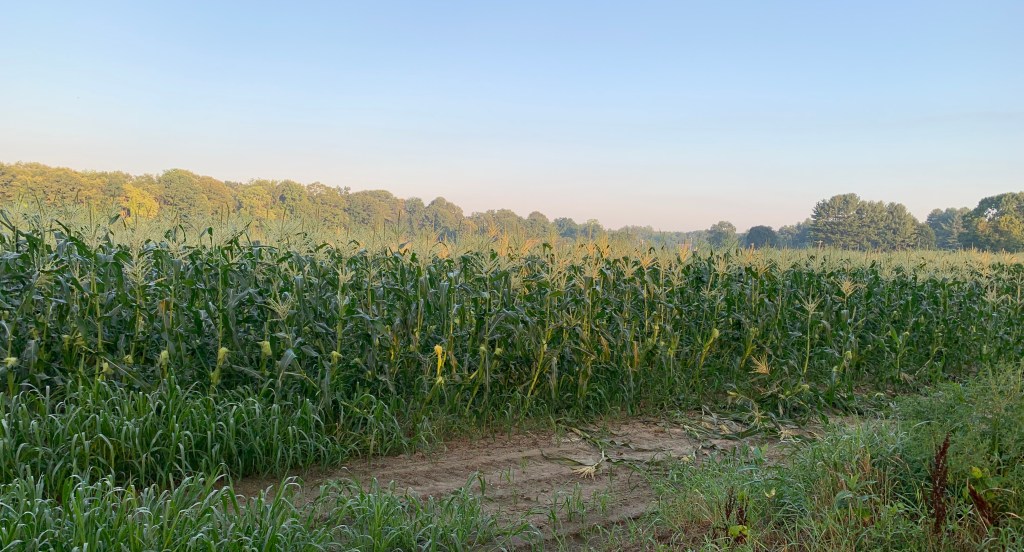
You can see a few still-folded stalks in the forefront of this photo. But the rest are standing back up at attention, looking none the worse for wear than their comrades. I almost couldn’t believe my eyes when I saw that. Almost. But I had to believe it, because the evidence was staring me in the face.
Perhaps their recovery had to do with evapotranspiration – the process whereby a corn stalk draws water from the earth up into itself, before spewing it out into the atmosphere in ungodly amounts, in the form of corn sweat, to create hideous levels of humidity that plague nearby humans… As much as I would like to be able to find a way to feel really good about evapotranspiration (aside from the fact that it makes tasty sweet corn possible), in this case I prefer to ascribe the corn stalks’ recovery to something less concrete: resilience.
The mechanics of resilience are more mysterious than the those of evapotranspiration, its manifestations much more varied. And I’m thinking of people here, now. What does each of us draw up into us, that enables us to right ourselves in the aftermath of powerful storm winds? And where do we draw whatever we draw up from? I’m sure this varies for each of us. For the corn, maybe it was partly some form of rejuvenating nourishment from the earth, a kind of elemental supporting stake. Or maybe – as I enjoyed imagining – the farmer came by and tipped each individual stalk back up, into place, fortifying it with an encouraging touch and gentle, loving words. It could also have been that those hundreds of cornstalks were able to rise up thanks to support that each of them – the fallen ones and those surrounding them protectively as they struggled – offered to the others. “Come on back up.” “One at a time.” “We can get through this.”
I like thinking of that chorus of spiky-haired corn-stalks boosting and spurring each other on. I like thinking of us that way, too. Resilient. Drawing from reserves we may have to tap down deep to access, and then sharing them with those around us. Drawing on and supporting each other in whatever way we can at any given moment, as individuals and as community. This is so important now – and always: being resilient. Oh, and also: believing that we can get through whatever winds whip through and push us over. So, let’s do that. Let’s be strong. Cornfield strong. Spiky haircuts optional.
 Sue Downing