As 2020 comes to a close, I’m happy to be able to invite you to join me this coming Sunday for the first Virtual Club Joy gathering of 2021! Sunday, January 3rd, from 2:00-3:00 p.m. Eastern Standard Time. See below for the Zoom link to click on.
2020 has been so challenging, on so many fronts, that it’s not surprising if it’s the unpleasant experiences we’ve had during the past twelve months that pop into our mind when we look back at the year. But it doesn’t have to be that way. As I wrote in an earlier post, we can consciously choose to focus our mind on joyful thoughts. To be sure, doing this is easier at some times than at others. But with practice, choosing this focus for our thoughts can grow easier. Over time, it can become a new and nourishing habit! So, on Sunday, we’ll practice one way we can shift our attention to joy: We’ll do a guided meditation where we’ll call up a memory of a joyful moment in our life, and tap back into the positive feelings and thoughts we experienced at that time. I hope you’ll be able to join me as we collaborate to create a joyful start to the year!
But you don’t have to wait until Sunday to get started on recalling Joy back into your mind and heart. I invite you to take a minute sometime between now and then to think of one joyful moment you experienced in 2020. Spend a little time recalling it in detail, and see what arises in your heart as you do!
Here’s the link to use to join Sunday’s gathering:
The passcode is “Joy”, and the Zoom meeting ID is 811 6239 8559. No need to register or RSVP. And do feel free to forward the meeting info to someone you think might enjoy (enJOY) being there with us.
I wish you a peaceful rest of the week, and I look forward to being with you and sharing and spreading some joy on Sunday!
I’m writing to invite you to join me this coming Sunday for another Virtual Club Joy gathering on Zoom! Sunday, December 20th, from 2:00-3:00 p.m. Eastern Standard Time. See below for the Zoom link to click on. (I’ll also be offering a gathering on January 3rd, at the same time, and using the same Zoom link.)
There are limitless ways for us to invite Joy into ours lives. This week, we’ll be exploring how calling up a memory of a joyful moment in our life can enable us to tap back into the positive feelings and thoughts we experienced at that time. And I’ll take you through a guided meditation so you can practice doing this. As we’ve done before, a few of us who’d like to do so will also briefly share our own recent joyful experiences. (Hint, mine has to do with bubbles…)
But you don’t have to wait until Sunday to get started on recalling Joy back into your mind and heart. I invite you to take a minute sometime between now and Sunday to choose an item in your living space that helps you feel connected joyfully to someone, or to a place in nature where you’ve felt joy. Spend a little time contemplating that item and the person it connects you to, and see what arises in your heart as you do this. Then, if you attend our gathering on Sunday, bring that – or another item that connects you joyfully to someone in your life – along with you.
The passcode is “Joy”, and the Zoom meeting ID is 811 6239 8559. No need to register or RSVP. And do feel free to forward the meeting info to someone you think might enjoy (enJOY) being there with us.
I wish you a peaceful rest of the week, and I look forward to being with you and sharing and spreading some joy on Sunday!
As I write this, I’m sitting at my dining room table, looking out the sliders to my deck. A light snow is falling, and I’m watching the chickadees and finches and sparrows and titmice make forays to the feeder I’ve put out for them. The blue jays have already scooped up all the peanuts I put out on the deck earlier, and a squirrel has already gone through its gymnastics to access the suet feeder for a morning snack. All is right with the world. At least from the birds’ and squirrels’ perspective. At this moment.
But if the birds were to think back to the scene that unfolded yesterday morning out at the bird feeder on my front porch, they might not have considered their world so cheery. That’s because yesterday morning a juvenile red-tailed hawk stopped by. It began visiting us last week. The first time I glimpsed it, it was perched on my porch railing, about three feet away from me. We were separated only by my kitchen window. What a gorgeous bird! And a real treat to see it up close. It even looked in my direction at one point. It returned the next two days. I continued to delight in its presence, grateful for such a close-up view of this raptor.
Not surprisingly, the birds didn’t share my enthusiasm: One day a few years ago, when we had a particularly harsh winter, I saw a hawk swoop down onto my back deck and pick off a junco. The other birds stayed away from the blood-stained snowy deck for the rest of the day. Now, too, when the hawk shows up, the songbirds clear out. So do the chipmunks that gather the seeds that the birds drop.
Yesterday, the hawk chose to perch on a bush at the corner of my front porch. Had it spied the chipmunk that had run off the porch a bit earlier? Or was it just hanging out and waiting, having learned that breakfast was to be had in this area? Who knows. I don’t even know whether it’s ever caught anything out there. I haven’t witnessed the murder of any of the little critters I adore, but I’m not so naïve as to think that if I don’t see it, it’s not happening.
And what about the birds? What awareness do they have of the possibility of danger when danger is not yet obviously present? They must have some awareness of that sort – that must be what urges the chickadee to fly off to the cover of a pine tree with each little seed it plucks from the feeder, instead of lazily munching on it right out in the open. But here’s the question that comes to mind for me: Does knowing that danger is possible prevent that chickadee from enjoying the seeds it eats? Or dilute the squirrel’s enjoyment of the suet? (I’m convinced that it wouldn’t show the same enthusiasm for a piece of bread, so I’m going to conclude that when it chows down on suet, it’s experiencing whatever we call “joy” in non-human creatures.)
I’m going to go out on a limb and say that the chickadee and the squirrel just experience that joy whenever and wherever it shows up: in a sunflower seed here, a suet feeder there. I think that even though part of their brain is scanning for danger, another part is also scanning for joy. And when they encounter it – in the form of a millet seed or a mouthful of suet – they totally go for the gusto and squeeze every possible bit of joy out of it that they can. They say “Yes!” – not only to the life-sustaining nourishment of the food, but also to the joy that comes with eating it, even though they know on some level that a hawk might be circling above them.
It seems to me that we humans operate differently than my friends on the deck. Because we have these big, reasoning brains, we get far more distracted than they do by thinking about past or possible dangers. If I were a junco – but with my human consciousness – and if I’d seen a red-tailed hawk devour a flock-mate before my eyes, I would never, ever, EVER want to visit that birdfeeder again. But I imagine that if I did visit it again, because, well, I needed to eat, my mind would be so overwhelmed by fear that I’d be unable to enjoy my meal at all. The terror of the memory of the hawk would crowd out the joy.
It seems to me that this crowding-out-of-joy happens so often to us humans. We get preoccupied with whatever unpleasant situations are playing out in our lives or in the world (i.e., hawks, from the perspective of a bird or a chipmunk), and, before we realize it, we’ve eaten an entire chocolate pecan turtle without having properly soaked in the caramel-chocolate-pecan yumminess. In other words, we’ve just squandered an opportunity to invite joy in.
So, what I’ve been thinking about lately is that, because we are such thinking-oriented creatures, we humans need to make a conscious effort to bring joy into our lives. More chocolate pecan turtles, fewer “hawks”. I’ll admit that it’s often not easy to choose to focus on what’s joyful, instead of on what’s upsetting. I know this from my own experience: I was writing about myself earlier when I mentioned the pecan turtle. And yet, I find that when I consciously shift my thoughts away from a potential or past or present difficulty, and toward doing or thinking about something pleasant, I can experience so much joy!
Take watching the birds and squirrels on my deck. When I gaze out at that scene in a frame of mind that is clouded by this or that situation that’s weighing me down, I may see the birds, but I don’t really see them. My mind is preoccupied with what’s bothering me. But when I can set all of that aside and really look, here’s what I might see: a junco doing its hilarious two-footed hop on the deck, or a chickadee tapping a sunflower seed on the branch of a nearby tree. That’s when I find myself smiling, grateful that these tiny birds’ antics have just filled me with so much joy. And marveling that all it took was a conscious decision on my part to mentally invite joy into my life for a visit.
So, I as we approach the end of this crazy year, I want to take the opportunity to wish you many, many moments of joy. May you have the wish to focus your attention on what will throw the door of your heart and mind wide open to joy. And may you have the courage and perseverance to make this wish a reality, a new habit that will guide and infuse your life as you enter 2021. I’d like to offer a little mantra, too. This helps me stay focused on inviting joy in, instead of on dwelling on what bothers me: Fewer “hawks”, more turtles.
Much love to you all.
* * *
And to give you a bit of practice at inviting joy into your life, here’s a guided meditation for you. (The transcript follows the recording.)
Inviting Joy In – Guided Meditation
Let’s start by finding a way to sit that will be comfortable for about ten minutes. Or, you can lie down, if you prefer. Close your eyes, if that feels good to you. Otherwise, just lower your gaze so that you won’t be distracted by your surroundings.
Let’s take in one nice deep breath, and then let it out, slowly.
Then do that two more times, at your own pace.
We’re here in our virtual Club Joy, taking a break from everything in the outside world of our life. And I think we’d all say that there’s some area of that life that we’d like to be experiencing more joy in. So that’s what we’re going to do today- invite Joy into one part of our life.
If you were here with us last week, or if you listened to the recording of the guided meditation from last week, then you’ve already come up with an image of a door for yourself, a door that opens up to Joy. If you already have an image of that door, imagine it before you now. If you haven’t yet created a door that opens up to Joy, for now, just imagine that you’re standing in front of a door. It can be whatever kind of door you want. And on that door is a sign that says, “Joy”. This sign is there to show you that Joy is right on the other side of the door, and that whenever you open that door, you are opening up to experience Joy.
So now, take a moment to imagine your door. This is your personal door to Joy.
Now imagine that you’re holding a different sign in your hands. This sign is blank. But in a few moments you’re going to decorate it or write something on this sign, so that it will indicate the part of your life that you’d like to invite Joy into. Then you’ll be hanging that sign on the outside of your door to Joy. That way Joy will know exactly which part of your life it can enter once you open the door.
In your mind now, hold this blank sign out in front of you. What color would you like the sign itself to be? Go ahead and imagine making it that color.
Now let’s go ahead and start the process of choosing which part of your life will be represented on this sign. You can be certain that whichever part of your life would like an infusion of Joy has been waiting for this moment since we began our meditation. Maybe it’s already standing in front of you, one arm raised in excitement, calling out, “Pick me! Pick me!” If that’s the case, then you already know what will go onto your sign.
But if no particular part of your life has occurred to you yet to focus on, that’s okay. It’s just being a little shy. To encourage it to make itself known to you, start by imagining once again that you’re holding that blank sign out in front of you. And allow a message to appear there from whichever part of your life would like to have a visit from Joy. It may appear as a word on the sign, or as a word or phrase in your mind. Or as an image of some part of your life or person. Or you may simply know without seeing or hearing anything. Take a minute or two now to gaze at your sign and to allow yourself to become aware of which part of your life this is, in as much detail as possible.
Now that you have a sense of which area of your life is calling out to have Joy come for a visit, take a moment to express that on your sign in some way – in words, or in an image. So that Joy will see it and understand where to it’ll be heading once you open the door.
Okay. Now it’s time to hang this inviting sign on the outside of your door to Joy. Go ahead and imagine doing that right now. And take time to look at your sign and admire it, once it’s hanging on the door.
Great. Now you have a door that clearly tells Joy which area of your life it will enter when it comes through this door that you’ve created and labelled. So, now it’s time to actually invite Joy to come through the door and into this part of your life. We need to do this consciously, because Joy doesn’t want to just barge in, uninvited. Think of it this way: It’s like having a little sign with your name on it next to your front door, so that a visitor who comes to your house will know who they’ll find on the other side of the door. But that sign isn’t an invitation to come in. It’s just there to let visitors know they’ve come to the right place. They still need to wait on the doorstep until you open the door and say, “Come on in!” It’s the same with Joy. It sees your sign – right at this very moment, in fact! – and knows which part of your life is behind that door. But it’s waiting for your invitation to enter that space.
Before you go ahead and open the door to Joy, though, let’s take a moment to decide how you want to invite Joy in. Is there a certain phrase you’d like to use? A gesture? A sound? A song? A dance? What feels right to you at this moment as a way to invite Joy to enter your life? Take a moment to consider your invitation.
Now, go ahead. Open your door and offer your special invitation to Joy. Invite it to enter and join you in the part of your life you’ve chosen.
Imagine now that Joy really is stepping into this space where you’re standing now, and that this space represents the part of your life you chose to invite Joy to enter. Maybe you’ll see Joy, or hear it, or feel it, or simply sense it. But know that it is coming in. After all, you gave it a lovely invitation, and Joy is a very enthusiastic visitor! Take a couple of minutes now, just to rest in the awareness that Joy is now present in the part of your life that you indicated on your sign. Allow yourself to receive this awareness in whatever way it arrives. And I’ll let you know when we’re finished with this part of the meditation.
Wonderful. No matter what you experienced in this last part of our meditation, I invite you to inwardly give thanks to Joy for visiting. Even if it seems to you that you didn’t experience anything at all, know that Joy has entered into that part of your life that invited it to visit. In fact, it’s still there. It intends to stay for a good, long while. And if you ever have a moment when you doubt that it’s still there, go ahead and open the door once again. Consciously invite Joy in again. You can even ask Joy to give you some kind of sign that it’s really there.
You can also feel free to create a new sign for your door, if you want to invite Joy into another part of your life. And don’t think you have to take down the first sign when you do that. You can fill up the outside of your door to Joy with invitations. That’s because Joy can be present in more than one part of your life at once. There’s plenty of Joy to go around.
So, I hope you’ll enjoy your visits with Joy, and I wish for Joy to be present in every nook and cranny of your life.
Now we’re going to start gently and gradually returning our attention to where we’re gathered together.
I’m so happy to invite you to join me this coming Sunday for our second Club Joy gathering on Zoom! Sunday, December 6th, from 2:00-3:00 p.m. Eastern Standard Time. (See below for the Zoom link to click on.) I’ll also be holding two more get-togethers, two weeks apart, on December 20th and January 3rd, at the same time, and using the same Zoom link.
I see our virtual Club Joy get-togethers as a space of respite and peace and positivity, where we can relax in body and heart and mind and spirit, and experience joyful moments alongside others who also hold this wish and intention.
This Sunday, we’ll be focusing on how we can invite joy into various areas of our life, and I’ll take you through a guided meditation so you can practice doing this. As we did last week, a few of us who’d like to do so will also briefly share our own recent joyful experiences.
And because I believe that coziness can really enhance our experience of Joy, I invite you to bring an item or two along to our gathering that will help you feel cozy while we’re together. A cup of tea or cocoa? A candle or some soothing essential oil? A special blanket or sweater or shawl? What says “cozy” to you? Bring that along with you on Sunday, and we’ll settle in for a nice, cozy afternoon break together.
The passcode is “Joy”, and the Zoom meeting ID is 811 6239 8559. No need to register or RSVP. And do feel free to forward the meeting info to someone you think might enjoy (enJOY) being there with us.
I wish you a peaceful rest of the week, and I look forward to being with you and sharing and spreading some joy on Sunday!
As I wrote in a previous post, when I created my Garage Club, it wasn’t long before I developed the feeling that its real name should be “Club Joy”. That’s what felt right. And not long after this realization, I found myself reflecting on what, exactly, I think “joy” is.
I used to think of joy as something that popped up in my life. Joy has always seemed different to me than happiness, which I’ve tended to see as a more or less enduring state that results when a certain set of external or internal circumstances comes together. By contrast, I thought of joy as a momentary experience, like the blink of a light in the darkness.
As for how we come to experience happiness and joy, here’s how I used to distinguish between the two: Happiness comes on gradually. It’s something you consciously create, by setting an intention to build it. Then you take certain steps that you believe will move you toward your goal of a state of happiness.
What about joy, then? I used to feel that joy just, well… happens. It’s something we receive, not something we create. Either it arises, or it doesn’t, and we have very little control over whether that happens.
I tended to see joy as akin to a total stranger who knocks on your door and then, when you open it, both totally surprises you and presents you with pure delight as a gift. You never imagined this scenario, and yet, here’s Joy, showing up on your doorstep.
Then, somehow, just as inexplicably, Joy fades away, vanishes into thin air. Sure, this visitor will most likely pop by again some other day. But you’ll never know when to expect it. Joy isn’t the kind of visitor who gives you a heads up so that you can mark your calendar and look forward to its arrival.
And because we never know when Joy might show up again, a thin layer of disappointment can settle over us once our unexpected visitor leaves. “Come back!” we want to call after it. But it’s gone, and it didn’t leave us a phone number or an email address. Not even a snail mail address. And that’s too bad, because if it had, we would definitely mail off a note, probably even an engraved invitation, and invite it to drop by again soon. “How about next Tuesday? Is 3:00 good for you?”
Seeing Joy this way – as an unpredictable, even unreliable, guest, whose visits we are powerless to control, can take its toll on us. We want to spend time with Joy again, but we don’t know how to go about making that happen. We’re left feeling that we have no agency – that all we can do is wait passively until Joy deigns to knock on our door again.
In reflecting on this over the years, I concluded that, indeed, we can’t make Joy show up on our doorstep on command. Even so, I believe that we do have a certain kind of agency in our relationship with Joy: We can enter into a kind of collaboration with it. We can initiate this collaboration by creating a welcoming space in our heart and mind. Think of it as a cozy, peaceful guest room with Joy’s name on it.
The first step in creating a guest room in our mind and heart is to let go of any disappointment we might be feeling at Joy’s absence. Then we place our focus on reorganizing and spiffing up the space in our mind and heart. This process is similar to what I did with my garage when I was working on my physical Garage Club/Club Joy. I started out with a dusty, unkempt garage, full of unappealing garage items; some genuine garbage that needed to be gotten rid of; and stuff to be recycled or tossed in the compost bin. I had a vision in my mind of how I wanted Garage Club to look, and I kept my focus on that, as I rearranged the contents of my garage and added new, more lighthearted elements to the décor.
I don’t want to give you the impression that it was all smooth sailing, setting up Garage Club. I was really discouraged at first, right after I hung up the string lights on my bare garage walls. There was no way that struck me as fun or welcoming. Would anyone really enjoy sitting there? I could have obsessed over how disappointing it looked, then slipped into concluding that it would never look right, and then end up by abandoning the project entirely.
But I didn’t do that. Instead of focusing on what was wrong with the space, I kept returning in my mind to my vision of how I wanted Garage Club to look. And, little by little, it came together. Now I love the space, and my visitors seem delighted by it, too. I think it seems like such a surprise to them, this moment of joy that’s popped up unexpectedly from behind a garage door. And yet, Garage Club – Club Joy! – did not just happen. I had a vision for it, set my intention to create it, and then methodically went about moving toward my goal.
So, how can we go about creating the internal equivalent of Club Joy, a space in our mind and heart where Joy will feel like plopping down in an easy chair for a nice, long visit? The very first step is to create a door in our mind and heart that we can open up to Joy – like my garage door, just in your mind.
This is such an important step! The door to Joy’s guest room is a special door: a portal that will make it possible for Joy to join us. So, in our mind, we consciously create a door, and express a strong, clear intention as we’re doing so. Something along the lines of, “I’m creating this door so that I can open it up and invite Joy to come visit.”
Setting our intention this way is like hanging a lovely sign on the other side of our door that says, “Coming Soon! Joy Guest Room!” Maybe it even makes note of some appealing perks: “Three meals a day included. Plus unlimited chocolate”. As soon as we do this, our intention – to welcome Joy as our guest – filters out beyond the door, out into the space where Joy is roaming around, doing whatever it does all day and night. And Joy thinks, “Hmm. This is intriguing. What’s going on here?” From that point on, Joy’s going to make a point of stopping by every so often, to see whether your guest room is open for visits yet.
Once you’ve stated your intention, you can begin working on creating the interior of this room for Joy. And, based on my own experience setting up my physical Club Joy, my advice to you is this: Don’t wait until everything feels ideal and perfect inside your mind to open the door.
Don’t think you have to have a perfectly calm and peaceful mind and heart in place before you open the door to your Joy guest room. If you put that pressure on yourself, you’ll never change the sign on the door from “Coming Soon!” to “Open for Joy!” Make peace with the fact that, if you’re at all like me, there will always be mental or emotional cobwebs in your mind, just the way my garbage pail and all my garage-y things are still in my garage.
When I was setting up Club Joy, I didn’t have the goal of taking all of that distracting stuff out before I invited visitors in. I knew that was neither practical nor possible. Instead, I just set up a cute wooden screen at the back of my garage. Sure, anyone who comes by knows that the screen is there for a reason: There are things behind it that I don’t particularly want people to see. Not because they’re bad things, but because having to look at them might distract us from our visit with Joy. Putting up the screen also conveys my intention: I choose not to focus on all of that stuff right now! After all, this is Club Joy, not Club All-The-Stuff-You-Associate-With-A-Garage.
And so, my physical Club Joy is open, and no one seems deterred by all the unappealing clutter behind the screen. Folks come right on in. And so does Joy. Joy heard there was a club with its name on it, and it headed right over.
So, as you’re creating your internal Club Joy, you don’t need to worry about all the odds and ends that are knocking around your head and heart space, either. Just take the first, intentional step of creating the door that you can open up to Joy. And Joy can’t wait! It’s so excited for Opening Day.
* * *
Because creating a door and opening it to Joy may feel a bit daunting, I’ve recorded a meditation/visualization that will guide you through that process. (And the text of the meditation follows, below the audio player.)
Guided Meditation: Opening the Door to Joy
Opening the Door to Joy – Guided Meditation
Let’s start by finding a way to sit that will be comfortable for about ten minutes. Or, you can lie down, if you prefer. Close your eyes, if that feels good to you. Otherwise, just lower your gaze so that you won’t be distracted by your surroundings.
Let’s take in one nice deep breath, and then let it out, slowly.
Then do that two more times, at your own pace.
Now, imagine that right in front of you, there’s a door. You can imagine it in your actual living space, or just in your mind, or in your heart – wherever you want it to be. Imagine whatever style of door appeals to you.
Now imagine that there’s a sign on this door. And the sign says, “Joy”. What this “Joy” sign on the door is telling you is that, right on the other side of that door, is Joy. It’s there right now.
I invite you to imagine your door once again. What color or colors would you like your door to be? Now, imagine that painting the door that color. And if you’d like to take the “Joy” sign off while you’re painting, that’s fine. Go right ahead. Just imagine taking it off and setting it down on the floor next to the door. Joy is still there on the other side, even if you take down the sign.
Go ahead and paint your door, using whatever color or colors you’d like.
Now that it’s painted, would you like to decorate your door in any way? Add a design? Or a picture of a person or an animal or a place you enjoy? Take a moment now to decorate your door.
Now, take a step back, so to speak, and take a look at your door. It doesn’t matter if you haven’t finished decorating it. You can come back another time and do more. The door that you can open up to Joy is a work in progress.
Now, let’s look again at the sign that says “Joy”. I invite you to hang it back up on the door, if you took it off earlier, and make any changes you’d like to the way it looks. Or, you can get rid of the sign entirely and just write the word “Joy” directly onto your door. It’s up to you. The main thing is that when you’re done, you should be able to see the word “Joy” on the door really, really clearly, even from a distance.
So, go ahead and take a little time to label your door “Joy”, in whatever way appeals to you.
Wonderful! So now you’re standing before your beautiful door that is labelled “Joy”. Really imagine standing in front of it. In a moment, you’re going to put your hand out and take hold of the doorknob. But first, check in with yourself.
How are you feeling about opening this door to Joy? I ask, because this idea of opening the door to Joy can be trickier than it sounds at first. Maybe you sat down with the thought that you’d just throw that door wide open, then stand there in the doorway with your arms wide open, and shout, “Come on in, Joy!” Maybe that’s how you’re still feeling. But maybe it’s not. Maybe the idea of opening the door to Joy leads us to put a little or a lot of pressure on ourselves. We might feel pressured to not just open the door to Joy, but to feel Joy, once the door’s open. Thoughts might come into this lovely room we’re starting to set up here, thoughts like, “Okay, I have to do it now. I have to feel joy!” or “What if I don’t feel joyful once I open the door?” Thoughts like that can come into our mind space. That happens. But they can be a big distraction, and at the moment, we don’t need them here, not when we’re trying to focus on opening the door to Joy. So, we’re going to move them to another part of our mind space. That way they won’t distract us.
So, imagine a folding screen, made of whatever substance you like: wood, metal, ivy… Make it wide enough that it can stretch from one side of the space behind you to the other. Turn around and put this screen in place. Now, mentally gather up any worrying or pressuring thoughts into your hands. Then toss them up and over the top of the screen. Imagine the thoughts sinking to the floor behind the screen. They’ll sink because they’re heavy, and they’ll stay there, on the floor behind the screen.
Now turn your attention back to your door that opens to Joy. Spend a moment reacquainting yourself with the beautiful door you’ve created. Look at the details. Look at where you’ve written the word “Joy”.
Now let’s get ready to actually open your door to Joy. You can open it as far as you want: just a crack, or all the way, or somewhere in between. It’s entirely up to you, and any amount of opening is perfect. So now, in your imagination, reach your hand out and take hold of the doorknob. And open your door to Joy.
Now, no matter how far you’ve opened the door, just rest in that openness. And allow yourself to experience Joy, in whatever way it is present with you at this moment. Joy might arise as a feeling somewhere in your body, or as an image, or a thought. Or you might not notice anything at all. That is totally fine, too. No pressure. So let’s relax in this space of openness for a minute or two and receive whatever arises. And I’ll let you know when we’re done with this part of the meditation.
Okay. Great.
Take another look at your door to Joy. And, no matter what you experienced in this last part of our meditation, I invite you to inwardly give thanks for that. And even if it seems to you that you didn’t experience anything at all, know that Joy was with you in the space you’ve created. Know that Joy is always there, on the other side of that door that you decorated and labelled with the word “Joy”.
What you do now is up to you. You can leave the door open, or close it. Whatever you want. And remember that you now know where Joy is located: Right behind that door. So that now, you always have access to it, and to the Joy behind it. You always have the wastebasket, too, in case thoughts come in that want to distract you from opening your door to Joy. I invite you to visit your door often. Open it up and see how Joy appears to you.
Now we’re going to start gently and gradually returning our attention to where we’re gathered together.
In my recent blog posts, I’ve written about how important it’s feeling to me these days to focus on connecting with folks in joyful ways. I believe that these moments of positivity nourish us and serve as a respite amidst everything in our world that can make it hard for us to maintain a stable foundation of joy. And the responses I’ve received to my recent posts have given me the sense that others are also wanting to bring more joy into their lives. So, the question arose in my mind a few days ago: What might I do to help us tap into joy on a regular basis, together, to expand Club Joy beyond the bounds of my physical garage space?
Nudged by a feeling of curiosity about this, I sat down the other morning to reflect. I silently expressed my wish to gain some insight, and then just sat there, allowing my mind and heart to settle into a calm space. Before long, ideas began to bubble up from deep inside me – concrete ideas for how to help us create and nurture our storehouses of joy. Just contemplating these possibilities gave me a feeling of such lightness – and joy!
I’ve decided to start off with the idea I’m calling “Opening the Door to Joy”. And we’ll do it on Zoom, since we can’t all come to my physical Garage Club/Club Joy in person!
“Opening the Door to Joy” is all about creating a safe space – free of talk about anything negative or calamitous or worrying – where we can relax into a peaceful frame of mind and heart, and invite joy to join us. Here’s what you can expect:
I’ll start our Zoom gathering by welcoming everyone, and bringing our focus to being present with each other in this virtual Club Joy. I’ll spend a few minutes talking about the role that joy plays in my life. Then I’ll offer a guided meditation that will help us inwardly open our hearts to joy.
After this meditation, if there are people in the group who would like to share a joyful experience with us, I’ll invite a couple of them to speak for a minute or two. But there’s no pressure at all to speak! If you want to just sit quietly and listen, that is perfect, too. The whole point is for us to be in a safe space where we can open up our hearts and invite joy to come on in. And there’s no “right” way for that to happen: the experience will be different for each of us. For some of us, joy may flow in as we simply sit in silence in the presence of others who are telling their brief stories. For others of us, joy might arise as we share a story. I look forward to each of us discovering for ourselves how it happens!
After we’ve had the chance to hear a few joyful stories, I’ll close us out with a brief wish for preserving whatever joy and positivity we’ve taken in.
That’s it. About 45 minutes. Maybe up to an hour, but no more.
Our first “Opening the Door to Joy” gathering on Zoom will be next weekend, on Sunday, November 29th, from 2:00-3:00 p.m. Eastern Standard Time. And there’ll be a second one the following Sunday, too, on December 6th, at the same time.
The passcode is “Joy”, and the Zoom meeting ID is 811 6239 8559. No need to register or RSVP. And do feel free to forward the meeting info to someone you think might enjoy (enJOY) being there with us.
I hope you’ll join in! Time’s a-wastin’. Let’s open the door and invite joy to come in and visit.
Its first iteration was what I called, variously, my Pandemic Porch Paradise, or Cozy COVID Café. I live in a condo complex, and I have a perfectly nice little covered front porch. My kitchen windows look out onto it, and I really enjoy watching the birds that come to the feeder I have hanging there. But I’ve never spent much time sitting out there at all. That changed with the pandemic.
During the summer, one friend or another would come by occasionally, and we’d sit out on my porch, six or more feet apart, masked, for a chat. Even so, these occasions weren’t so frequent, because, mostly, I was getting together with friends outdoors in parks, or on their front stoops, or at ice cream stands where we could easily distance. Then there came the very warm early-fall day when a friend was going to come over for mid-afternoon tea and pie on my porch. I decided to set up a nice spot for us, with pretty kitchen towels over our individual low porch tables, and nice plates and teacups and napkins. I even swept up all the fallen birdseed! Then I realized that the sun was hitting the porch at just the right angle that it would be right in our eyes and also make us really hot. We needed a sun shield.
I remembered the gorgeous batik-fabric sheets that my sister and nieces had made me for my Reiki table. So, I brought those outside and duct-taped them up to the front roof edge of the porch. Success! And it wasn’t just that the jolly burgundy and orange fabrics created shade. Sitting there with our tea and cherry pie, my friend and I felt like we’d been transported to some snazzy street café in a distant land. In the blink of an eye, my boring condo porch became my Pandemic Porch Paradise, my Cozy COVID Café…
The Pandemic Porch Paradise in the evening
That’s what I called it, but what it had actually become was a space of joy. (My Jolly Joy Joint, maybe?) It seems to me, reflecting on it now, that I achieved this by bringing elements out to the porch that feel soothing and comforting and homey. Tea and sweet snacks are something my friends and I regularly share. Reiki, too! I think that having the sheets I use during my Reiki sessions hanging up outside with us lent a particular coziness and sweetness to the atmosphere. It was a way we could continue to feel enveloped in that loving, healing energy, even though the pandemic had put a stop to our hands-on Reiki sessions for each other.
Over the next couple of weeks, I added more elements that carry joyful associations for me: some string lights and candles…. plus yoga blankets, as the autumn weather began to settle in. But as the air temperature began to drop, I recognized that my Porch Paradise would soon have to reckon with winter.
Now, I have as much super warm outerwear as the next Bay Stater. Even so, “cozy” is not a word I associate with a condo porch exposed to the whipping winds of a Western Massachusetts blizzard, batik sheets or no batik sheets. But don’t think that I was even remotely considering retreat into a winter of solitude and nothing but Zoom teatime chats. No! As I sat huddled on the porch under my yoga blanket a month ago, eating a take-out dinner with a friend who’d driven up from Connecticut, my inner warmth may have been seeping out of me, but my determination was not. I resolved that I would NOT allow the pandemic and winter conspire to rob me of in-person meetings with my friends! So, I turned my determination not to stocking up on more down coats or fur-lined hats, but to creating a space where I could continue to meet with my friends safely and in at least relative comfort and warmth.
My single-car garage seemed the perfect (and only!) choice. If we left the garage door open for ventilation and added some space heaters, it should work, I reasoned. It would be easy to distance sufficiently if one friend came over. We could probably even manage three of us, in a triangle formation. In my mind’s eye, I saw us sitting there, in masked, distanced bliss, lifting our masks to sip on warming tea or hot chocolate, and satisfying our stomach rumblings with tasty snacks or take-out meals. We’d chat around a heater, definitely with blankies, since, hey, this would still be Massachusetts in winter, and the garage door would be open…
The heating question turned out to be easy to solve. After researching options, I went with two small, portable tower infrared heaters that were very reasonably priced. I decided against heaters that have fans, because … well …COVID. It didn’t seem a great idea to have heaters blowing air all over the place, even with the garage door open. Maybe I’m over-cautious, but the infrared heaters seemed like a safer option. I ended up buying two. Since they heat what they’re facing, instead of warming up the air, you really need one per person, even if they oscillate, like mine do.
I’ll admit quite readily that I could easily have stopped there and made do with just these heaters and the blankies I already had. I mean, really. If the goal was to be able to sit in a well-ventilated space with my friends and stay warm, then I now had everything I needed to achieve that. But that wasn’t good enough for me. Because I had no intention of settling for just “warm enough”. I wanted “paradise”.
It became painfully obvious that I still had a long way to go toward reaching this goal as soon after I hung up string light curtains across two of the bare white garage walls. The genuinely festive lights did move the “coziness” needle ever so slightly in the right direction. But they created much less of an effect than they had on my porch paradise, because I was in my garage. And my garage, naturally, contains all the usual garage-y things: garbage and recycling pails, a slightly rusted tall storage shelf, a rolling tool chest, plus brooms and other paraphernalia hanging on the wall. As well as a cold cement floor. Sigh.
You have to realize that I’d tackled the garage with a vision in my head of how I wanted “Club COVID”, as I started out calling it, to look. My goal was to replicate the effect I’d created on my porch. But as I looked at the stark, pitiful contrast of string lights against white garage walls, I felt a twinge of disappointment. “This is not paradisical,” I thought, frowning. True, I still had my gorgeous sheets to hang up. But they were small, and a vast amount of garage wall space would remain exposed. But I resolved, once again, to not be deterred. I would not give up on “paradise”!
Until I started writing this post, I hadn’t interrogated the stubbornness of my determination to achieve paradise in my garage. But now I see clearly why I didn’t want to create a space that would meet only our need for free-flowing air and physical warmth. I wanted to create a space that would bring warmth to our hearts, too. The garage’s “paradise” element needed to include the tasty snacks and décor accoutrements that would help us all feel comforted and soothed, the way we had done on my porch. The way we had done during pre-pandemic times.
That’s what was key to me, I see now. I wanted to invite people into a space that would transport us to another realm – one of happiness and joy. I envisioned it as a space we could enjoy on its own merits, rather than experience as a pale, disappointing substitute for the welcoming spaces we’ve created inside our homes. I did not want our surroundings to be a constant reminder of why we were meeting in a garage in the first place. I wanted us to forget that it was a garage. That’s why the heaters and blankies would not be sufficient. And so I got to work.
Part of the transformation involved jettisoning the words “COVID” and “Pandemic” from my club’s name. Now it’s simply Garage Club. That’s its nickname. Its official name (think American Kennel Club) is Club Joy. My friends who heard about it first still mostly call it Club COVID, and someone referred to it as “your COVID Cave” yesterday. That struck me as hilarious, for some reason. But mostly, folks have begun following my lead. We leave the pandemic outside, linguistically and physically.
And oh my, I think it’s really taken shape. It finally corresponds to my vision. It makes me smile. It’s silly and lighthearted and decorated with a variety of colors and textures and nature scenes. I’ve also incorporated some of the fairy house elements I created in years past, along with fairies a friend gave me last year. These sit atop three painted wooden shelves that adorn one wall and hold not only the rolled-up blankies, but also tea cups and teaspoons and a variety of tea bags. They’re self-service, so I don’t have to hand them to my guests. Napkins in a basket. Dried flowers in a metal can. Votive candles in sparkly holders. And snacks. And a folding wooden screen to shield us from seeing the garage-y elements. Oh – and shout out to the Chicago Canvas Company for the colorful tarps on the floor!
My friends all seem excited about it, too! One person, upon hearing about the Club, texted me, “Can we have liquor?” “It’s BYOB,” I replied. When another friend heard about the alcohol policy, she mused that she could bring over a bottle of red wine. I told her she could have her own shelf and leave the bottle there for future visits. A third, when I mentioned this idea of a system of personal shelves to store your favorite snacks, declared that she’d want hers stocked with peanut M&Ms. (She came for a visit this weekend, and that’s exactly what she found on one of the shelves…) The very first visitor to the Club said that she hopes to come back when the string lights will show up more against the tapestries behind them. (No more bare white garage walls!) We agreed that drinking a late afternoon cup of hot cocoa as the lights twinkled around us would be very cozy and comforting.
So, joy is already beginning to seep into the Club. Along with some unexpected and poignant surprises. One of my neighbors who popped by to see what I’d done with the place settled in for a visit. As we chatted, I saw her gazing over at the fairy houses, and smiling. She said that they reminded her of the creative endeavors of her best friend, who’d passed away back in the winter. As she told me about this woman and her sculptures, her face shone. I was so touched by that. I’m sure I would have really liked her friend.
Certainly, there are things to tweak. My friend who favors the peanut M&Ms noted, quite correctly, that the heaters can make you feel like a rotisserie chicken. (And no, we’re NOT going to be cooking chicken this way at the Club, just in case you wondered!) And it’s clear that we’re going to have to experiment with chair placement, so that whoever’s sitting nearest the open door doesn’t freeze when the wind comes up. But, overall, I feel that Garage Club is a success – if by “success” I mean that folks come by and sit for a while and share some tea or seltzer and a fun snack, and just smile and joke and laugh. In fact, that’s precisely what I mean by “success”. It feels to me like the Club is all about lightening our hearts. I’m feeling so grateful that I had this garage to transform, and a bit of money to fund the transformation.
To all of you who visit this gathering space in my garage, whether in person, or by reading this post, I want to say the following: Go ahead and call “Garage Club” whatever you want. Make up a new name that fits your vision or mood. Call it something different each time you think of it or mention it to someone else. It doesn’t matter what you call it. It doesn’t matter whether the space is created by me or by you, in some fabulous way I can’t imagine (but would love to hear about…) What matters is the underlying essence of whatever Club we might create: At its heart, each one is a Joy Machine. So, go ahead. Turn yours on and fire it up. Let it pump out the joy.
I’m finally getting started on answering your questions about Above the River! Here’s one from Janet:
“I’m curious about the tingling sensation people feel when attending a healing. Is that related to energy work?”
This tingling in the body that a number of the characters in Above the River feel when they’re in the room with Bruno Groening is something that many people have felt when they encounter what Bruno referred to as the “Heilstrom” (“the healing stream”).
Bruno Groening, as I mention in the Author’s Note at the beginning of the book, was a real person who carried out healing work in Germany after World War II. He said that the Heilstrom came from God, whom he described as “the greatest physician”. Many, many people who spent time in Bruno’s presence reported feeling this tingling that you mention, whether in their hands or feet, or throughout their bodies. Some people said that it felt like an electric current running through their body. When asked about this sensation, Bruno just said that it was the sensation of the Heilstrom moving through the body. He said that the Heilstrom would flow to every spot in the body where there was something that was “not from God”, and would clear it all out.
Certainly, not everyone felt this. Some people felt nothing at all. Others felt a deep sense of peace and calm and love, as did some of the characters in my novel. Bruno made a point of saying that it’s not necessary to feel the Heilstrom in order for it to have a healing effect on the body and mind.
This is so similar to what we sometimes experience during energy healing work. As someone who practices Reiki, I can say that both my recipients and I often feel tingling in the body during a session. And it’s my belief, which is shared by other practitioners, too, that what we’re feeling at those moments is the flow of the healing energy through our bodies, to the spots where healing is needed – a process similar to what Bruno said about the Heilstrom going to where there’s something that’s not from God. However, Bruno said that the Heilstrom was different from prana or chi. I imagine that he would also say it is different from the energy that we Reiki practitioners access when we give Reiki. And I can say, personally, that the Heilstrom feels different to me from the energy I use during a Reiki session, and also from the energy I’ve felt moving through me during, say, acupuncture or jin shin jyutsu. All of these have their own distinct feel to me.
I’m able to share this personal take on how the Heilstrom feels thanks to having been part of the Bruno Groening Circle of Friends: After Bruno passed away in 1959, a small group of what he called his Circle of Friends, managed to continue his work. These friends began helping people connect to the Heilstrom by instructing them the way Bruno did during his lifetime (basically in the same way that Bruno and Egon Arthur Schmidt explain it in my novel when the Gassmann-Bunke family goes to see Bruno). They also shared Bruno’s teaching about the healing process and Regelungen. One of these friends, Grete Häusler, who was a close associate of Bruno’s during his lifetime, eventually formed the Bruno Groening Circle of Friends, which is active today throughout the world. I was in that group for quite a few years, and that’s how I came to experience the Heilstrom.
Now, although the Heilstrom feels different to me than all of these others energies, I feel that they all do fall into the category of “healing energies”. Maybe they have different sources, and maybe they work in the body and mind in different ways. I don’t know. As far as I know, Bruno didn’t talk about whether the Heilstrom differs from prana or chi in terms of source. He just said that the Heilstrom is the healing energy from God. Maybe another reader who has more info about this could comment.
The main point, though, is that I’d say you’re absolutely right: When people take in the Heilstrom, they can feel a tingling that is similar to the tingling folks sometimes feel during Reiki or acupuncture or other types of energy work; and that, in both cases, this tingling sensationresults from the flow of healing energy through the body.
Note: Although I do write about my response to the recent election here, this is not a partisan post. I wrote it for humans, not for Democrats or Republicans.
When Joe Biden was declared President-Elect on Saturday morning, the first emotion I felt was great relief. Then, as the day progressed and the news began to sink in, I began to feel more and more joyful, despite the fact that neither Joe Biden nor Kamala Harris was my first choice during the primaries.
When I listened to their speeches on Saturday night, I found myself crying. I felt so moved that this long campaign was finally over. Watching these two new leaders’ faces as they spoke, I could feel their deep joy. I was so happy – both for them, and for us. The level of joy among the friends and relatives I was in touch with on Saturday was also super high. We were basking.
Already on Sunday, though, I could feel the mood beginning to shift. When I spoke or texted with folks, they’d start by expressing how happy and relieved they were. Then a, “But…” would creep in, or an, “I’m just worried that…”, or a, “What if…”. Someone sent me an article about conflicts that were arising around vote-counting and concession speeches. And I noticed my attention threatening to shift away from my great happiness. My ebullience was on the verge of slipping. That’s when I said to myself, “Oh, no you don’t! You’re not taking my joy away from me!”
I really mean it when I say that I said this to myself. To be clear, I also said some version of this to the people who were expressing their doubts and worries. Something along the lines of, “Please don’t. I’m not ready to stop being over-the-top happy yet.” But the main conversation I was having was with myself: “Don’t go there.”
I’ve spent the last nearly two months on a Facebook and news “fast”. I initiated the fast in the first place because I realized how negatively all the rancorous partisan posts and reports were affecting me – even when they were coming from people whose political leanings align with mine. I saw quite clearly that consuming all these expressions of disgust and dissatisfaction and all the exhortations to worry was serving as an obstacle to my spiritual practice.
Over the past several months in particular, I’ve been focusing a lot on cultivating loving kindness. Loving kindness practices can help chip away at the feelings of dislike we experience toward some people; enhance the love we already feel for some others; and cultivate feelings of affection for specific individuals we encounter but don’t really know at all. These last folks are people we feel basically neutral toward.
I do these practices because my ultimate goal is to cultivate a feeling of equanimity for everyone around me. Part of this process entails recognizing that the love and affection I already feel for people is quite biased: I like them because they’re nice to me or to people I love. These practices also call on me to recognize that the same is true of the dislike I feel: I dislike certain people because they’ve done or said something unkind to me or someone I love. It’s also about seeing that I don’t really see the strangers I encounter: I’ve never interacted with them enough to gravitate toward either liking or disliking them.
For me, developing equanimity through the loving kindness practices is all about recognizing and transcending these biases. What helps me to do the transcending part is focusing on the fact that all people around me want to be happy. Just like I do. That they don’t want to suffer. That they are all in the grip of what Buddhism calls the three poisons: attachment, aversion, and delusion. And that I am, too.
When I remind myself that we are all suffering the effects of these poisons – and when I’m not swimming in the toxic sea of news and social media – I have a fighting chance of shifting out of a deeply partisan mindset that deems someone worthy of my affection or deserving of my rejection because of how they treat me or those I love. I am more easily able to see everyone around me as humans. And as humans, we are all worthy of being treated with kindness. Not that we allow each other to run roughshod over us, or over our fellow human beings, or over our democracy. But when we’re able to see another person in this light, instead of rejecting or embracing them because of a certain view or action – that’s when something really powerful and beautiful begins to happen. We can experience a moment of joy within this human connection that transcends the biases on which we’ve always habitually based our evaluations of others. (And I say “we” here because I genuinely believe each and every one of us is capable of doing this.)
This joy, I believe, is what carries us through life’s ever-present challenges and difficulties. And joy is a choice. We can choose to make it a habit. That’s what I’m trying my damnedest to do now: Hold onto the joy and not allow my mind to be drawn into fixating on what’s still wrong in our country, on what might go wrong. And this is tricky to do, because the fixating is always attached to, or directed toward, certain individuals whom we’ve chosen to either like or dislike.
This is the habit of partisan liking and disliking that so many of us have fallen into over the past four years. (And I say this in a truly non-partisan way, because I believe that, whether you supported Biden or Trump – or no one – in this election, you feel strongly that much is wrong in our country, and that much more can still go wrong.) So, when I say that I am choosing joy now, I am not saying that I think everything is going to be perfect, now that Joe Biden and Kamala Harris have been elected. I am no Pollyanna, and there are no magic wands.
However, our mental habits are magic wands of a sort. Slow-acting magic wands. They have the power to gradually transform our daily lives into a hell or a paradise. And they exercise that power every moment of the day, when we get caught up in reading every last news story about all the possible scenarios for how everything might go wrong; when we get worked up by scrolling through Facebook, alternately embracing or denouncing our friends’ posts. And then we’re off and running – and feeling powerless, because, actually, most of us are not the ones in control of counting votes, or making transitions of power happen (or not happen, if that’s your personal preference). At this point, it’s not we who are in control of our minds, but our habits of liking and disliking. No wonder we’re finding it hard to settle ourselves now!
That’s why I started my news and Facebook fast, and why I’ll be continuing it. That’s why I’ve been telling myself, “Don’t go there.” It’s because I see how easy it is to slip into the biased mindset that has become deeply ingrained in so many of us during the past four years. And how hard it can be to choose to focus on the joy.
But that’s exactly where I believe we need to be focusing our minds and our hearts right now. Cultivating joy is what will keep us sane and grounded as we move ahead, through whatever awaits us. It’s what will nourish us as we take the concrete actions we feel moved to take out of our desire to contribute to making life better and more just for everyone.
I don’t know where you, personally, will conjure up that joy. Maybe it’s in the election results. Maybe it’s in the abiding love you feel for someone who’s close to you, or for a pet. Maybe it’s in the glorious warmth of the unexpected warm spell we’ve been having here in New England. Or maybe it will make its way quietly into your heart when you reflect on the fact that your neighbor or coworker or cousin also just wants to be happy, even if their way of going about it seems crazy or wrong to you. I don’t know where you’ll end up finding it. But do search for it, my dears. And when you find it, invite it into your heart and mind – but not just as an occasional guest. Grant it permanent residency. Embrace it as your dearest mental habit. Do that, and it will keep you company in everything you do to make this world a better place for us all.
Hello, Everyone! This coming week, I’ll be posting Chapter 34 of Above the River. This is the last chapter in the book! I’ve really enjoyed this experiment of serializing the novel by putting up one chapter at a time. I’ll definitely write a post about this process some time soon, because I’ve been reflecting a lot on the opportunities and challenges that this way of sharing my writing has offered me.
I’ve also been wondering what the experience of reading the novel in serialized form has been like for those of you who’ve been following along. Over the past six months or so, various readers have written to ask me questions about the novel. I’ve greatly enjoyed this communication with readers, so I decided to invite you to take part in an Above the River Q&A. Here’s how it’ll work:
* Use the Comments section below, or the Contact page on this site to send me your questions about any aspect of the novel, or about my writing process. Basically, submit any questions you’d like to pose about Above the River. (Just don’t reply to this email, though. It’s sent out by an automated system, so any reply you might send won’t get to me.) I’ll then do a series of posts to respond to your questions. And you’ll be able to leave comments for those posts, too, so that we can have an actual back-and-forth conversation about these topics. *
Now, before I sign off and start getting the last chapter of Above the River ready to post, I want to tell you that there’s going to be more to come about the Gassmanns and Bunkes in the not-too-distant future. (I’ll be writing a post about that, too.) For now, though, I send you all my warmest wishes. May you be well, may you be safe, may you be healthy. I look forward to being in touch!
Last Wednesday, I took a walk along the route I usually follow near my house. The afternoon and evening before, Hurricane Isaias had barreled through the Pioneer Valley in Massachusetts, where I live. But by the time it got to us, it brought only tropical storm-force winds. Although people across town from me lost power, and many trees were downed, I didn’t notice much out of order in my neighborhood on my walk, at first: only a few small branches lay on or along the road here and there. But then I came up alongside the big cornfield that lines a long stretch of my walking path.
The corn here is about five or six feet tall now, the stalks well-tasseled, deep green. Tufts of silks hang from the slim, immature ears on each stalk. Although I’m well aware that each acre of corn in this field sweats off 3,000-4,000 gallons of water into the air each and every day – yes, “corn sweat” is a thing! – I always enjoy passing by the thousands of corn stalks on my walks. It’s as if each of them is standing up as straight as it can, in an effort to show its serious devotion to bringing its one or two offspring to tasty ripeness. A series of Walls of Corn Moms, perhaps? The corn’s spiky tassels look like a jaunty, spiked haircut to me – a bit of irreverence amidst the stalks’ arrangement in formal rows.
As I walked, I saw that the rows were all in order for about the first third of the field. Then, I noticed that a big swath of cornstalks on the edge of the field – at least ten feet wide, and thirty or more feet long – had broken formation. They were all tipped over in the direction of the road I was walking on, bent fully over. They looked like they’d just fallen asleep standing up and had all tipped over. The stalks weren’t uprooted, just toppled, as if some giant foot had tramped over them and pressed them down hard. Which is, basically, what had happened, if you think of Isaias as the giant, and its winds as the foot.
It struck me that only part of the field had been affected by the strong winds. I thought of the iconic photo I saw as a child, growing up in Illinois, where tornados were common: a photo of a piece of hay that had been driven into a barn board by a twister’s crazy winds. The scene before me now reminded me of the strange ways strong storm winds can affect the landscape, and how those effects can seem capricious. Here, I wondered why only this section of the field had been affected, and why the cornstalks hadn’t been uprooted and flung about the area, but merely folded over, firmly pressed down to meet the ground.
This question of unpredictability – Who gets struck down? Who remains standing, untouched? – seemed so relevant to me as I passed by. As I continued walking, I wondered what would become of those stalks that had been brought to their knees, so to speak, by the swirling winds that rushed in without warning the day before. Could they recover? It seemed unlikely that they could simply pop back up, like some plant version of those inflatable toys with the weighted bottoms that spring back up when you punch them over. And yet, unpredictability is the hallmark of our very existence… I really have come to believe in recent years, that anything is possible – in terms of both positive and negative events. What might this cornfield be capable of?
I found out this morning:
You can see a few still-folded stalks in the forefront of this photo. But the rest are standing back up at attention, looking none the worse for wear than their comrades. I almost couldn’t believe my eyes when I saw that. Almost. But I had to believe it, because the evidence was staring me in the face.
Perhaps their recovery had to do with evapotranspiration – the process whereby a corn stalk draws water from the earth up into itself, before spewing it out into the atmosphere in ungodly amounts, in the form of corn sweat, to create hideous levels of humidity that plague nearby humans… As much as I would like to be able to find a way to feel really good about evapotranspiration (aside from the fact that it makes tasty sweet corn possible), in this case I prefer to ascribe the corn stalks’ recovery to something less concrete: resilience.
The mechanics of resilience are more mysterious than the those of evapotranspiration, its manifestations much more varied. And I’m thinking of people here, now. What does each of us draw up into us, that enables us to right ourselves in the aftermath of powerful storm winds? And where do we draw whatever we draw up from? I’m sure this varies for each of us. For the corn, maybe it was partly some form of rejuvenating nourishment from the earth, a kind of elemental supporting stake. Or maybe – as I enjoyed imagining – the farmer came by and tipped each individual stalk back up, into place, fortifying it with an encouraging touch and gentle, loving words. It could also have been that those hundreds of cornstalks were able to rise up thanks to support that each of them – the fallen ones and those surrounding them protectively as they struggled – offered to the others. “Come on back up.” “One at a time.” “We can get through this.”
I like thinking of that chorus of spiky-haired corn-stalks boosting and spurring each other on. I like thinking of us that way, too. Resilient. Drawing from reserves we may have to tap down deep to access, and then sharing them with those around us. Drawing on and supporting each other in whatever way we can at any given moment, as individuals and as community. This is so important now – and always: being resilient. Oh, and also: believing that we can get through whatever winds whip through and push us over. So, let’s do that. Let’s be strong. Cornfield strong. Spiky haircuts optional.
This is how I saw the situation initially: Here I am, going about my normal life, doing my everyday things, feeling basically healthy and safe and secure in pretty much every way. Then along comes COVID-19, and suddenly, all the places outside my house I used to spend time in or even just pass through, are potential vectors of deadly disease. The same goes for all the people I was used to hanging out with regularly, or even in close proximity to, in a coffee shop or yoga studio. I was feeling anxious about the situation, but self-isolating at home helped me feel more at ease – until I developed COVID-19 symptoms, that is. That was when the fear that I really might die surfaced in me. And I’m grateful for that, because, according to the Buddhist teachings, this awareness of death is what really kicks our Buddhist practice into high gear.
When it comes to explaining why we need to be mindful of death, the Tibetan Buddhist teachings get right down to the nitty gritty. We’re told to meditate on three main points: 1) We’ll definitely die. 2) The time of death is uncertain. This second point is considered the most important one to meditate on: that maybe we’ll die in twenty years. Or maybe we’ll die today. As Lama Tsong-kha-pa * wrote in his Lam Rim Chen Mo, “[…] you must assume that you will die and should think, ‘I will die today.’” Evidently he realized that this can be a tremendously hard practice to adopt, for a few lines later we read, “If you think every day, ‘I will die today’, or at least, ‘I will probably die today’, you will act for the benefit of whatever next life you will go to, and you will not make preparations to remain in this life.” And this leads right into the third point to meditate on: 3) At the time of death, nothing helps except religious practice.
It’s the second point I’ve been reflecting on quite a bit lately. This morning, while I was out on my walk, I sat in the woods for a while and contemplated impermanence. All of the new leaves popping out on the trees, and the multitudes of blossoms on the fruit trees clearly illustrate the cycle of death and rebirth. We humans go through this process, too, I reminded myself. Just like the leaves, we all die. And even though I think about the death of leaves in terms of the cycle of seasons, I know full well that leaves on trees can die at any time of year. At any moment, even. For example, if a tornado rips through and uproots a tree. So, I can contemplate a maple tree and admit that the concept of the uncertainty of the time of death applies to it, too.
But trees are one thing, and our own human lives are quite another. Sitting in the woods this morning, amidst infinite proofs of the cycle of death and rebirth, I found myself unable to utter the phrase, “I will die today.” Even, “I will probably die today,” was beyond me. What I was able to manage was this: “I might die today.” That felt challenging enough right then. It wasn’t that I didn’t believe it was possible for me to die today. No. It was precisely the fact that I did believe it that brought the lump into my throat when I contemplated saying that phrase out loud. I recalled the list Lama Tsong-kha-pa provides of so many of the things that can kill us. I won’t enumerate them here. You can imagine lots of them yourself, I think. I sure can. The point is, that, as Tsong-kha-pa says, “the causes of death are very many and the causes of life few”. Yikes. Tsong-kha-pa goes on to quote a couplet from Nagarguna’s “Precious Garland”, that sums up the situation quite succinctly: “You dwell among the causes of death/Like a butter lamp standing in a strong breeze.” As much as I feel a deep-down resistance to accepting this fact, it’s true. I’m going to die, and my death can happen at any moment, brought about by one of a nearly infinite number of causes. A nearly infinite number. Not just COVID-19. This last point is what I’ve been contemplating most the past couple of days.
I started out, back in February, thinking that this COVID-19 situation was so unusual, an anomaly within the “normal” flow of my life. Then I came to see it this way: Unexpected and awful events occur all the time, just the way unexpected and wonderful events do. Both exist within the “normal” flow of life. And any one of the infinite number of “awful” events could serve as the cause of my death, at any moment. (“The time of death is uncertain.”) Despite this fact, I have tended to forget about the little, ever-present dangers. I worry about dying only when a really big, obvious threat to my life materializes – such as my COVID-19 symptoms. So it’s no wonder that I saw the pandemic as an anomaly, instead of saying, “Yes. Here’s another one of the million threats to my life.”
I can see now that I adopted this approach because I was unable to accept the fact that I could die any day. And since I rejected this fact, there’s no way I was going to be able to sit in the woods and say, “I will die today.” Why, exactly, couldn’t I accept Tsong-kha-pa’s assertion that death can come at any moment? It’s because my spiritual practice and skills aren’t strong enough to enable me to calmly face the prospect of losing my “self” at the moment of death. That’s where point 3) comes in: “At the time of death, nothing helps except religious practice.” Yep. Got it now. I had to experience a giant, obvious threat – COVID-19 – before I could finally begin acknowledging the inevitability and unpredictability of death, as well as the millions of tiny threats to our fragile lives. That’s what it took to motivate me to engage in my Buddhist practice in a truly intensive way. I’m hoping that, if I practice more deeply now, it’ll be at least a bit easier for me to release my grip on my “self” when death comes to take me. And that I’ll won’t be so taken by surprise when that moment arrives, whether that’s tomorrow, or in ten years, or today.
So, hey, COVID-19, thanks. I needed that kick in the butt.
* Lama Tsong-kha-pa (1357-1419) completed the Lam Rim Chen Mo (The Great Treatise on the Stages of the Pathto Enlightenment), a classic text of Tibetan Buddhism, in 1402. Citations are from Volume 1, Chapter 9, “Mindfulness of Death”.
Now that a couple of months have passed since I launched this blog, I’ve settled into a routine of sorts for putting up a new post. I’m not one of those “I spend two hours at the computer every day, no matter what!” bloggers. I sit down only when I feel inspired to write, then work on a draft until I get the sense that it’s ready. Sometimes I’ll hear my inner self nudging me: “Stop fussing with it. Post it, already.” And so I do. Once I’ve put a new post up, I generally feel quietly happy and content, glad to have sent a little bit more of my true thoughts and true self out into the world. But last week, when I posted the first two chapters of my novel, Above the River, I noticed that I felt even happier than I usually do when I hit “Publish”.
Back at the beginning of March, when I was caught up in the whirlwind of creating a website and composing my first few blog posts, my novel couldn’t have been further from my mind. But once I settled into the routine I described above, quiet, novel-related thoughts began popping into my head: “What about your book?” Or, “Is that it for Above the River?” After a few days of this, it occurred to me, out of the blue, that I could publish my novel on my website – in serialized form, as blog posts. It felt like such a nineteenth-century thing. That appealed to me. So old-school! Plus, what better time to post a long work of fiction than now, when so many folks are stuck at home? Most of all, though, the idea of publishing my novel in small installments just felt super fun. My inner self agreed.
The trickiest part of putting this new plan into action was deciding which version of the novel to post. I had three and a half drafts. Which one to use? Because, to be clear, I had no intention of doing any more revisions before posting the book. As I saw it, I’d already spent way too much time fussing over this novel as it was. I needed to just choose a version and go with it. So, I sat down one morning and opened up the big binder that contained what constituted my third draft: the printout of the second draft plus the handwritten edits I still hadn’t entered into the file on my computer. I flipped through the pages. Perfect, I thought. I’ll type in the edits and… Boom! Done!
The next day, I began reading the novel on the computer, right from the beginning. And as I read, I typed in the handwritten changes from the printout. But at some point during this process, I also began making other, new, changes here and there. Just a few words, a phrase, wherever it felt right to me to do that. By the time I reached the middle of Chapter 2, I noticed that I was feeling really happy. I stopped writing and focused on what I was experiencing. And in that moment, I recognized it: this was the joyful state I had somehow always inhabited while composing the first two drafts – and which had slipped away at some point during my work on the third draft.
That third draft period was when a deep fear began driving me to revise, revise, revise – in an attempt to postpone the day when I would have to risk rejection by sending my completed novel out into the world. I can see now that the fear drained nearly all the joy out of the writing process for me. By the time I began working on the re-envisioned novel back in February, I saw the draft in that big binder as deeply flawed. Although I knew my characters inside out by that point, I no longer felt close to them. As I saw it, all of those Gassmanns and Bunkes, along with the plot and the narrative form, needed to be either scrapped or drastically altered.
But last week, when I reentered the world of the novel, and reengaged with the characters and their story and the pure joy of writing, all of that suddenly shifted. I felt no trace of the old fear. I was simply thrilled to be back in the creative space of my novel. I began to feel so happy as I prepared those first two chapters! My heart overflowed with affection for all my characters, as if they were old friends I was seeing for the first time in ages. “Awww, it’s Lina!” I caught myself thinking. Or, “Sheesh, Renate, loosen up!” It felt so sweet to be with them again. And I remembered: Yes, I really love this novel.
I certainly didn’t anticipate this turnaround when I decided to serialize my book, but it came my way anyway. I got everything back this past week: the joy of writing, the love for my characters and for the story of their trials. I got my novel itself back, if that makes sense.
I can’t say right now exactly which version of Above the River I’ll be posting in the coming weeks. Probably a combination of the second and third drafts, plus whatever else makes its way through me and out onto the page. All I know for sure is that when I clicked “Publish” last week and saw Chapters 1 and 2 of Above the River appear on my website, I felt something I hadn’t experienced with any of the other blog posts, not even the very first one: a giant burst of joy, a happiness so unbridled that it took me completely unawares.
I’ve learned over the years that when an opportunity for spiritual inquiry presents itself to me, I take advantage of it only when I feel strong enough inner motivation to do so. In my recent post, “Who Am I Now?”, I wrote that I felt moved to begin examining the question of “self” after noticing the discomfort I felt as my various “selves” began slipping away during this pandemic. But that unpleasant feeling is not all that’s made me so committed to this practice now.
You may recall, from my earlier posts, that I experienced a series of panic attacks at the end of 2019. Whenever they came on, the fear that I was dying rushed in and overwhelmed me. That in itself isn’t surprising, but what is odd, is that this was the second time in a few months that I’d had to face this fear: Back in the late summer and early fall, a super scary situation developed that involved someone I barely knew. I spent the five or six weeks it took for things to reach a (peaceful) resolution, in a state of terror and anxiety that I might be physically attacked. This was a really tough time for me.
During both of these experiences, I turned to my spiritual practice with great intensity. What ended up helping me most was keeping my focus on the present moment. Every time my mind began spinning off into scenarios of all the horrible things that might happen in the next minute or hour or days, I reined it back in and turned my attention to what was going on right then. “In this moment, you are safe.” That was my mantra. This practice didn’t prevent the fear of dying from arising, but it gave me a way to cope when it did pop up. I was so thankful for that!
I was also genuinely grateful for the chance to deepen my spiritual practice. There was even a moment after the panic attacks had faded away, when I thought, “Now that things have calmed down, will you still be motivated to keep practicing present moment awareness?” I wasn’t sure I would be. Then something else occurred to me: I realized that although I’d gotten through these hard things, but there would always be a next hard thing. That’s because – just like the fabulous occurrences and the calm patches – hard things are regular features of life, not anomalies. Given that fact, then, I concluded that I needed to find a reliable way to move through them with ease, instead of freaking out each time they came around.
Looking back, I guess I was really asking for it right then. I think my inner self interpreted my musings as an official request for another life-or-death challenge that would force/allow me to practice getting through the inevitable hard parts of life. My inner self found a very effective way to grant my request. “Here you go.” (Picture it smiling, holding out a beautifully-wrapped package, with fancy gold ribbon.) “Have some COVID-19 symptoms.”
I received this gift in the middle of March, when I’d begun self-isolating, and was feeling very fearful and anxious about the virus. My fear intensified when, a few days into isolation, I got sick. Had this been any other winter, I would have thought, “Okay, something’s working its way out of your body. Just take it easy, and you’ll be fine.” But now, since I had been reading the news reports obsessively, I was well aware of the way COVID-19 symptoms usually progress. I still retain the clear memory of the panic that overcame me when I developed a fever, on the heels of a sore throat and dry cough. Although I managed to stop my mind from endlessly reviewing the details from the news, the anxiety remained. At its foundation lay the same terror I’d experienced in the fall, and then again in December: I might just die. My body might not survive this, and then I will be dead. This fear persisted, even though the doctor saw no need for me to come into the clinic: I wasn’t short of breath, and my fever wasn’t very high. I had no desire to crowd into a clinic waiting room, so I was happy to stay put. But that meant that I was left to my own devices at home, where scary thoughts were continually trying to get my attention.
During this period, when my symptoms persisted, while the fever hung on, I latched onto every single tool in my spiritual tool box. The present moment awareness practice, in particular, was a great help. “In this moment, you are okay.” I repeated that a lot, although I did eventually change it to, “In this moment, you are alive.” Even as I repeated this sentence in my mind, it felt overly-dramatic to me. But I couldn’t bring myself to go back to, “You are okay”, because how could I feel like I was okay with all these symptoms?? Once it seemed like I really was, by all objective indications, on the downslope of the infection, a twinge of fear – or sometimes panic, even – still rushed through me every time a little chill came on, or whenever I felt a scratchy tickle in my throat.
It was after one of these moments of terror had arisen and faded away, that I thought, “This is just horrible. I can’t live like this.” What I meant was that I didn’t see how I could possibly make it through life if I was going to be overwhelmed by panic every time my throat started to hurt. At this point, I was mostly recovered from whatever I’d had, but still felt very tired. So, I had a lot of time to sit or lie around and think. That was when I cast my mind back to the two other experiences of terror I’d gone through in the previous six months. Just as I did when I found the dead sparrow on my porch recently, I began looking for a message. It seemed to me that these three experiences must be linked by some common thread. If I could find that thread, I reasoned, it might help me find a way to make my way through whatever hard situations life throws at me.
As I was tucked cozily under a blanket on the couch one day, with a purring cat to keep me company, In Love with the World suddenly came to mind. I remembered how much it had helped me before to read Mingyur Rinpoche’s account of how he had gotten through the difficulties he encountered on his retreat. So, the next day, I opened the book back up and started reading it again.
What Rinpoche wrote about the “self” and impermanence had spoken to me so powerfully the first time I read it. Now, returning to these opening pages, I recognized that in all three of my difficult experiences, the thought of my body dying had thrown me into a panic. Because I was identifying my body as my “self”, the thought of losing it terrified me. I was clinging to the idea that if my body failed and died, then that would be the end of my “self”. So, in all three of these recent situations, I had desperately sought to protect my “self” by protecting my body. And it was my strong belief that I needed to protect my “self” from dissolution that caused me all the mental and emotional suffering.
The next morning, during meditation, I considered this question: How would it feel to be going through this pandemic if I fully knew that I am not my body, that there is no fixed “self” the virus can threaten, no “me” the virus can kill? As I reflected on this, I noticed myself begin to relax. It felt liberating simply to contemplate the possibility of being able to move through life in a state where I wouldn’t see every ache or pain in my body as a threat to the existence of my “self”. Just the idea of mentally letting go of clinging to my body as “me” was comforting, calming. And I’ll take even that slight comfort any day, over the suffering I’ve felt keenly since last fall. But there’s another way I’ve benefited from this reflecting on being sick during this pandemic, too: Realizing how my view of my “self” causes me to suffer has really ramped up my motivation to explore that “self” and to practice letting go of trying to protect it all the time.
Thanks for the opportunity, inner self. Really, I mean it.
May all beings be free of suffering and the causes of suffering.
On Saturday morning, as my breakfast was cooking on the stove, I went out onto my front porch to fill the birdfeeder that hangs there. I keep the bird seed on the porch in a big Rubbermaid tub that sits inside a large wicker chest. I call it “the seed vault”. As I stepped outside and turned toward the feeder, I noticed that something was lying on top of the vault, near the front right hand corner. As drew closer, I realized what it was: a dead sparrow.
The poor birdie corpse looked intact, except for its skull, most of which was missing. The sparrow’s feathers were matted and rumpled. Some creature had obviously held and carried the bird in its damp mouth. But what creature? If my cats were outdoor cats, which they’re not, I would have interpreted this as a classic offering of prey. Perhaps this is what it was. But would a random neighborhood cat really present me with its catch, in a display of gratitude for filling the feeder that made the capture possible? Mystified, I picked the dead sparrow up with a paper towel and laid it down gently amongst a pile of dried leaves beneath a big bush at the corner of my porch. I wanted it to have some cover, but I wasn’t up to digging a grave.
Throughout the day, I pondered this dead sparrow’s appearance in my life. That’s because I’m a big fan of looking at the metaphorical meaning of occurrences – as well as of illness, as I’ve written in earlier posts. For whatever reason, I am not the kind of person who sees a dead sparrow on her seed vault, puts it under a bush, and goes on with her life. Instead, I immediately wonder whether there’s a message in it for me. “Is it simply a gift from a cat?” I asked myself now. “Or is the Universe conspiring with my inner self to try to tell me something?”
What came to mind first as I mulled this over, was that my inner self was pointing out my blatant hypocrisy: I profess to adore the birds, and yet, I still eat meat. Was I being directed to go back to being a vegetarian?? This is, in fact, something that I have been considering lately. Even so, this explanation didn’t feel like an “Aha!” moment for me. I carried on with my day, my question still hovering beneath the surface of my awareness…
Then came Sunday morning. Easter morning.
I stepped out onto my porch. There I found the dead sparrow, back in the same corner of the vault. At first I thought it might be a second one, but I looked under the bush and found the tiny, leafy grave empty. When I looked at the little fellow closely, I concluded that it was most likely the same sparrow as the day before: Although this body’s feathers were more mangled and matted, its injuries were the same. “Why is it here again?” I wondered, incredulous. “What cat would do that??” I put it back under the bush, under more leaves, feeling both a bit sad and a bit creeped out.
Later in the afternoon, I had the thought to just go out and take a peek at the vault…
A wing. In the same spot. Splayed out, as if it had been plucked neatly from the body. The rest of the sparrow was now lying under the railing at the corner of the porch, below the spot where the birdfeeder hung from the top of the porch. And yet, other sparrows and finches and blackbirds were happily plucking seeds from the feeder. “How can they,” I wondered, “with their fallen brother lying right down there?” This was just so weird… Without dealing with the disembodied wing in any way – which felt callous to me even as I turned my back on it – I went back into the house. By evening, both the wing and the rest of the corpse had vanished.
Monday morning. By now I was almost apprehensive about going out to the porch. But the birds were already hopping around on the branches of the graveyard bush, waiting for their breakfast, so out I went.
A sparrow tail. In the usual place. No sign of the rest of the body. I moved it off the porch, onto some leaves. Actually, I have to be honest about this: I didn’t gently place it on the leaves, as I’d done with the whole sparrow. I tossed it away, carelessly and hardheartedly.
Back indoors, I ate my breakfast and watched the surviving birds jostle each other for a turn at the feeder. There had to be a message for me here. The way the sparrow kept appearing – whether whole, or in its constituent parts– convinced me of this. But what message? I’d been pondering this for forty-eight hours now. That morning, during my meditation, I’d even sought guidance from my inner self. “What is this all about?” I queried. “Is it really about vegetarianism? Or is there some other meaning?” As had been the case all weekend, no satisfying answer had come to me during meditation. But now, as I was finishing up my breakfast, another possible interpretation suddenly occurred to me: This sparrow was giving me a teaching about the identity of the “self”.
There’s a tale I recall from my Buddhist studies: A monk named Nagasena uses the example of a chariot to explain to a king that nothing exists independently; nothing possesses its own, fixed “self”. “Is the pole on the chariot the chariot?” Nagasena asks the king. “No,” the king replies. “What about the axle?” Nagasena asks. “No,” the king tells him. “What about the wheel?” Nagasena continues. “No.” It goes on like this, until the king grasps this idea: The parts of the chariot on their own do not constitute “chariot”. At the same time, what we call a “chariot” doesn’t exist separately from those parts. Nagasena then tells the king that it’s the same with the human “self”.
The sparrow, I realized, is my chariot. Is the missing skull the sparrow? No. How about its brains? No. The wing? No. The tail? No. How about the little foot that stuck out so stiffly from beneath the body? Or the spare feather that remained wedged between two woven reeds of the wicker chest’s lid? No.
When I thought of the sparrow this way, I suddenly felt that this little creature had appeared – however that happened – to remind me that, like the chariot, what I call a “sparrow” exists only thanks to the constituent parts that make it up. I can say that although I identified the bird as “sparrow” when I first saw it on the wicker chest, once I saw that most of its skull was gone, “sparrow without a skull” felt more accurate than “sparrow”. But when I saw only the wing, and then, the tail, I could no longer call them “sparrow”. My mind could see them only as “sparrow parts”, not as “sparrow”. It occurs to me now that this also explains my decision (but without justifying it!) to either ignore or callously toss aside the wing and tail, those body parts that I could no longer consider “sparrow”.
Interpreting the dear, dead sparrow as a reminder of the story of the chariot resonated with me deeply, given my current focus on the meaning of “self”. In fact, I had done this type of meditation just a few days earlier, in regard to my own “self”. I asked, “Am I my hand? My leg? My blood?” “No.” Finally, I asked, “Am I my mind?” The answer was the same: “No”. But this was a tougher “No” to utter, since it entailed a willingness to let go of the idea that the mind represents who I am. And, in fact, letting go of my attachment to my mind as my “self” is a large part of what I’m working on now. So, it seems fitting that the first thing I noticed about the dead sparrow when I looked at it closely, was that its skull had been crushed, its brain removed. No more thinking. No more sparrow mind. The sparrow is not its mind.
I feel so thankful for this experience, disquieting as it was. I am sad for the death of one of the little creatures I love, but grateful for its very concrete and yet self-less gift. Thank you, dear sparrow-teacher.
Tomorrow I’ll be starting week five of self-isolation. It occurred to me last weekend that I can approach this time as a period of “self” isolation: stepping back from all the “selves” I’d gotten used to identifying with before this pandemic hit.
I began thinking about this question of “self” on Sunday because I’d just started rereading In Love with the World, a memoir of sorts by Yongey Mingyur Rinpoche, a Tibetan Buddhist teacher. I first read the book in January, on the recommendation of a friend, and I found it so compelling that I’ve come back to it now.
A revered meditation master who teaches throughout the world and serves as the abbot of several monasteries in India, Rinpoche decided, in 2011, to embark on a solitary wandering retreat. His goal? To remove himself from his familiar, comfortable life and work setting, and enter into new circumstances which he anticipated would challenge him in unimaginable ways. This would, in turn, give him the chance to test – and improve – his spiritual skills. “Adding wood to the fire” of his practice is how he put it.
Rinpoche laid out plans for how the monasteries and his international teaching organization would function in his four-year absence, but he didn’t tell anyone exactly when he would set off. Then, one night, he left his monastery in secret, literally under cover of darkness. Although all the arrangements were in place for how the monasteries would continue to run, no one expected to simply wake up one morning to find their abbot gone from his room. Thus, when he vanished in the night, his community experienced the sudden loss of Rinpoche.
His departure also meant a loss of “Rinpoche” for Rinpoche himself: Although he was still wearing his traditional monk’s robes when he walked out of the monastery gates, he left behind the people who always traveled with him, who bought his train tickets and arranged for his meals, who made sure he had comfortable, quiet lodgings. He was now also without those comfortable hotel rooms and first class train tickets themselves. He’d taken only a small amount of money with him, enough to cover basic meals and third-class train tickets for the first couple of weeks. After that, he would sleep out in the open, or in caves, and beg for his food. As well, since he was traveling anonymously, he no longer experienced the respectful treatment from others that his position in life had brought him for decades. To those around him now, he was simply a monk in robes sitting on the floor of the train station like so many other travelers. In Love with the World tells the story of the initial weeks of his retreat, when Rinpoche comes face to face with this loss of all the interactions with disciples and attendants and family members, whose respect and deferential treatment had defined who he was and validated his existence over the previous thirty-six years of his life.
Rinpoche writes with great poignancy of how unprepared he feels for this loss, despite three decades of Buddhist training and practice. He describes for the reader the disturbing thoughts and emotions that rise up and destabilize his mind in these first days, and how he manages to cope with them by turning to all the practice tools he has acquired over the years. We read how difficult it is for him to just be at these times, when no one is aware that he is a famous lama, when no one offers him a seat on the train, or luxurious sleeping quarters, simply because of who he is. “Who is it who is feeling overwhelmed and scared?” Rinpoche asks himself repeatedly, now that he has suddenly relinquished the roles that defined him in the past, now that those who continually affirmed his status and spiritual attainments are all far away. He inquires, “Who is Mingyur Rinpoche?”
As part of his inquiry, he reminds himself, over and over again, that, according to Buddhist teachings, none of us has any fixed, stable identity. The “self” we cling to never remains the same from one moment to the next. It is his oft-repeated act of reaching back to this and other core Buddhist teachings that enables Rinpoche to get through hour after hour of mental disturbance. Some days, though, he is not sure he will be able to keep it up. In a middle of a days-long bout with food poisoning, he wonders whether he should go back to the support and familiarity of the monastery. But he stays where he is, and perseveres.
It’s so comforting for me, a lay practitioner of Buddhism, to read about how Rinpoche meets the challenges that confront him. Here’s someone who grew up with the teachings and received instruction from his father (also an esteemed teacher) from his early childhood, before heading to the monastery at age eleven to begin his own formal studies. Even this accomplished monk, who consciously choosesto make this change in his life and begin a retreat, even he – bolstered by three decades of Buddhist practice – finds it difficult to cope with this sudden shift in who he is in the world. Sitting on the floor of third class train compartments, sleeping out in the open, eating leftover (and spoiled) food that a restaurant owner scrapes from the plates of patrons and gives him for free once his money runs out: This is his life on wandering retreat.
I cannot begin to compare whatever challenges I have encountered during the four weeks of what I could call my non-wandering retreat, with what Rinpoche faced. If you want to talk about adding wood to the fire of practice, I’ve added maybe the equivalent of a matchstick to mine. Even that is overstating it. What I’m doing is more like adding one blade of dried grass to some barely-lit embers. I’m also so much less prepared than Rinpoche was, for even the effects of that grass: I come to my self-isolation retreat armed with some years of pretty lackadaisical, layperson Buddhist practice. It’s probably precisely because of my own lack of spiritual preparation that the story of how Rinpoche managed to make his way through the early weeks of his retreat suddenly felt very relevant to me last weekend. That’s why I picked his book up once more.
At one point, describing what he would face upon leaving the monastery, Rinpoche writes, “I had never known a day without people and props that mirrored the stitched-together patchwork that became known to me and others as Mingyur Rinpoche.” It struck me when I read this, that I’m facing a somewhat similar situation. In my pre-self-isolation life, I used any of a number of labels to describe myself: mom, grandma, sister, aunt, friend, writer, cat-petter, coffee shop regular, bookstore frequenter, yoga practitioner, Reiki practitioner, Buddhist practitioner, racial justice organizer, knitter, Russian speaker, hiker, bakery patron… In living within these roles, I encountered people who used these same labels to define me. Sometimes they even respected or appreciated me in some way because of them. These mutually-accepted labels provided a stable context for my interactions with the people I knew. They also lent a certain solidity to the image I had of my “self”. “I am a Reiki/yoga/Buddhist practitioner, etc.” Any feeling that folks appreciated me in some way based on one of these labels only bolstered my attachment to this or that aspect of my “self”.
Then, not quite four weeks ago, I, just as Rinpoche did, made a conscious choice to take myself out of the usual flow of my life. I did so out of a desire to safeguard my health and the health of those around me. Unlike Rinpoche, I was not intending to dive into sustained inquiry into the question that Buddhism insistently places before us: What is the true nature of “self”? But, as it turns out, this is what I’m being given the opportunity to do.
When I stepped out of my familiar way of living, I also lost many of the interactions that shore up my identification with the various labels I use to define who I am, and to gain respect and validation. I didn’t entirely lose them, of course. I still speak with my friends and family, and have Zoom meetings and classes with folks. But the in-person interactions which constantly reinforced that I am [fill in label of choice] are no more. It struck me yesterday that, now that I’ve lost the ability to be active out in the world in the roles I’ve painstakingly constructed for myself, I’ve been attempting to create new, quarantine-friendly roles that can supply me with gratifying interactions and validation. One example: I’ve been making face masks for friends and family and neighbors. This would seem, on the surface, to be just an act of neighborliness, or affection. But, I realized yesterday, that’s not all that’s going on here. Sewing face masks is also a way to assert that I am still someone in this world, that I still have some role to play for which I can be recognized and valued. I am a sew-er of masks! As I sew them, I am helping others. At the same time, though, I am also diving into a sewer of attachment to my “self”.I am clinging to the habit of doing whatever I can to distinguish this “self”, to defend and perpetuate it. In the midst of this pandemic, I have been seeking new ways to keep my “self” alive and well.
Now I can see that this period of self-isolation is offering me something very precious: the chance to loosen my grip on this need to defend my “self” and protect it against a slide into anonymity. So, I’ve decided to embrace this sudden loss of so many of the labels I’ve thought of as “me”, and approach it as an opportunity to explore my “self”,and to make friends with the idea that no fixed “Sue Downing” exists. I have the chance to practice a new way of just being in the world, as whoever I end up being at a given moment, without then holding tight to it. A breakfast eater, for example. Or a flower sniffer. A lap for a napping cat. A birdlistener.
I have the great good fortune to be carrying out my exploration within a safe and comfortable home that’s well-stocked in food and virtual interactions with people I love – and who know and love me. That means that I’m not going to be creating the kind of bonfire Rinpoche constructed as he sought to add wood to the fire of his practice. But I feel strongly motivated to make the most of this opportunity. So, for the foreseeable future, I’ll practice isolating from my “self” as best I can in each moment, and continue my non-wandering retreat, one thin blade of dried grass at a time.
It’s April 4rd, 2020. Here in Massachusetts, we are being told to expect COVD-19 cases to peak in about two weeks. I don’t know whether that’s an accurate prediction. Nor do I know what, exactly, we will face when the peak does come. All I know is that, for the moment, we in Massachusetts are not Wuhan, China. We are not Italy. Nor are we New York. Not yet. But we will soon be some version of all of these places. So, I’ve been thinking over the past few days: What is my task in these next couple of weeks, as a human being in this place where I am, for now at least, alive?
Some days I have been building domino raceways out of colorful wooden dominoes that I mindfully stand upright, one next to the other, in a long trail. It’s good practice at staying present, in the moment. When I’m finished, I lure one of my cats to the end of the line with a piece of kibble so that, as she nibbles, the little blocks tremble and then tumble, tumble, tumble, tumble, until they are all lying, silent, on the floor. They make such a pleasant, even soothing, sound as they knock each other over. Many minutes’ work. Only a few seconds for them all to tip and fall. Such a joyful few seconds, too!
But amidst the lightheartedness, sometimes a thought creeps in: You shouldn’t be doing something so frivolous while so many people are sick and dying, while nurses and doctors are fighting to keep others and themselves alive, while store clerks who can barely live on the wages they earn are packing up groceries for delivery, so that you don’t have to go outside to shop for food.
When these thoughts sneak in, though, I’ve taken to reminding myself of something: These minutes of domino- and kitty-related joy create a strong, positive energy that fills my heart and lifts my spirits. They increase my stores of happiness and of inner strength. This, in turn, makes it easier for me to get through each day, because I have some reserves of calm and joy to draw on in the midst of the chaos swirling through the world.
At other times, I sit in meditation, tracing in my mind the long string of people who made it possible for me to receive three books I ordered last week from my local bookstore, to support them while they are closed: the store employee who read my online order and processed my payment; another employee who took the books from the shelf and placed them in a box and sealed it up; the mail carrier who picked the box up from the store and took it to the post office; the who-knows-how-many post office employees who passed the box along, until it ended up in the hands of my neighborhood mail carrier, who delivered it to my doorstep on Wednesday. His name is Jeff. Thank you, Jeff. Many thanks to all of you in that chain of humans who made it possible for me to hold these books that will occupy my mind during the coming weeks. I am so grateful to all of you. May you be safe, and healthy, and happy, and free from suffering. When I practice this meditation, I feel a loving connection to each of the people I imagine as part of the delivery chain. Like setting up the dominoes and smiling as my cat knocks them down, this also adds to my storehouse of nourishing energy. It helps me establish and maintain bonds of affection and well-wishing with those outside my house. More love to draw on.
As I said, I don’t know what the weeks ahead will bring, here in Massachusetts. But it seems likely that many of us – most of us? – will know people who get ill, some very ill, some of whom will die. Some of whom may be us. I can’t know what any of that will feel like until I am invited – no, forced! – to feel it. But what I’ve been thinking about lately is that I am going to need deep reserves of joy and happiness and peace to get through whatever comes. They give me resilience of a sort that’s different from the kind that I access through determination or sheer force of will. I’ll need both of these types of energies in abundance, if I’m going to be able to not only remain calm myself, but also be the best possible support for those around me.
So, as I make my way forward now, day by day, I am going to focus on building up my stores of happiness and love and joy, one tiny addition at a time – through meditation, and walks in the woods where the mockingbirds’ songs make me laugh; through heartfelt and lighthearted talks with my friends and family; and, yes, through setting up a couple hundred dominoes, so that I can have the fun of watching my kitty set them all tumbling. I hope that these reserves and my continuing, loving connections with others will enable me to remain upright when the pieces of world around me threaten to tip and fall. And not just me. Of course not just me. May we all be sustained and carried by the love and joy that flow between us. May all beings be safe, and healthy, and happy. May all beings be free from suffering and the causes of suffering.

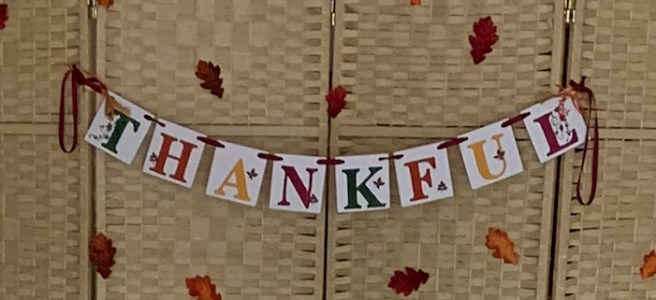
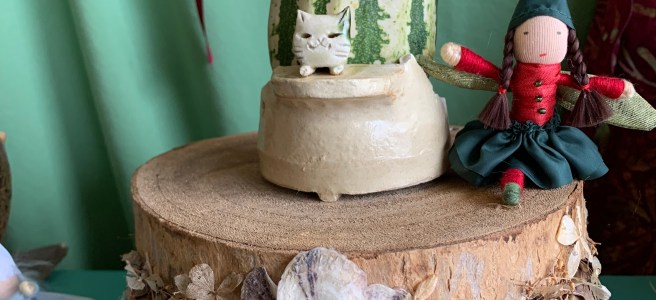
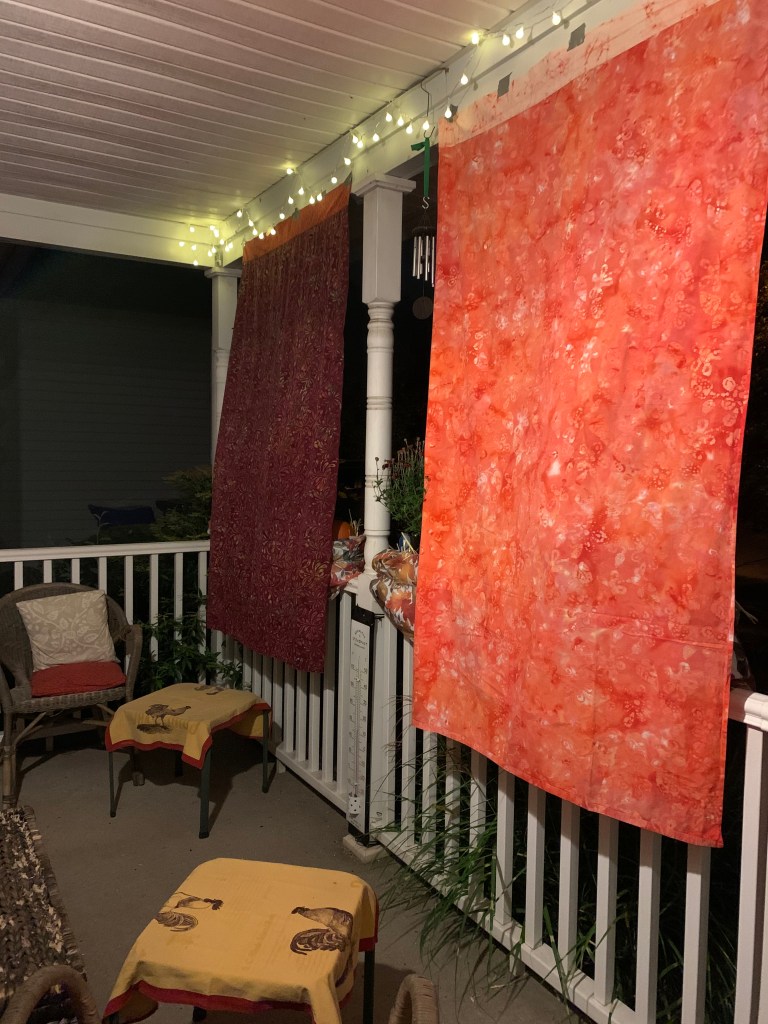
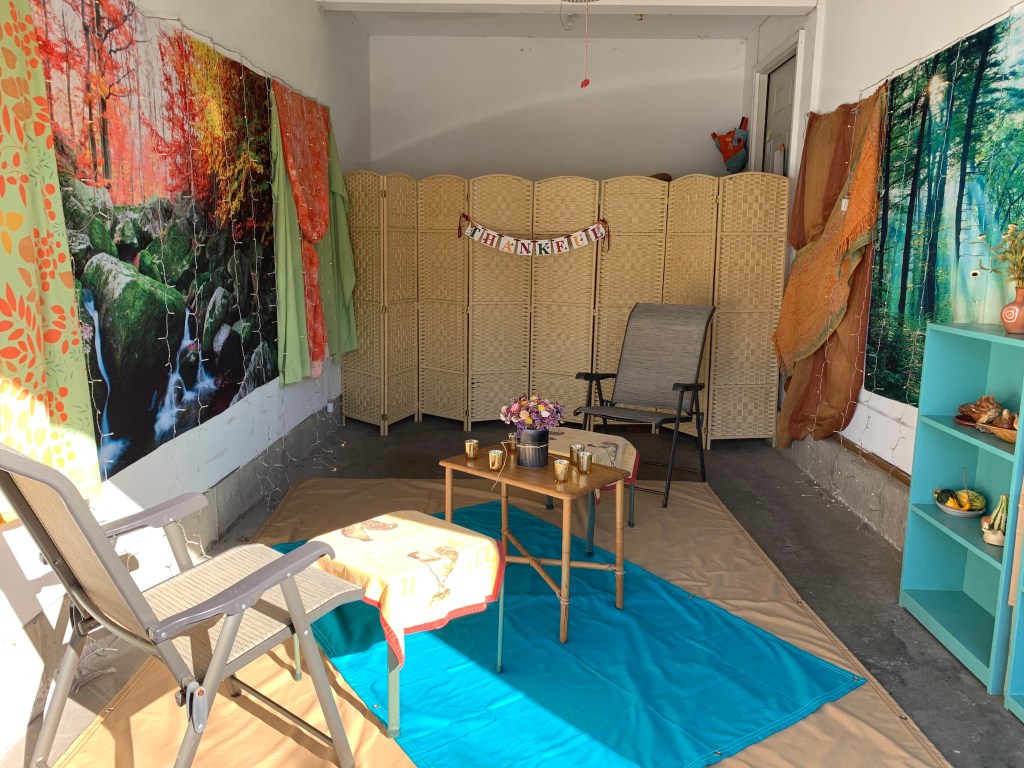
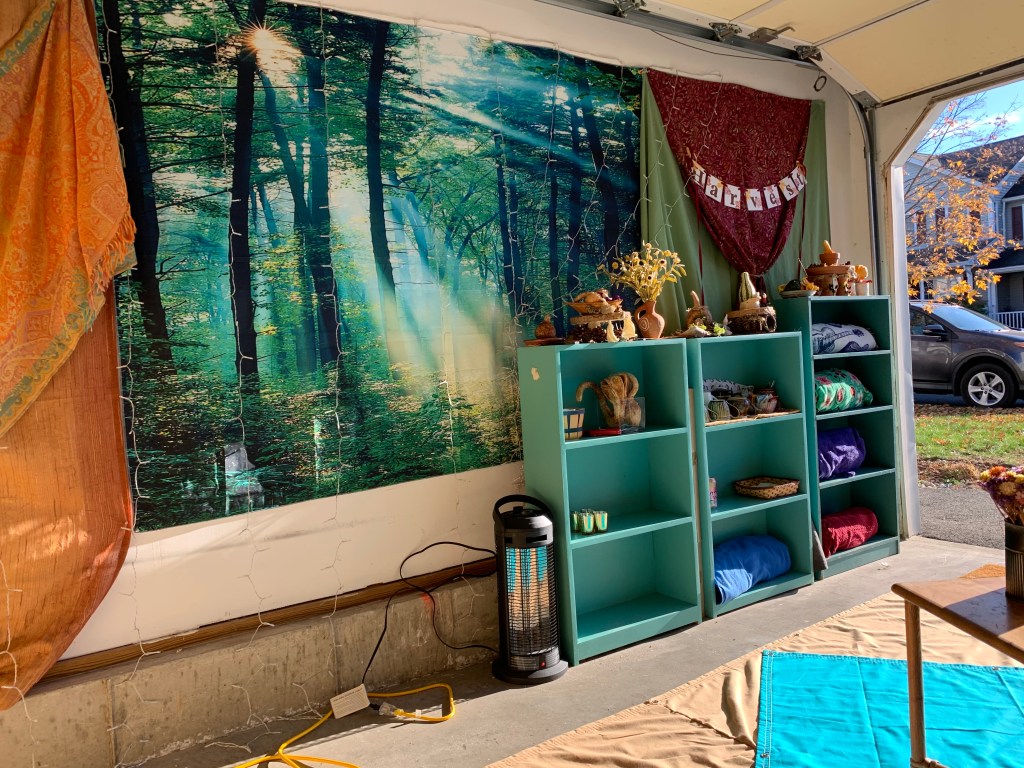
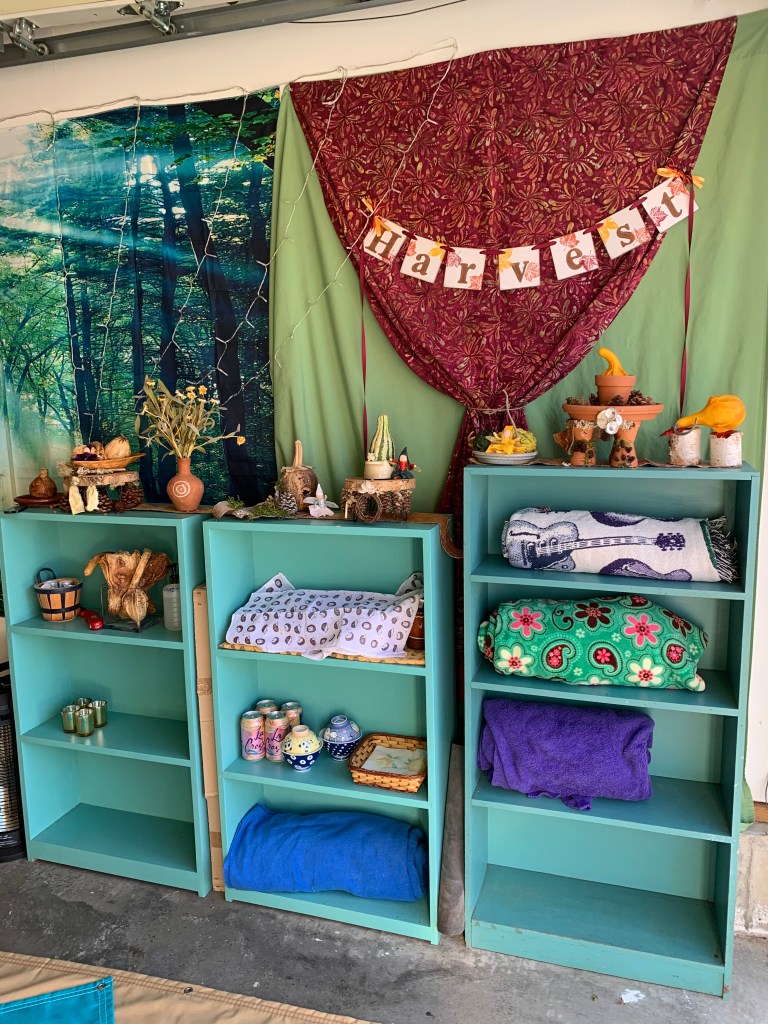
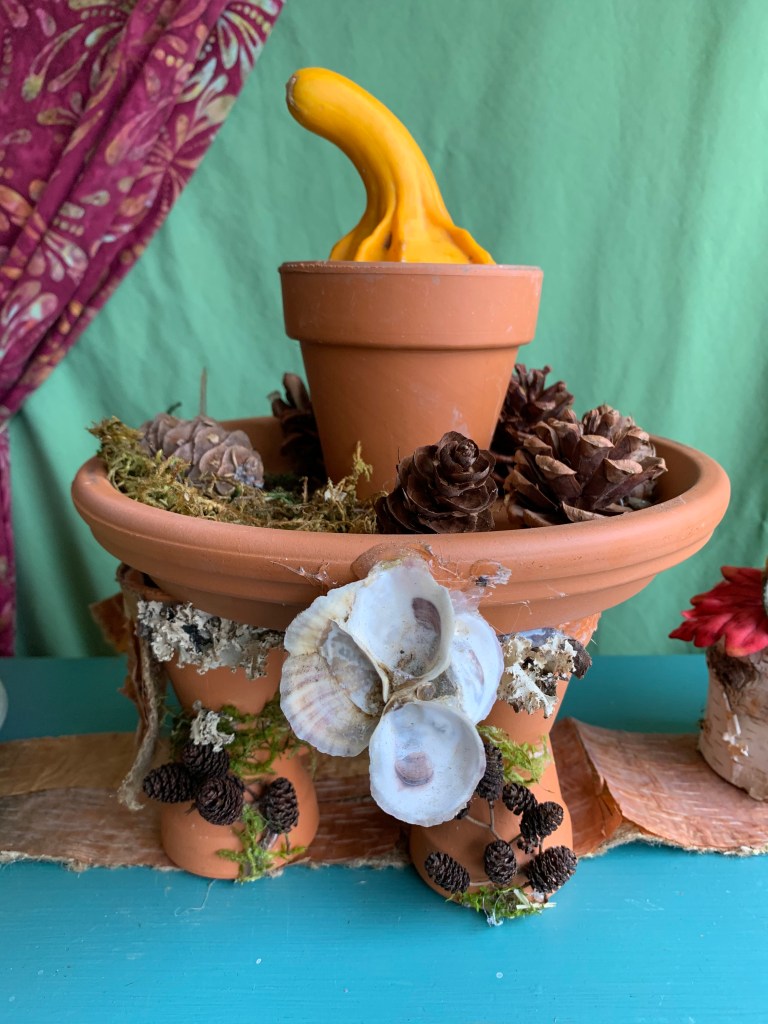
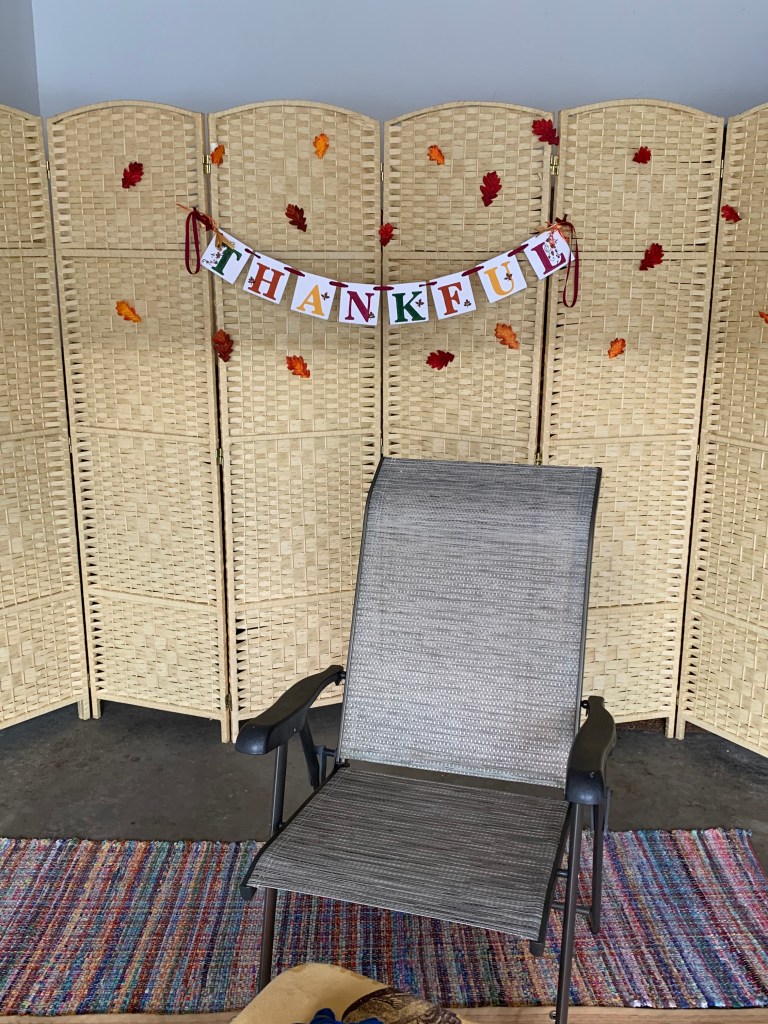

 Sue Downing