Virtual Club Joy for the New Year!

As 2020 comes to a close, I’m happy to be able to invite you to join me this coming Sunday for the first Virtual Club Joy gathering of 2021!   Sunday, January 3rd, from 2:00-3:00 p.m. Eastern Standard Time. See below for the Zoom link to click on.

2020 has been so challenging, on so many fronts, that it’s not surprising if it’s the unpleasant experiences we’ve had during the past twelve months that pop into our mind when we look back at the year. But it doesn’t have to be that way. As I wrote in an earlier post, we can consciously choose to focus our mind on joyful thoughts. To be sure, doing this is easier at some times than at others. But with practice, choosing this focus for our thoughts can grow easier. Over time, it can become a new and nourishing habit! So, on Sunday, we’ll practice one way we can shift our attention to joy: We’ll do a guided meditation where we’ll call up a memory of a joyful moment in our life, and tap back into the positive feelings and thoughts we experienced at that time. I hope you’ll be able to join me as we collaborate to create a joyful start to the year!

But you don’t have to wait until Sunday to get started on recalling Joy back into your mind and heart. I invite you to take a minute sometime between now and then to think of one joyful moment you experienced in 2020. Spend a little time recalling it in detail, and see what arises in your heart as you do!

Here’s the link to use to join Sunday’s gathering:

https://us02web.zoom.us/j/81162398559?pwd=b041QzVtajR2bmhlSVAvcHI4SnhTUT09

            The passcode is “Joy”, and the Zoom meeting ID is 811 6239 8559. No need to register or RSVP. And do feel free to forward the meeting info to someone you think might enjoy (enJOY) being there with us.

I wish you a peaceful rest of the week, and I look forward to being with you and sharing and spreading some joy on Sunday!

More Virtual Club Joy this Sunday: Recalling Joy

   I’m writing to invite you to join me this coming Sunday for another Virtual Club Joy gathering on Zoom!   Sunday, December 20th, from 2:00-3:00 p.m. Eastern Standard Time. See below for the Zoom link to click on. (I’ll also be offering a gathering on January 3rd, at the same time, and using the same Zoom link.)

There are limitless ways for us to invite Joy into ours lives. This week, we’ll be exploring how calling up a memory of a joyful moment in our life can enable us to tap back into the positive feelings and thoughts we experienced at that time. And I’ll take you through a guided meditation so you can practice doing this. As we’ve done before, a few of us who’d like to do so will also briefly share our own recent joyful experiences. (Hint, mine has to do with bubbles…)

But you don’t have to wait until Sunday to get started on recalling Joy back into your mind and heart. I invite you to take a minute sometime between now and Sunday to choose an item in your living space that helps you feel connected joyfully to someone, or to a place in nature where you’ve felt joy. Spend a little time contemplating that item and the person it connects you to, and see what arises in your heart as you do this. Then, if you attend our gathering on Sunday, bring that – or another item that connects you joyfully to someone in your life – along with you.

Here’s the link you can use to join:

https://us02web.zoom.us/j/81162398559?pwd=b041QzVtajR2bmhlSVAvcHI4SnhTUT09

            The passcode is “Joy”, and the Zoom meeting ID is 811 6239 8559. No need to register or RSVP. And do feel free to forward the meeting info to someone you think might enjoy (enJOY) being there with us.

I wish you a peaceful rest of the week, and I look forward to being with you and sharing and spreading some joy on Sunday!

Enter your email address to subscribe to this blog and receive notifications of new posts by email.

Inviting Joy In OR Here’s to Pecan Turtles!

            As I write this, I’m sitting at my dining room table, looking out the sliders to my deck. A light snow is falling, and I’m watching the chickadees and finches and sparrows and titmice make forays to the feeder I’ve put out for them. The blue jays have already scooped up all the peanuts I put out on the deck earlier, and a squirrel has already gone through its gymnastics to access the suet feeder for a morning snack. All is right with the world.  At least from the birds’ and squirrels’ perspective. At this moment.

            But if the birds were to think back to the scene that unfolded yesterday morning out at the bird feeder on my front porch, they might not have considered their world so cheery. That’s because yesterday morning a juvenile red-tailed hawk stopped by.  It began visiting us last week. The first time I glimpsed it, it was perched on my porch railing, about three feet away from me. We were separated only by my kitchen window. What a gorgeous bird! And a real treat to see it up close. It even looked in my direction at one point.  It returned the next two days. I continued to delight in its presence, grateful for such a close-up view of this raptor.

            Not surprisingly, the birds didn’t share my enthusiasm: One day a few years ago, when we had a particularly harsh winter, I saw a hawk swoop down onto my back deck and pick off a junco.  The other birds stayed away from the blood-stained snowy deck for the rest of the day. Now, too, when the hawk shows up, the songbirds clear out. So do the chipmunks that gather the seeds that the birds drop.

            Yesterday, the hawk chose to perch on a bush at the corner of my front porch. Had it spied the chipmunk that had run off the porch a bit earlier? Or was it just hanging out and waiting, having learned that breakfast was to be had in this area? Who knows. I don’t even know whether it’s ever caught anything out there. I haven’t witnessed the murder of any of the little critters I adore, but I’m not so naïve as to think that if I don’t see it, it’s not happening.

            And what about the birds? What awareness do they have of the possibility of danger when danger is not yet obviously present? They must have some awareness of that sort – that must be what urges the chickadee to fly off to the cover of a pine tree with each little seed it plucks from the feeder, instead of lazily munching on it right out in the open. But here’s the question that comes to mind for me: Does knowing that danger is possible prevent that chickadee from enjoying the seeds it eats? Or dilute the squirrel’s enjoyment of the suet? (I’m convinced that it wouldn’t show the same enthusiasm for a piece of bread, so I’m going to conclude that when it chows down on suet, it’s experiencing whatever we call “joy” in non-human creatures.)  

            I’m going to go out on a limb and say that the chickadee and the squirrel just experience that joy whenever and wherever it shows up: in a sunflower seed here, a suet feeder there. I think that even though part of their brain is scanning for danger, another part is also scanning for joy. And when they encounter it – in the form of a millet seed or a mouthful of suet – they totally go for the gusto and squeeze every possible bit of joy out of it that they can. They say “Yes!” – not only to the life-sustaining nourishment of the food, but also to the joy that comes with eating it, even though they know on some level that a hawk might be circling above them.

            It seems to me that we humans operate differently than my friends on the deck. Because we have these big, reasoning brains, we get far more distracted than they do by thinking about past or possible dangers. If I were a junco – but with my human consciousness – and if I’d seen a red-tailed hawk devour a flock-mate before my eyes, I would never, ever, EVER want to visit that birdfeeder again. But I imagine that if I did visit it again, because, well, I needed to eat, my mind would be so overwhelmed by fear that I’d be unable to enjoy my meal at all. The terror of the memory of the hawk would crowd out the joy.

            It seems to me that this crowding-out-of-joy happens so often to us humans. We get preoccupied with whatever unpleasant situations are playing out in our lives or in the world (i.e., hawks, from the perspective of a bird or a chipmunk), and, before we realize it, we’ve eaten an entire chocolate pecan turtle without having properly soaked in the caramel-chocolate-pecan yumminess. In other words, we’ve just squandered an opportunity to invite joy in.

            So, what I’ve been thinking about lately is that, because we are such thinking-oriented creatures, we humans need to make a conscious effort to bring joy into our lives. More chocolate pecan turtles, fewer “hawks”. I’ll admit that it’s often not easy to choose to focus on what’s joyful, instead of on what’s upsetting. I know this from my own experience: I was writing about myself earlier when I mentioned the pecan turtle. And yet, I find that when I consciously shift my thoughts away from a potential or past or present difficulty, and toward doing or thinking about something pleasant, I can experience so much joy!

            Take watching the birds and squirrels on my deck. When I gaze out at that scene in a frame of mind that is clouded by this or that situation that’s weighing me down, I may see the birds, but I don’t really see them. My mind is preoccupied with what’s bothering me. But when I can set all of that aside and really look, here’s what I might see: a junco doing its hilarious two-footed hop on the deck, or a chickadee tapping a sunflower seed on the branch of a nearby tree. That’s when I find myself smiling, grateful that these tiny birds’ antics have just filled me with so much joy. And marveling that all it took was a conscious decision on my part to mentally invite joy into my life for a visit.

            So, I as we approach the end of this crazy year, I want to take the opportunity to wish you many, many moments of joy. May you have the wish to focus your attention on what will throw the door of your heart and mind wide open to joy. And may you have the courage and perseverance to make this wish a reality, a new habit that will guide and infuse your life as you enter 2021. I’d like to offer a little mantra, too. This helps me stay focused on inviting joy in, instead of on dwelling on what bothers me: Fewer “hawks”, more turtles.

Much love to you all.

* * *

And to give you a bit of practice at inviting joy into your life, here’s a guided meditation for you. (The transcript follows the recording.)  

Inviting Joy In – Guided Meditation

Let’s start by finding a way to sit that will be comfortable for about ten minutes.  Or, you can lie down, if you prefer. Close your eyes, if that feels good to you. Otherwise, just lower your gaze so that you won’t be distracted by your surroundings.

Let’s take in one nice deep breath, and then let it out, slowly.

Then do that two more times, at your own pace.

We’re here in our virtual Club Joy, taking a break from everything in the outside world of our life. And I think we’d all say that there’s some area of that life that we’d like to be experiencing more joy in. So that’s what we’re going to do today- invite Joy into one part of our life.

If you were here with us last week, or if you listened to the recording of the guided meditation from last week, then you’ve already come up with an image of a door for yourself, a door that opens up to Joy. If you already have an image of that door, imagine it before you now. If you haven’t yet created a door that opens up to Joy, for now, just imagine that you’re standing in front of a door. It can be whatever kind of door you want. And on that door is a sign that says, “Joy”.  This sign is there to show you that Joy is right on the other side of the door, and that whenever you open that door, you are opening up to experience Joy.

So now, take a moment to imagine your door. This is your personal door to Joy.

Now imagine that you’re holding a different sign in your hands. This sign is blank. But in a few moments you’re going to decorate it or write something on this sign, so that it will indicate the part of your life that you’d like to invite Joy into. Then you’ll be hanging that sign on the outside of your door to Joy. That way Joy will know exactly which part of your life it can enter once you open the door.

In your mind now, hold this blank sign out in front of you. What color would you like the sign itself to be? Go ahead and imagine making it that color.

Now let’s go ahead and start the process of choosing which part of your life will be represented on this sign.  You can be certain that whichever part of your life would like an infusion of Joy has been waiting for this moment since we began our meditation. Maybe it’s already standing in front of you, one arm raised in excitement, calling out, “Pick me! Pick me!” If that’s the case, then you already know what will go onto your sign.

But if no particular part of your life has occurred to you yet to focus on, that’s okay. It’s just being a little shy. To encourage it to make itself known to you, start by imagining once again that you’re holding that blank sign out in front of you. And allow a message to appear there from whichever part of your life would like to have a visit from Joy. It may appear as a word on the sign, or as a word or phrase in your mind. Or as an image of some part of your life or person. Or you may simply know without seeing or hearing anything. Take a minute or two now to gaze at your sign and to allow yourself to become aware of which part of your life this is, in as much detail as possible.

Now that you have a sense of which area of your life is calling out to have Joy come for a visit, take a moment to express that on your sign in some way – in words, or in an image. So that Joy will see it and understand where to it’ll be heading once you open the door.

Okay. Now it’s time to hang this inviting sign on the outside of your door to Joy. Go ahead and imagine doing that right now. And take time to look at your sign and admire it, once it’s hanging on the door.

Great. Now you have a door that clearly tells Joy which area of your life it will enter when it comes through this door that you’ve created and labelled. So, now it’s time to actually invite Joy to come through the door and into this part of your life. We need to do this consciously, because Joy doesn’t want to just barge in, uninvited. Think of it this way: It’s like having a little sign with your name on it next to your front door, so that a visitor who comes to your house will know who they’ll find on the other side of the door.  But that sign isn’t an invitation to come in. It’s just there to let visitors know they’ve come to the right place. They still need to wait on the doorstep until you open the door and say, “Come on in!” It’s the same with Joy. It sees your sign – right at this very moment, in fact! – and knows which part of your life is behind that door. But it’s waiting for your invitation to enter that space.

Before you go ahead and open the door to Joy, though, let’s take a moment to decide how you want to invite Joy in.  Is there a certain phrase you’d like to use? A gesture? A sound? A song? A dance? What feels right to you at this moment as a way to invite Joy to enter your life? Take a moment to consider your invitation.

Now, go ahead. Open your door and offer your special invitation to Joy. Invite it to enter and join you in the part of your life you’ve chosen.

Imagine now that Joy really is stepping into this space where you’re standing now, and that this space represents the part of your life you chose to invite Joy to enter. Maybe you’ll see Joy, or hear it, or feel it, or simply sense it. But know that it is coming in. After all, you gave it a lovely invitation, and Joy is a very enthusiastic visitor! Take a couple of minutes now, just to rest in the awareness that Joy is now present in the part of your life that you indicated on your sign. Allow yourself to receive this awareness in whatever way it arrives. And I’ll let you know when we’re finished with this part of the meditation.

Wonderful. No matter what you experienced in this last part of our meditation, I invite you to inwardly give thanks to Joy for visiting. Even if it seems to you that you didn’t experience anything at all, know that Joy has entered into that part of your life that invited it to visit.  In fact, it’s still there. It intends to stay for a good, long while. And if you ever have a moment when you doubt that it’s still there, go ahead and open the door once again. Consciously invite Joy in again. You can even ask Joy to give you some kind of sign that it’s really there.

You can also feel free to create a new sign for your door, if you want to invite Joy into another part of your life. And don’t think you have to take down the first sign when you do that. You can fill up the outside of your door to Joy with invitations. That’s because Joy can be present in more than one part of your life at once. There’s plenty of Joy to go around. 

So, I hope you’ll enjoy your visits with Joy, and I wish for Joy to be present in every nook and cranny of your life. 

Now we’re going to start gently and gradually returning our attention to where we’re gathered together.

As you’re ready, I invite you to open your eyes.

Enter your email address to subscribe to this blog and receive notifications of new posts by email.

More virtual Club Joy this Sunday: “Inviting Joy In”

   I’m so happy to invite you to join me this coming Sunday for our second Club Joy gathering on Zoom!   Sunday, December 6th, from 2:00-3:00 p.m. Eastern Standard Time. (See below for the Zoom link to click on.) I’ll also be holding two more get-togethers, two weeks apart, on December 20th and January 3rd, at the same time, and using the same Zoom link.

I see our virtual Club Joy get-togethers as a space of respite and peace and positivity, where we can relax in body and heart and mind and spirit, and experience joyful moments alongside others who also hold this wish and intention.

This Sunday, we’ll be focusing on how we can invite joy into various areas of our life, and I’ll take you through a guided meditation so you can practice doing this. As we did last week, a few of us who’d like to do so will also briefly share our own recent joyful experiences.

And because I believe that coziness can really enhance our experience of Joy, I invite you to bring an item or two along to our gathering that will help you feel cozy while we’re together. A cup of tea or cocoa? A candle or some soothing essential oil? A special blanket or sweater or shawl? What says “cozy” to you? Bring that along with you on Sunday, and we’ll settle in for a nice, cozy afternoon break together.

Here’s the link you can use to join:

https://us02web.zoom.us/j/81162398559?pwd=b041QzVtajR2bmhlSVAvcHI4SnhTUT09

            The passcode is “Joy”, and the Zoom meeting ID is 811 6239 8559. No need to register or RSVP. And do feel free to forward the meeting info to someone you think might enjoy (enJOY) being there with us.

I wish you a peaceful rest of the week, and I look forward to being with you and sharing and spreading some joy on Sunday!

Enter your email address to subscribe to this blog and receive notifications of new posts by email.


Opening the Door to Joy

As I wrote in a previous post, when I created my Garage Club, it wasn’t long before I developed the feeling that its real name should be “Club Joy”. That’s what felt right. And not long after this realization, I found myself reflecting on what, exactly, I think “joy” is.  

            I used to think of joy as something that popped up in my life. Joy has always seemed different to me than happiness, which I’ve tended to see as a more or less enduring state that results when a certain set of external or internal circumstances comes together. By contrast, I thought of joy as a momentary experience, like the blink of a light in the darkness.

            As for how we come to experience happiness and joy, here’s how I used to distinguish between the two: Happiness comes on gradually. It’s something you consciously create, by setting an intention to build it. Then you take certain steps that you believe will move you toward your goal of a state of happiness.

            What about joy, then? I used to feel that joy just, well… happens. It’s something we receive, not something we create. Either it arises, or it doesn’t, and we have very little control over whether that happens. 

            I tended to see joy as akin to a total stranger who knocks on your door and then, when you open it, both totally surprises you and presents you with pure delight as a gift. You never imagined this scenario, and yet, here’s Joy, showing up on your doorstep.

            Then, somehow, just as inexplicably, Joy fades away, vanishes into thin air. Sure, this visitor will most likely pop by again some other day. But you’ll never know when to expect it. Joy isn’t the kind of visitor who gives you a heads up so that you can mark your calendar and look forward to its arrival. 

            And because we never know when Joy might show up again, a thin layer of disappointment can settle over us once our unexpected visitor leaves. “Come back!” we want to call after it. But it’s gone, and it didn’t leave us a phone number or an email address. Not even a snail mail address. And that’s too bad, because if it had, we would definitely mail off a note, probably even an engraved invitation, and invite it to drop by again soon. “How about next Tuesday? Is 3:00 good for you?”

            Seeing Joy this way – as an unpredictable, even unreliable, guest, whose visits we are powerless to control, can take its toll on us. We want to spend time with Joy again, but we don’t know how to go about making that happen. We’re left feeling that we have no agency – that all we can do is wait passively until Joy deigns to knock on our door again.  

            In reflecting on this over the years, I concluded that, indeed, we can’t make Joy show up on our doorstep on command. Even so, I believe that we do have a certain kind of agency in our relationship with Joy: We can enter into a kind of collaboration with it. We can initiate this collaboration by creating a welcoming space in our heart and mind. Think of it as a cozy, peaceful guest room with Joy’s name on it.

            The first step in creating a guest room in our mind and heart is to let go of any disappointment we might be feeling at Joy’s absence. Then we place our focus on reorganizing and spiffing up the space in our mind and heart. This process is similar to what I did with my garage when I was working on my physical Garage Club/Club Joy. I started out with a dusty, unkempt garage, full of unappealing garage items; some genuine garbage that needed to be gotten rid of; and stuff to be recycled or tossed in the compost bin. I had a vision in my mind of how I wanted Garage Club to look, and I kept my focus on that, as I rearranged the contents of my garage and added new, more lighthearted elements to the décor.

            I don’t want to give you the impression that it was all smooth sailing, setting up Garage Club. I was really discouraged at first, right after I hung up the string lights on my bare garage walls. There was no way that struck me as fun or welcoming. Would anyone really enjoy sitting there? I could have obsessed over how disappointing it looked, then slipped into concluding that it would never look right, and then end up by abandoning the project entirely. 

            But I didn’t do that. Instead of focusing on what was wrong with the space, I kept returning in my mind to my vision of how I wanted Garage Club to look. And, little by little, it came together. Now I love the space, and my visitors seem delighted by it, too. I think it seems like such a surprise to them, this moment of joy that’s popped up unexpectedly from behind a garage door. And yet, Garage Club – Club Joy! – did not just happen. I had a vision for it, set my intention to create it, and then methodically went about moving toward my goal.             

            So, how can we go about creating the internal equivalent of Club Joy, a space in our mind and heart where Joy will feel like plopping down in an easy chair for a nice, long visit?  The very first step is to create a door in our mind and heart that we can open up to Joy – like my garage door, just in your mind.

            This is such an important step! The door to Joy’s guest room is a special door: a portal that will make it possible for Joy to join us. So, in our mind, we consciously create a door, and express a strong, clear intention as we’re doing so. Something along the lines of, “I’m creating this door so that I can open it up and invite Joy to come visit.”

            Setting our intention this way is like hanging a lovely sign on the other side of our door that says, “Coming Soon! Joy Guest Room!” Maybe it even makes note of some appealing perks: “Three meals a day included. Plus unlimited chocolate”. As soon as we do this, our intention – to welcome Joy as our guest – filters out beyond the door, out into the space where Joy is roaming around, doing whatever it does all day and night. And Joy thinks, “Hmm. This is intriguing. What’s going on here?” From that point on, Joy’s going to make a point of stopping by every so often, to see whether your guest room is open for visits yet.

            Once you’ve stated your intention, you can begin working on creating the interior of this room for Joy. And, based on my own experience setting up my physical Club Joy, my advice to you is this: Don’t wait until everything feels ideal and perfect inside your mind to open the door.

            Don’t think you have to have a perfectly calm and peaceful mind and heart in place before you open the door to your Joy guest room. If you put that pressure on yourself, you’ll never change the sign on the door from “Coming Soon!” to “Open for Joy!” Make peace with the fact that, if you’re at all like me, there will always be mental or emotional cobwebs in your mind, just the way my garbage pail and all my garage-y things are still in my garage.

            When I was setting up Club Joy, I didn’t have the goal of taking all of that distracting stuff out before I invited visitors in. I knew that was neither practical nor possible. Instead, I just set up a cute wooden screen at the back of my garage. Sure, anyone who comes by knows that the screen is there for a reason: There are things behind it that I don’t particularly want people to see. Not because they’re bad things, but because having to look at them might distract us from our visit with Joy.  Putting up the screen also conveys my intention: I choose not to focus on all of that stuff right now! After all, this is Club Joy, not Club All-The-Stuff-You-Associate-With-A-Garage.

            And so, my physical Club Joy is open, and no one seems deterred by all the unappealing clutter behind the screen. Folks come right on in. And so does Joy. Joy heard there was a club with its name on it, and it headed right over.

            So, as you’re creating your internal Club Joy, you don’t need to worry about all the odds and ends that are knocking around your head and heart space, either.  Just take the first, intentional step of creating the door that you can open up to Joy. And Joy can’t wait! It’s so excited for Opening Day.

* * *

         Because creating a door and opening it to Joy may feel a bit daunting, I’ve recorded a meditation/visualization that will guide you through that process. (And the text of the meditation follows, below the audio player.)

Guided Meditation: Opening the Door to Joy

Opening the Door to Joy – Guided Meditation

Let’s start by finding a way to sit that will be comfortable for about ten minutes.  Or, you can lie down, if you prefer. Close your eyes, if that feels good to you. Otherwise, just lower your gaze so that you won’t be distracted by your surroundings.

Let’s take in one nice deep breath, and then let it out, slowly.

Then do that two more times, at your own pace.

Now, imagine that right in front of you, there’s a door. You can imagine it in your actual living space, or just in your mind, or in your heart – wherever you want it to be. Imagine whatever style of door appeals to you.

Now imagine that there’s a sign on this door. And the sign says, “Joy”. What this “Joy” sign on the door is telling you is that, right on the other side of that door, is Joy. It’s there right now.

I invite you to imagine your door once again. What color or colors would you like your door to be? Now, imagine that painting the door that color. And if you’d like to take the “Joy” sign off while you’re painting, that’s fine. Go right ahead. Just imagine taking it off and setting it down on the floor next to the door. Joy is still there on the other side, even if you take down the sign.

Go ahead and paint your door, using whatever color or colors you’d like.

Now that it’s painted, would you like to decorate your door in any way? Add a design? Or a picture of a person or an animal or a place you enjoy? Take a moment now to decorate your door.

Now, take a step back, so to speak, and take a look at your door. It doesn’t matter if you haven’t finished decorating it. You can come back another time and do more. The door that you can open up to Joy is a work in progress.

Now, let’s look again at the sign that says “Joy”. I invite you to hang it back up on the door, if you took it off earlier, and make any changes you’d like to the way it looks. Or, you can get rid of the sign entirely and just write the word “Joy” directly onto your door.  It’s up to you.  The main thing is that when you’re done, you should be able to see the word “Joy” on the door really, really clearly, even from a distance.

So, go ahead and take a little time to label your door “Joy”, in whatever way appeals to you.

Wonderful! So now you’re standing before your beautiful door that is labelled “Joy”. Really imagine standing in front of it. In a moment, you’re going to put your hand out and take hold of the doorknob. But first, check in with yourself.

How are you feeling about opening this door to Joy? I ask, because this idea of opening the door to Joy can be trickier than it sounds at first. Maybe you sat down with the thought that you’d just throw that door wide open, then stand there in the doorway with your arms wide open, and shout, “Come on in, Joy!” Maybe that’s how you’re still feeling. But maybe it’s not. Maybe the idea of opening the door to Joy leads us to put a little or a lot of pressure on ourselves. We might feel pressured to not just open the door to Joy, but to feel Joy, once the door’s open. Thoughts might come into this lovely room we’re starting to set up here, thoughts like, “Okay, I have to do it now. I have to feel joy!” or “What if I don’t feel joyful once I open the door?” Thoughts like that can come into our mind space. That happens.  But they can be a big distraction, and at the moment, we don’t need them here, not when we’re trying to focus on opening the door to Joy. So, we’re going to move them to another part of our mind space. That way they won’t distract us.

So, imagine a folding screen, made of whatever substance you like: wood, metal, ivy… Make it wide enough that it can stretch from one side of the space behind you to the other. Turn around and put this screen in place. Now, mentally gather up any worrying or pressuring thoughts into your hands. Then toss them up and over the top of the screen. Imagine the thoughts sinking to the floor behind the screen. They’ll sink because they’re heavy, and they’ll stay there, on the floor behind the screen.

Now turn your attention back to your door that opens to Joy. Spend a moment reacquainting yourself with the beautiful door you’ve created.  Look at the details. Look at where you’ve written the word “Joy”. 

Now let’s get ready to actually open your door to Joy. You can open it as far as you want: just a crack, or all the way, or somewhere in between. It’s entirely up to you, and any amount of opening is perfect. So now, in your imagination, reach your hand out and take hold of the doorknob. And open your door to Joy.

Now, no matter how far you’ve opened the door, just rest in that openness. And allow yourself to experience Joy, in whatever way it is present with you at this moment. Joy might arise as a feeling somewhere in your body, or as an image, or a thought. Or you might not notice anything at all. That is totally fine, too. No pressure. So let’s relax in this space of openness for a minute or two and receive whatever arises. And I’ll let you know when we’re done with this part of the meditation.

Okay. Great.

Take another look at your door to Joy. And, no matter what you experienced in this last part of our meditation, I invite you to inwardly give thanks for that. And even if it seems to you that you didn’t experience anything at all, know that Joy was with you in the space you’ve created. Know that Joy is always there, on the other side of that door that you decorated and labelled with the word “Joy”.

What you do now is up to you. You can leave the door open, or close it. Whatever you want. And remember that you now know where Joy is located: Right behind that door. So that now, you always have access to it, and to the Joy behind it. You always have the wastebasket, too, in case thoughts come in that want to distract you from opening your door to Joy.  I invite you to visit your door often. Open it up and see how Joy appears to you.

Now we’re going to start gently and gradually returning our attention to where we’re gathered together.

As you’re ready, I invite you to open your eyes.

Enter your email address to subscribe to this blog and receive notifications of new posts by email.

Join me on Zoom for Club Joy: “Opening the Door to Joy”

            In my recent blog posts, I’ve written about how important it’s feeling to me these days to focus on connecting with folks in joyful ways. I believe that these moments of positivity nourish us and serve as a respite amidst everything in our world that can make it hard for us to maintain a stable foundation of joy. And the responses I’ve received to my recent posts have given me the sense that others are also wanting to bring more joy into their lives.   So, the question arose in my mind a few days ago: What might I do to help us tap into joy on a regular basis, together, to expand Club Joy beyond the bounds of my physical garage space?

            Nudged by a feeling of curiosity about this, I sat down the other morning to reflect. I silently expressed my wish to gain some insight, and then just sat there, allowing my mind and heart to settle into a calm space. Before long, ideas began to bubble up from deep inside me – concrete ideas for how to help us create and nurture our storehouses of joy. Just contemplating these possibilities gave me a feeling of such lightness – and joy!

            I’ve decided to start off with the idea I’m calling “Opening the Door to Joy”. And we’ll do it on Zoom, since we can’t all come to my physical Garage Club/Club Joy in person!

            “Opening the Door to Joy” is all about creating a safe space – free of talk about anything negative or calamitous or worrying – where we can relax into a peaceful frame of mind and heart, and invite joy to join us. Here’s what you can expect:

            I’ll start our Zoom gathering by welcoming everyone, and bringing our focus to being present with each other in this virtual Club Joy. I’ll spend a few minutes talking about the role that joy plays in my life. Then I’ll offer a guided meditation that will help us inwardly open our hearts to joy.

            After this meditation, if there are people in the group who would like to share a joyful experience with us, I’ll invite a couple of them to speak for a minute or two. But there’s no pressure at all to speak!  If you want to just sit quietly and listen, that is perfect, too. The whole point is for us to be in a safe space where we can open up our hearts and invite joy to come on in. And there’s no “right” way for that to happen: the experience will be different for each of us. For some of us, joy may flow in as we simply sit in silence in the presence of others who are telling their brief stories. For others of us, joy might arise as we share a story. I look forward to each of us discovering for ourselves how it happens!

            After we’ve had the chance to hear a few joyful stories, I’ll close us out with a brief wish for preserving whatever joy and positivity we’ve taken in.

            That’s it. About 45 minutes. Maybe up to an hour, but no more.

            Our first “Opening the Door to Joy” gathering on Zoom will be next weekend, on Sunday, November 29th, from 2:00-3:00 p.m. Eastern Standard Time. And there’ll be a second one the following Sunday, too, on December 6th, at the same time.

Here’s the link you can use to join:

https://us02web.zoom.us/j/81162398559?pwd=b041QzVtajR2bmhlSVAvcHI4SnhTUT09

            The passcode is “Joy”, and the Zoom meeting ID is 811 6239 8559. No need to register or RSVP. And do feel free to forward the meeting info to someone you think might enjoy (enJOY) being there with us.

            I hope you’ll join in! Time’s a-wastin’. Let’s open the door and invite joy to come in and visit.

Enter your email address to subscribe to this blog and receive notifications of new posts by email.

Garage Club, AKA Club Joy

Its first iteration was what I called, variously, my Pandemic Porch Paradise, or Cozy COVID Café.  I live in a condo complex, and I have a perfectly nice little covered front porch. My kitchen windows look out onto it, and I really enjoy watching the birds that come to the feeder I have hanging there. But I’ve never spent much time sitting out there at all. That changed with the pandemic.

            During the summer, one friend or another would come by occasionally, and we’d sit out on my porch, six or more feet apart, masked, for a chat. Even so, these occasions weren’t so frequent, because, mostly, I was getting together with friends outdoors in parks, or on their front stoops, or at ice cream stands where we could easily distance.  Then there came the very warm early-fall day when a friend was going to come over for mid-afternoon tea and pie on my porch. I decided to set up a nice spot for us, with pretty kitchen towels over our individual low porch tables, and nice plates and teacups and napkins. I even swept up all the fallen birdseed! Then I realized that the sun was hitting the porch at just the right angle that it would be right in our eyes and also make us really hot. We needed a sun shield.

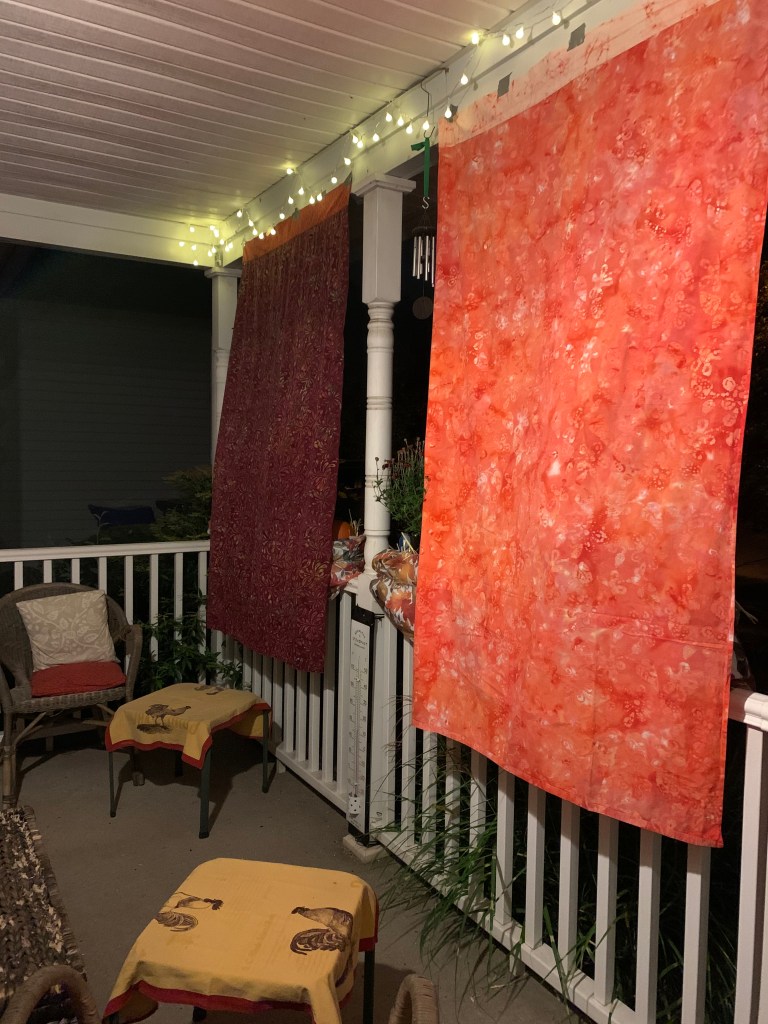
            I remembered the gorgeous batik-fabric sheets that my sister and nieces had made me for my Reiki table. So, I brought those outside and duct-taped them up to the front roof edge of the porch. Success! And it wasn’t just that the jolly burgundy and orange fabrics created shade.  Sitting there with our tea and cherry pie, my friend and I felt like we’d been transported to some snazzy street café in a distant land. In the blink of an eye, my boring condo porch became my Pandemic Porch Paradise, my Cozy COVID Café… 

The Pandemic Porch Paradise in the evening

            That’s what I called it, but what it had actually become was a space of joy. (My Jolly Joy Joint, maybe?) It seems to me, reflecting on it now, that I achieved this by bringing elements out to the porch that feel soothing and comforting and homey.  Tea and sweet snacks are something my friends and I regularly share. Reiki, too! I think that having the sheets I use during my Reiki sessions hanging up outside with us lent a particular coziness and sweetness to the atmosphere. It was a way we could continue to feel enveloped in that loving, healing energy, even though the pandemic had put a stop to our hands-on Reiki sessions for each other.  

            Over the next couple of weeks, I added more elements that carry joyful associations for me: some string lights and candles…. plus yoga blankets, as the autumn weather began to settle in.  But as the air temperature began to drop, I recognized that my Porch Paradise would soon have to reckon with winter.

            Now, I have as much super warm outerwear as the next Bay Stater. Even so, “cozy” is not a word I associate with a condo porch exposed to the whipping winds of a Western Massachusetts blizzard, batik sheets or no batik sheets. But don’t think that I was even remotely considering retreat into a winter of solitude and nothing but Zoom teatime chats. No! As I sat huddled on the porch under my yoga blanket a month ago, eating a take-out dinner with a friend who’d driven up from Connecticut, my inner warmth may have been seeping out of me, but my determination was not. I resolved that I would NOT allow the pandemic and winter conspire to rob me of in-person meetings with my friends! So, I turned my determination not to stocking up on more down coats or fur-lined hats, but to creating a space where I could continue to meet with my friends safely and in at least relative comfort and warmth.

            My single-car garage seemed the perfect (and only!) choice. If we left the garage door open for ventilation and added some space heaters, it should work, I reasoned. It would be easy to distance sufficiently if one friend came over. We could probably even manage three of us, in a triangle formation. In my mind’s eye, I saw us sitting there, in masked, distanced bliss, lifting our masks to sip on warming tea or hot chocolate, and satisfying our stomach rumblings with tasty snacks or take-out meals. We’d chat around a heater, definitely with blankies, since, hey, this would still be Massachusetts in winter, and the garage door would be open…

            The heating question turned out to be easy to solve. After researching options, I went with two small, portable tower infrared heaters that were very reasonably priced. I decided against heaters that have fans, because … well …COVID. It didn’t seem a great idea to have heaters blowing air all over the place, even with the garage door open. Maybe I’m over-cautious, but the infrared heaters seemed like a safer option. I ended up buying two. Since they heat what they’re facing, instead of warming up the air, you really need one per person, even if they oscillate, like mine do.

            I’ll admit quite readily that I could easily have stopped there and made do with just these heaters and the blankies I already had. I mean, really. If the goal was to be able to sit in a well-ventilated space with my friends and stay warm, then I now had everything I needed to achieve that. But that wasn’t good enough for me. Because I had no intention of settling for just “warm enough”. I wanted “paradise”.

            It became painfully obvious that I still had a long way to go toward reaching this goal as soon after I hung up string light curtains across two of the bare white garage walls. The genuinely festive lights did move the “coziness” needle ever so slightly in the right direction. But they created much less of an effect than they had on my porch paradise, because I was in my garage. And my garage, naturally, contains all the usual garage-y things: garbage and recycling pails, a slightly rusted tall storage shelf, a rolling tool chest, plus brooms and other paraphernalia hanging on the wall. As well as a cold cement floor. Sigh.

            You have to realize that I’d tackled the garage with a vision in my head of how I wanted “Club COVID”, as I started out calling it, to look. My goal was to replicate the effect I’d created on my porch. But as I looked at the stark, pitiful contrast of string lights against white garage walls, I felt a twinge of disappointment. “This is not paradisical,” I thought, frowning.  True, I still had my gorgeous sheets to hang up.  But they were small, and a vast amount of garage wall space would remain exposed. But I resolved, once again, to not be deterred. I would not give up on “paradise”!  

            Until I started writing this post, I hadn’t interrogated the stubbornness of my determination to achieve paradise in my garage.  But now I see clearly why I didn’t want to create a space that would meet only our need for free-flowing air and physical warmth. I wanted to create a space that would bring warmth to our hearts, too. The garage’s “paradise” element needed to include the tasty snacks and décor accoutrements that would help us all feel comforted and soothed, the way we had done on my porch. The way we had done during pre-pandemic times.

            That’s what was key to me, I see now.  I wanted to invite people into a space that would transport us to another realm – one of happiness and joy. I envisioned it as a space we could enjoy on its own merits, rather than experience as a pale, disappointing substitute for the welcoming spaces we’ve created inside our homes. I did not want our surroundings to be a constant reminder of why we were meeting in a garage in the first place. I wanted us to forget that it was a garage. That’s why the heaters and blankies would not be sufficient. And so I got to work.

            Part of the transformation involved jettisoning the words “COVID” and “Pandemic” from my club’s name. Now it’s simply Garage Club. That’s its nickname. Its official name (think American Kennel Club) is Club Joy. My friends who heard about it first still mostly call it Club COVID, and someone referred to it as “your COVID Cave” yesterday. That struck me as hilarious, for some reason. But mostly, folks have begun following my lead. We leave the pandemic outside, linguistically and physically.

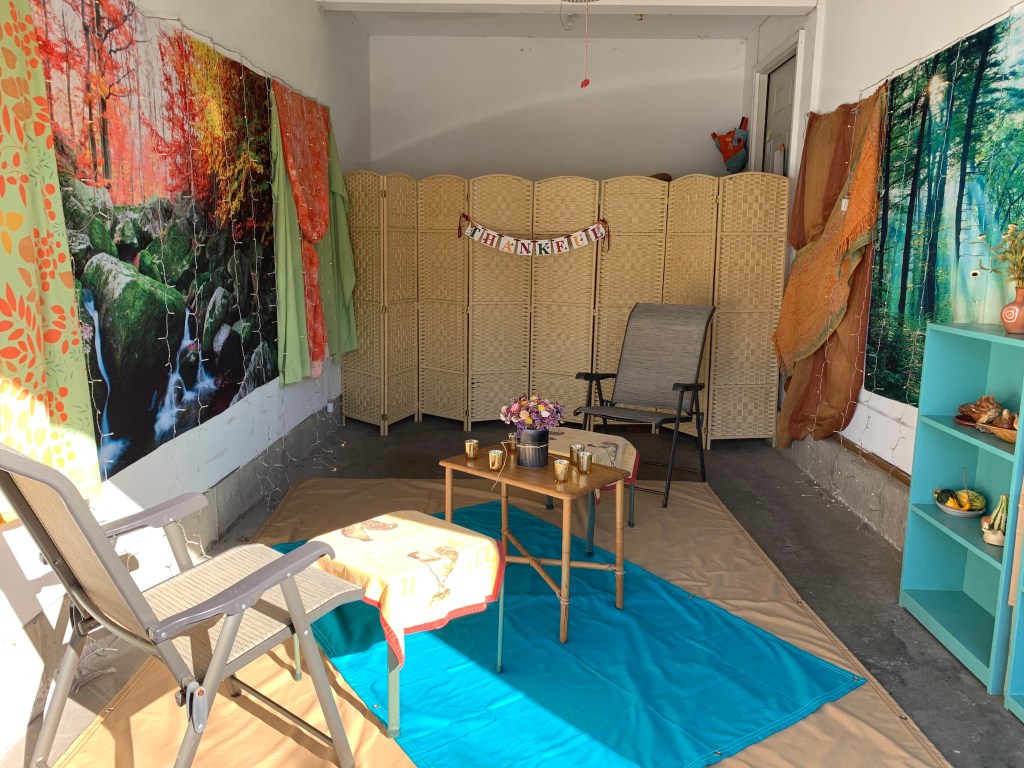
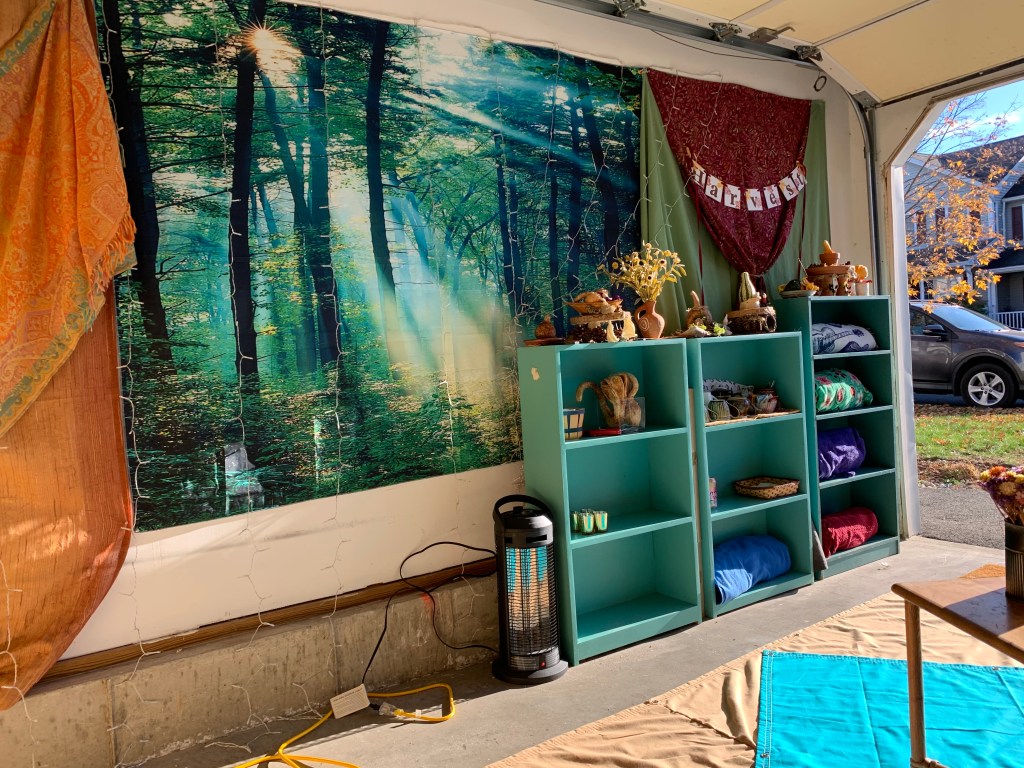
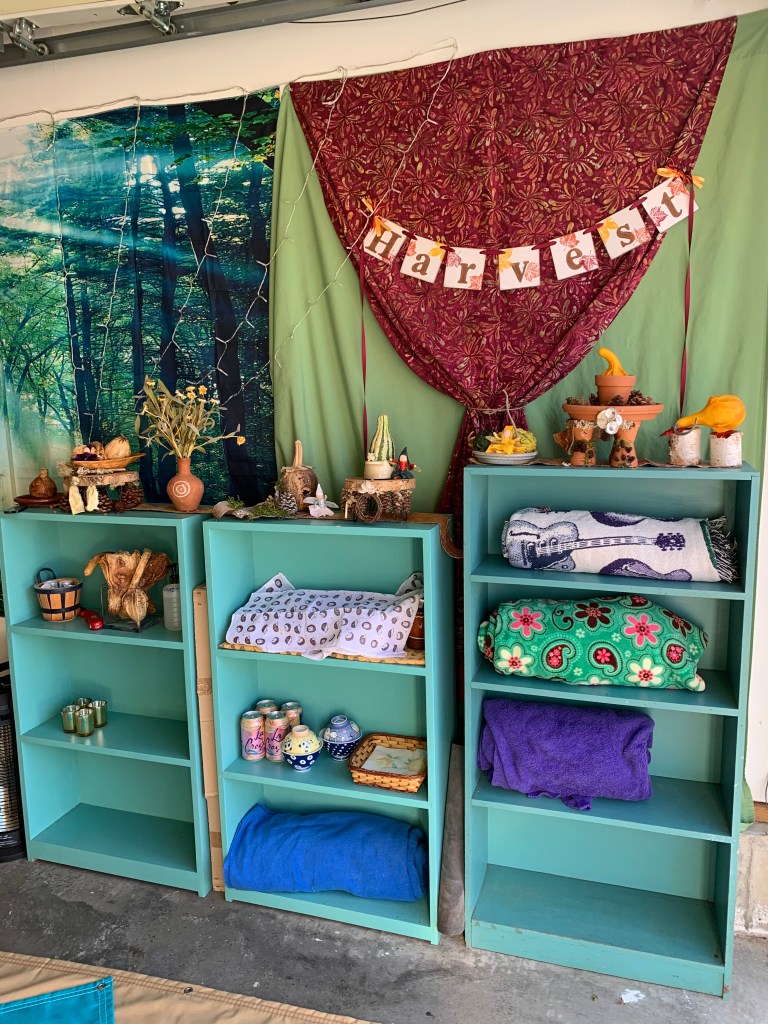
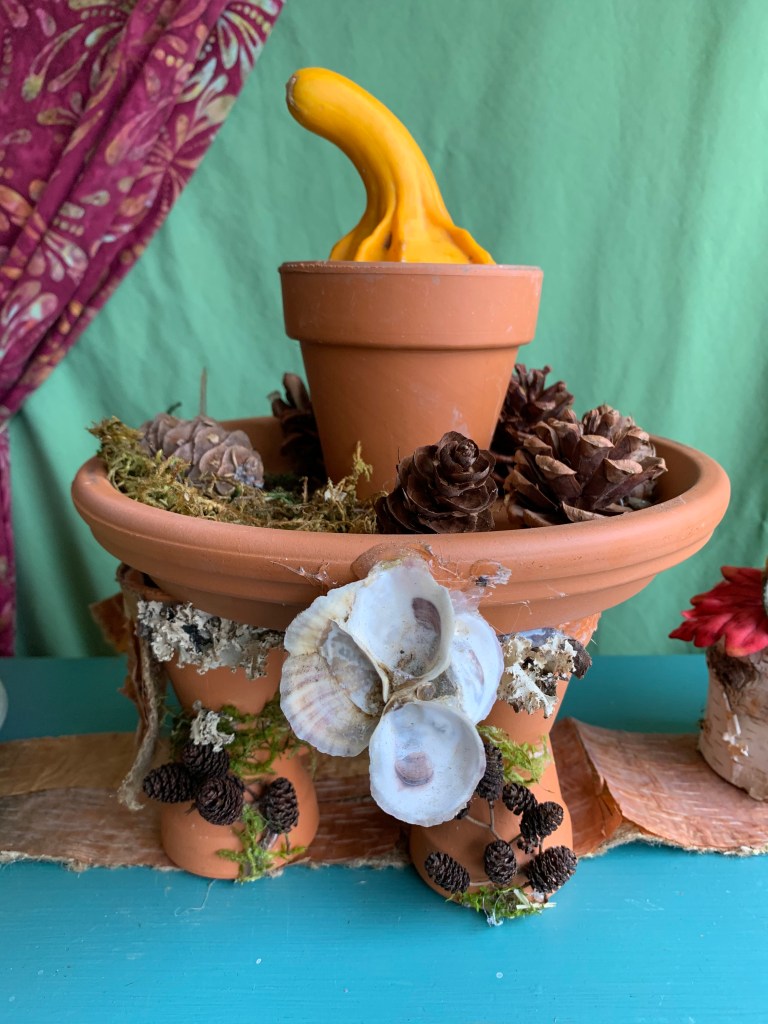
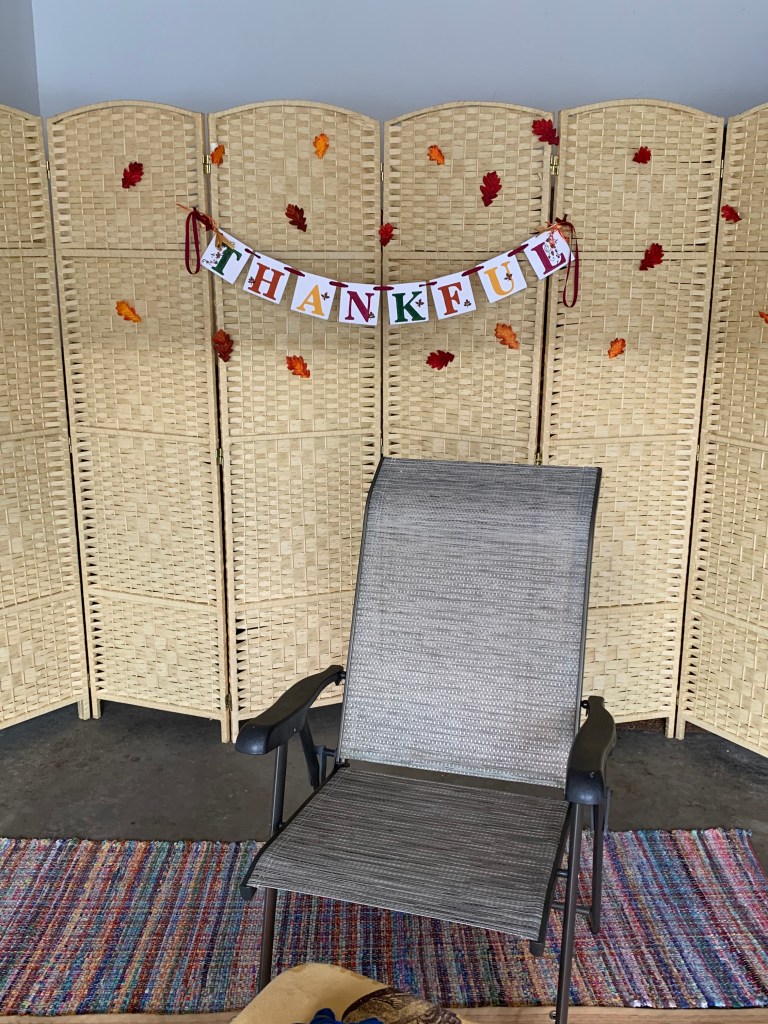
            And oh my, I think it’s really taken shape. It finally corresponds to my vision. It makes me smile. It’s silly and lighthearted and decorated with a variety of colors and textures and nature scenes. I’ve also incorporated some of the fairy house elements I created in years past, along with fairies a friend gave me last year. These sit atop three painted wooden shelves that adorn one wall and hold not only the rolled-up blankies, but also tea cups and teaspoons and a variety of tea bags. They’re self-service, so I don’t have to hand them to my guests. Napkins in a basket. Dried flowers in a metal can. Votive candles in sparkly holders. And snacks. And a folding wooden screen to shield us from seeing the garage-y elements. Oh – and shout out to the Chicago Canvas Company for the colorful tarps on the floor!

            My friends all seem excited about it, too! One person, upon hearing about the Club, texted me, “Can we have liquor?” “It’s BYOB,” I replied. When another friend heard about the alcohol policy, she mused that she could bring over a bottle of red wine. I told her she could have her own shelf and leave the bottle there for future visits. A third, when I mentioned this idea of a system of personal shelves to store your favorite snacks, declared that she’d want hers stocked with peanut M&Ms. (She came for a visit this weekend, and that’s exactly what she found on one of the shelves…) The very first visitor to the Club said that she hopes to come back when the string lights will show up more against the tapestries behind them. (No more bare white garage walls!) We agreed that drinking a late afternoon cup of hot cocoa as the lights twinkled around us would be very cozy and comforting.

            So, joy is already beginning to seep into the Club. Along with some unexpected and poignant surprises. One of my neighbors who popped by to see what I’d done with the place settled in for a visit. As we chatted, I saw her gazing over at the fairy houses, and smiling. She said that they reminded her of the creative endeavors of her best friend, who’d passed away back in the winter. As she told me about this woman and her sculptures, her face shone. I was so touched by that. I’m sure I would have really liked her friend.

            Certainly, there are things to tweak. My friend who favors the peanut M&Ms noted, quite correctly, that the heaters can make you feel like a rotisserie chicken. (And no, we’re NOT going to be cooking chicken this way at the Club, just in case you wondered!) And it’s clear that we’re going to have to experiment with chair placement, so that whoever’s sitting nearest the open door doesn’t freeze when the wind comes up.  But, overall, I feel that Garage Club is a success – if by “success” I mean that folks come by and sit for a while and share some tea or seltzer and a fun snack, and just smile and joke and laugh. In fact, that’s precisely what I mean by “success”. It feels to me like the Club is all about lightening our hearts. I’m feeling so grateful that I had this garage to transform, and a bit of money to fund the transformation.

            To all of you who visit this gathering space in my garage, whether in person, or by reading this post, I want to say the following:  Go ahead and call “Garage Club” whatever you want. Make up a new name that fits your vision or mood. Call it something different each time you think of it or mention it to someone else. It doesn’t matter what you call it. It doesn’t matter whether the space is created by me or by you, in some fabulous way I can’t imagine (but would love to hear about…) What matters is the underlying essence of whatever Club we might create:  At its heart, each one is a Joy Machine. So, go ahead. Turn yours on and fire it up. Let it pump out the joy.

Enter your email address to subscribe to this blog and receive notifications of new posts by email.

Above the River Q&A #1: Tingling

I’m finally getting started on answering your questions about Above the River! Here’s one from Janet:

“I’m curious about the tingling sensation people feel when attending a healing. Is that related to energy work?”

This tingling in the body that a number of the characters in Above the River feel when they’re in the room with Bruno Groening is something that many people have felt when they encounter what Bruno referred to as the “Heilstrom” (“the healing stream”).

Bruno Groening, as I mention in the Author’s Note at the beginning of the book, was a real person who carried out healing work in Germany after World War II. He said that the Heilstrom came from God, whom he described as “the greatest physician”. Many, many people who spent time in Bruno’s presence reported feeling this tingling that you mention, whether in their hands or feet, or throughout their bodies. Some people said that it felt like an electric current running through their body. When asked about this sensation, Bruno just said that it was the sensation of the Heilstrom moving through the body. He said that the Heilstrom would flow to every spot in the body where there was something that was “not from God”, and would clear it all out.

Certainly, not everyone felt this. Some people felt nothing at all. Others felt a deep sense of peace and calm and love, as did some of the characters in my novel. Bruno made a point of saying that it’s not necessary to feel the Heilstrom in order for it to have a healing effect on the body and mind.

This is so similar to what we sometimes experience during energy healing work. As someone who practices Reiki, I can say that both my recipients and I often feel tingling in the body during a session.  And it’s my belief, which is shared by other practitioners, too, that what we’re feeling at those moments is the flow of the healing energy through our bodies, to the spots where healing is needed – a process similar to what Bruno said about the Heilstrom going to where there’s something that’s not from God.  However, Bruno said that the Heilstrom was different from prana or chi.  I imagine that he would also say it is different from the energy that we Reiki practitioners access when we give Reiki. And I can say, personally, that the Heilstrom feels different to me from the energy I use during a Reiki session, and also from the energy I’ve felt moving through me during, say, acupuncture or jin shin jyutsu. All of these have their own distinct feel to me.

I’m able to share this personal take on how the Heilstrom feels thanks to having been part of the Bruno Groening Circle of Friends: After Bruno passed away in 1959, a small group of what he called his Circle of Friends, managed to continue his work.  These friends began helping people connect to the Heilstrom by instructing them the way Bruno did during his lifetime (basically in the same way that Bruno and Egon Arthur Schmidt explain it in my novel when the Gassmann-Bunke family goes to see Bruno). They also shared Bruno’s teaching about the healing process and Regelungen.  One of these friends, Grete Häusler, who was a close associate of Bruno’s during his lifetime, eventually formed the Bruno Groening Circle of Friends, which is active today throughout the world. I was in that group for quite a few years, and that’s how I came to experience the Heilstrom.

Now, although the Heilstrom feels different to me than all of these others energies, I feel that they all do fall into the category of “healing energies”. Maybe they have different sources, and maybe they work in the body and mind in different ways. I don’t know.  As far as I know, Bruno didn’t talk about whether the Heilstrom differs from prana or chi in terms of source. He just said that the Heilstrom is the healing energy from God. Maybe another reader who has more info about this could comment.

The main point, though, is that I’d say you’re absolutely right: When people take in the Heilstrom, they can feel a tingling that is similar to the tingling folks sometimes feel during Reiki or acupuncture or other types of energy work; and that, in both cases, this tingling sensationresults from the flow of healing energy through the body.

Enter your email address to subscribe to this blog and receive notifications of new posts by email.

Keeping Joy Front and Center

         Note: Although I do write about my response to the recent election here, this is not a partisan post. I wrote it for humans, not for Democrats or Republicans.

         When Joe Biden was declared President-Elect on Saturday morning, the first emotion I felt was great relief. Then, as the day progressed and the news began to sink in, I began to feel more and more joyful, despite the fact that neither Joe Biden nor Kamala Harris was my first choice during the primaries.

         When I listened to their speeches on Saturday night, I found myself crying. I felt so moved that this long campaign was finally over. Watching these two new leaders’ faces as they spoke, I could feel their deep joy. I was so happy – both for them, and for us. The level of joy among the friends and relatives I was in touch with on Saturday was also super high. We were basking.

         Already on Sunday, though, I could feel the mood beginning to shift. When I spoke or texted with folks, they’d start by expressing how happy and relieved they were. Then a, “But…” would creep in, or an, “I’m just worried that…”, or a, “What if…”. Someone sent me an article about conflicts that were arising around vote-counting and concession speeches. And I noticed my attention threatening to shift away from my great happiness. My ebullience was on the verge of slipping. That’s when I said to myself, “Oh, no you don’t! You’re not taking my joy away from me!”

         I really mean it when I say that I said this to myself. To be clear, I also said some version of this to the people who were expressing their doubts and worries. Something along the lines of, “Please don’t. I’m not ready to stop being over-the-top happy yet.” But the main conversation I was having was with myself: “Don’t go there.”

         I’ve spent the last nearly two months on a Facebook and news “fast”. I initiated the fast in the first place because I realized how negatively all the rancorous partisan posts and reports were affecting me – even when they were coming from people whose political leanings align with mine. I saw quite clearly that consuming all these expressions of disgust and dissatisfaction and all the exhortations to worry was serving as an obstacle to my spiritual practice.

         Over the past several months in particular, I’ve been focusing a lot on cultivating loving kindness. Loving kindness practices can help chip away at the feelings of dislike we experience toward some people; enhance the love we already feel for some others; and cultivate feelings of affection for specific individuals we encounter but don’t really know at all. These last folks are people we feel basically neutral toward.   

         I do these practices because my ultimate goal is to cultivate a feeling of equanimity for everyone around me. Part of this process entails recognizing that the love and affection I already feel for people is quite biased: I like them because they’re nice to me or to people I love. These practices also call on me to recognize that the same is true of the dislike I feel: I dislike certain people because they’ve done or said something unkind to me or someone I love. It’s also about seeing that I don’t really see the strangers I encounter: I’ve never interacted with them enough to gravitate toward either liking or disliking them.

         For me, developing equanimity through the loving kindness practices is all about recognizing and transcending these biases. What helps me to do the transcending part is focusing on the fact that all people around me want to be happy. Just like I do. That they don’t want to suffer. That they are all in the grip of what Buddhism calls the three poisons: attachment, aversion, and delusion. And that I am, too.

         When I remind myself that we are all suffering the effects of these poisons – and when I’m not swimming in the toxic sea of news and social media – I have a fighting chance of shifting out of a deeply partisan mindset that deems someone worthy of my affection or deserving of my rejection because of how they treat me or those I love.  I am more easily able to see everyone around me as humans. And as humans, we are all worthy of being treated with kindness. Not that we allow each other to run roughshod over us, or over our fellow human beings, or over our democracy. But when we’re able to see another person in this light, instead of rejecting or embracing them because of a certain view or action – that’s when something really powerful and beautiful begins to happen. We can experience a moment of joy within this human connection that transcends the biases on which we’ve always habitually based our evaluations of others.  (And I say “we” here because I genuinely believe each and every one of us is capable of doing this.)

         This joy, I believe, is what carries us through life’s ever-present challenges and difficulties. And joy is a choice. We can choose to make it a habit. That’s what I’m trying my damnedest to do now: Hold onto the joy and not allow my mind to be drawn into fixating on what’s still wrong in our country, on what might go wrong. And this is tricky to do, because the fixating is always attached to, or directed toward, certain individuals whom we’ve chosen to either like or dislike.

         This is the habit of partisan liking and disliking that so many of us have fallen into over the past four years. (And I say this in a truly non-partisan way, because I believe that, whether you supported Biden or Trump – or no one – in this election, you feel strongly that much is wrong in our country, and that much more can still go wrong.) So, when I say that I am choosing joy now, I am not saying that I think everything is going to be perfect, now that Joe Biden and Kamala Harris have been elected. I am no Pollyanna, and there are no magic wands.  

         However, our mental habits are magic wands of a sort. Slow-acting magic wands. They have the power to gradually transform our daily lives into a hell or a paradise. And they exercise that power every moment of the day, when we get caught up in reading every last news story about all the possible scenarios for how everything might go wrong; when we get worked up by scrolling through Facebook, alternately embracing or denouncing our friends’ posts. And then we’re off and running – and feeling powerless, because, actually, most of us are not the ones in control of counting votes, or making transitions of power happen (or not happen, if that’s your personal preference). At this point, it’s not we who are in control of our minds, but our habits of liking and disliking. No wonder we’re finding it hard to settle ourselves now!

         That’s why I started my news and Facebook fast, and why I’ll be continuing it. That’s why I’ve been telling myself, “Don’t go there.” It’s because I see how easy it is to slip into the biased mindset that has become deeply ingrained in so many of us during the past four years. And how hard it can be to choose to focus on the joy.

         But that’s exactly where I believe we need to be focusing our minds and our hearts right now. Cultivating joy is what will keep us sane and grounded as we move ahead, through whatever awaits us. It’s what will nourish us as we take the concrete actions we feel moved to take out of our desire to contribute to making life better and more just for everyone.

         I don’t know where you, personally, will conjure up that joy. Maybe it’s in the election results. Maybe it’s in the abiding love you feel for someone who’s close to you, or for a pet. Maybe it’s in the glorious warmth of the unexpected warm spell we’ve been having here in New England. Or maybe it will make its way quietly into your heart when you reflect on the fact that your neighbor or coworker or cousin also just wants to be happy, even if their way of going about it seems crazy or wrong to you. I don’t know where you’ll end up finding it. But do search for it, my dears. And when you find it, invite it into your heart and mind – but not just as an occasional guest. Grant it permanent residency. Embrace it as your dearest mental habit. Do that, and it will keep you company in everything you do to make this world a better place for us all.

Enter your email address to subscribe to this blog and receive notifications of new posts by email.

Above the River, Chapter 34

Chapter 34

August 5-6, 1949

Gassmann-Bunke homestead

Near Varel, Germany

            The day is nearly here. Tomorrow morning, Marcus will drive Ethel and Lina to Oldenburg, to the train that will take them to Marseille. There, on August 7th, they will board their ship, and sail to New York, arriving on August 20th. Their trunks have been packed for days already and stowed behind the stairs leading up to the second floor, awaiting departure.

            Today, Ethel has finished sewing together the fabric pieces that will comprise the top of the quilt she is making for Marcus and Kristina’s wedding. Renate and Lina have been telling her for days not to push herself to finish it before she leaves, but she has been stubborn about it, and finally, this afternoon, she sews the last seam.  Now it is late afternoon, before dinner, and she has laid the quilt top out on the bed in the room she shares with Viktor, to get a sense of how it will look as a finished quilt.  She has smoothed it down as best she can and is standing at the foot of the bed scrutinizing it, when Viktor quietly comes into the room. He walks over beside her and looks at the quilt top, too. They stand there in silence for a minute. Then Viktor speaks.

            “It reminds me of the day we went to the Kropps’ together. When you were delivering the quilt for Hannah, and I was going to talk about plans for the wardrobe. Remember?”

            Ethel nods, and a smile – both happy and tinged with sadness – comes to her face.

            “You wouldn’t tell me anything about it while you were working on it,” he goes on. “I had to wait, like everybody else, until you spread it out on Hannah’s bed, just the way you’ve laid this out here now.”

            “Yes,” Ethel says softly. “I didn’t want you getting any ideas.” Then she laughs. “But it was too late for that, wasn’t it?”

            “Oh, yes,” Viktor tells her. “I was already gone by that point. Head over heels in love.”

            “Me, too,” Ethel admits.  But her tone is not light, as it would have been, had they had this conversation before the family’s second visit to Groening.

            “You were?” Viktor looks at her in surprise.

            Ethel nods. “I just never told you. Didn’t want it to go to your head.” Another smile, although she is still looking at the quilt top.

            Viktor leans over to study the design, resting his arms on his knees so as not to put them on the fabric.

            “Look!” he says, extending a hand to point to one spot. “You added a butterfly here! Like the ones on Hannah’s quilt. And is it out of the same fabric? I don’t quite recall.”

            “Yes, yes,” Ethel replies, more animated now.  She steps forward, too, and runs her finger over the spot where she has appliqued a large butterfly sewn from blue and pink fabric on top of the spot where three other fabric strips meet. “I remembered how happy it made me to create that quilt, so I wanted to tuck a butterfly into this one, too.”

            Now Viktor reaches out and points to a different swatch of cloth, pale yellow with tiny brown flowers. “I do remember this one,” he tells her. “It’s from the quilt you made for us, to mark our first wedding anniversary.” He leans over to inspect it, then, cautiously, places his hand on top of it.

            “That’s right,” Ethel says, and her voice is very soft. 

            Viktor can tell from the way she speaks that she is crying, and when he stands up and turns to look at her, there are tears in his eyes, too.  He takes both of her hands in his.

            “Ethel,” he says, running his index finger over the beechwood ring he carved for her so many years earlier, “when I asked you to marry me, I told you I didn’t want to ever force you to jump off a cliff in order to be my wife.  And then that’s exactly what I went and did.”

            “I don’t think you had any idea you were headed for a cliff yourself, did you?” Ethel asks.

            “No! I didn’t,” he tells her. “Please believe me.”

            In the next moment, he is on his knees before her, still clasping her hands in his. At first, he is staring down at the floor, but then he raises his eyes up to meet hers. His voice is hoarse and grief-stricken as he speaks. “I have no right to ask you to forgive me, Ethel. But I tell you with all my heart, that I regret all I have done to hurt you and the family… and all the others I have hurt.” He lowers his lips to her hands and kisses them. “But I intend to find a way to make it all right.  And if you can find it in your heart to forgive me, I swear to you that there will be no more cliffs.” Now he leans his forehead against her hands and begins to sob quietly. Ethel doesn’t pull her hands away, but neither does she give Viktor any encouragement.

            In the weeks since Peter’s and Lina’s healings, since the revelations about her husband’s wartime acts, Ethel has struggled as much as any of the other family members, perhaps as much as all of them put together, even. While the others got a respite from the situation each night, Ethel has had to face her husband – and herself – every evening when she and Viktor have gone up to their bedroom for the night. All day, every day, Ethel has found herself thinking obsessively about what she would, should, could say once the two of them were alone again.

            What she has most wanted to say to her husband is nothing at all, and for him to say nothing to her. And, in fact, that is the way things played out for a few nights after the family’s second visit to Groening. That first evening, when Viktor sat out by the goat pen until Ethel went out and led him back in, he tried to talk. But she made it clear that she was not prepared to discuss any of it at the moment, and that she would let him know when she was prepared – if that moment ever arrived.

            Now, on the eve of her departure with Lina, she feels far more prepared to take a trans-Atlantic voyage, than to initiate the conversation her husband so desperately wants – and his desperation is clear in his eyes every night when they get into bed. “Tonight?” he seems to be asking her with his gaze. And each night, her negative answer has been obvious in her face. Some nights, she looks long and searchingly into his eyes, while remaining silent. Other nights, she hugs him briefly, or, sometimes, for a minute or more.

            It seems to Viktor, during these longer embraces, that she is seeking to learn some deep, inner truth through her contact with his body. Meanwhile, he concentrates on telling her, with his heart, that he loves her, loves them all, and is prepared to do whatever she wants, if only she will agree to find a way to move forward, together. For he senses, as does everyone else in the family, that it is all up to Ethel now, this decision about how the family will proceed.

            This is just the way things played out during the “Schweiburg period”: It was Ethel who made the decision to go after Viktor, with Marcus and Peter in tow. Back then, when Ethel first began talking about following Viktor to Schweiburg, Renate’s mind immediately traveled back a few years, to when Hans chose to emigrate to America. The pain of being excluded from this decision, of being denied the chance to sway his thinking, was still fresh in Renate’s heart, and she wasn’t about to miss her chance this time. Unwilling to be silenced, she readily shared her views and advice with Ethel, pressuring her to stay on the homestead and let Viktor sort out his own life at a distance, where he couldn’t wound them with his lies.  But Ethel kindly, but forcefully, asked her mother to leave her to decide for herself. She chose to go to Schweiburg. AndRenate released her fiercely-guarded decision-making role only with great difficulty and anguish.

            Thus, we can see that years later, in 1945, when Lina summoned a similar forcefulness to demand (as Renate saw it) that she be allowed to take on chores, this was not, actually, the first time a Gassmann or Bunke child had had a say. That was just a convenient story that Renate told herself. That was easier than allowing her mind to revisit the devastating moments when her two children had exercised their free will – and she ultimately, had had no say in either matter. Back then, in Ethel’s case, just as in the case of Lina’s chores, Renate recast her own powerlessness as a story of consciously lending support to a choice she initially opposed. As Ethel prepared to leave the homestead for Schweiburg, Renate told Ulrich that Ethel’s decision was for the best. “Besides,” she told her husband, “They’ll be in Schweiburg. That’s well outside my jurisdiction.” Ulrich knew enough to simply nod and congratulate his wife on her clear thinking.  

            “And here we all are again,” Renate tells herself now, in August of 1949. “Another situation.” And yet, she recognizes that her response is different. She notices no fear inside, no impulse to push Ethel in any certain direction. In fact, she is surprised by the ease with which she is now able to wait, day after day, week after week, to learn how Ethel wants to proceed. She notices a bit of relief, too – relief that the weight of this decision is not resting on her own shoulders. And confidence that whatever Ethel ultimately does will be the right thing for all of them.

            Marcus, too, is content to allow his mother her free will. That hadn’t been the case in the 30s, when he was a teenager. They were back living on the homestead by then, but it was clear to all of them that Viktor was still involved with violent agitators in Varel and Schweiburg. Marcus was not shy about voicing his concerns, about urging his mother to drive “that monster” away. He got no further than Renate had, half a dozen years earlier.

            But now, Marcus seems the most at ease out of all of them with the uncertainty of how the present situation will play out. That’s because he has already had his say on the matter, at the breakfast table the morning after Lina’s healing. So, no matter what his mother ends up doing, his own path forward is clear to him. Groening may have urged him to not despise anyone, but he has decided for himself: He will not forgive his father.

            For her part, Lina has often thought in recent days, grateful for the distraction of getting ready to travel.  Thank goodness for all the preparations! Now, on the last day before she and her mother are to set off, everyone – especially Viktor – is on tenterhooks. She has to decide before tomorrow morning, doesn’t she? they all think. Even Ethel, who has, by now, made a decision, is nervous as she ponders how best to share her thoughts with her husband.

            As Viktor joins his wife in their bedroom, as they look at the quilt together, Ethel reviews the conclusion she has come to: She just cannot give Viktor the forgiveness he is pleading for. Nor does she feel she can send him away. The family has been through so much these past months – years, and even decades, really. It has become clear to her that she has to sort everything out, piece by piece, the way she’d plan a quilt, the way she created her “pictures” as a little girl. But she can’t simply force things to fall into place. She must wait for the creative impulse to arise, and then allow it to guide her to just the right solution, just the right arrangement. And for that, she needs time. “This trip will give me that,” she says. She realizes that she has spoken aloud only when Viktor lifts his head and looks up at her.

            “What do you mean?” he asks, barely breathing. “What will the trip give you?”

            Ethel looks down at Viktor where he is kneeling before her, and meets his eyes. “The peace and calm I need to decide how to proceed.”

            “But…” Viktor begins, but Ethel interrupts him.

            “I know, I know. You want me to tell you right now. Do I forgive you or not? Will we remain a family on this homestead, or not? But I’m saying to you that I just cannot answer those questions yet.”

            “Then… What…?” Viktor asks.

            “Lina and I will go as planned. I’ll think things over. And it will all fall into place.”

            Viktor makes no reply, but his head slumps forward in disappointment. He is still clasping his wife’s hands in his.

            Ethel lowers herself to the floor, too. Pulling her hands gently from Viktor’s, she wraps her arms around his neck and lays her head upon his shoulder. He brings his arms around her back and embraces her, but she can feel his uncertainty about how tightly he is allowed to hold her now. Then he lowers his head, so that the two of them are kneeling, cheeks touching. Their flowing tears mingle as the last rays of the day’s sun spread into the room and briefly illuminate the butterfly on the quilt top, before fading, suddenly, into the shadow of twilight.

*          *          *

            In the morning, they have a quick breakfast. They are all grateful that there is no time to linger over the meal: this day is so full of strong emotions, that it would be torture to have to make idle conversation. Ethel has shared her decision with Renate, who has informed the others. Except for Lina, who will have the trip ahead to distract her from the cares of life on the homestead, and Marcus, whose own way forward seems clear to him, they all feel at loose ends. How are we supposed to manage here, with all this uncertainty?

            They have all made their real goodbyes already, the day before, so now each member of the family heads off to his or her routine tasks, striving to treat this like just another day. Before going back into her room to sit for a few minutes before they leave, Lina calls out to her father as he turns to walk out the kitchen door.

            “Papa,” she tells him, “Don’t go yet! I have something for you.”

            With a look of surprise, Viktor stops. She walks up and hands him a small bundle of cloth. Unfolding it, he sees that it is a little sack, with a drawstring.

            “For your tin foil ball,” Lina tells him. “Like this one,” she explains, showing him the pouch where she keeps the ball Bruno Groening gave her. “I made this for you, so you can always carry the ball from Mr. Groening with you.” She shows him how he can loop his finger through the drawstring and wrap his hand around the sack. “So you’ll never lose it.”

            Viktor is so touched that he doesn’t know what to say. So, he just gently wraps his arms around Lina and holds her tight for a minute.  She allows him to do this, making no attempt to sort out the conflicting feelings that rush into her heart and mind. There will be time enough to examine them during her trip. As Viktor stands there, his feeling his daughter’s arms loosely wrapped around his waist, he hears her whisper something to him.

            “Trust and believe, Papa. Trust and believe.”

            And then, she is walking back across the kitchen. He watches her vanish into her bedroom. 

            Viktor looks down to study the pouch Lina has made for him.  He sees that it is made of the very same fabric that Ethel used to make their first anniversary quilt. Did she know that when she chose it? He turns and walks swiftly out of the house, across the yard, clutching the pouch tightly in his hand.  

            Even as he is crossing the yard, walking past the clotheslines, he hears Ethel in the kitchen, calling out to their daughter.

            “Lina? Marcus is pulling the car up.  Did you hear? Are you ready?”

            But before he can hear Lina’s reply, or the engine of the Opel Kapitän as Marcus pulls it up by the door, Viktor is stepping onto the path that leads into the forest. To the treehouse…

To be continued…

Enter your email address to subscribe to this blog and receive notifications of new posts by email.

Above the River Q and A: An Invitation

            Hello, Everyone! This coming week, I’ll be posting Chapter 34 of Above the River. This is the last chapter in the book!  I’ve really enjoyed this experiment of serializing the novel by putting up one chapter at a time.  I’ll definitely write a post about this process some time soon, because I’ve been reflecting a lot on the opportunities and challenges that this way of sharing my writing has offered me.

            I’ve also been wondering what the experience of reading the novel in serialized form has been like for those of you who’ve been following along.  Over the past six months or so, various readers have written to ask me questions about the novel. I’ve greatly enjoyed this communication with readers, so I decided to invite you to take part in an Above the River Q&A. Here’s how it’ll work:

            * Use the Comments section below, or the Contact page on this site to send me your questions about any aspect of the novel, or about my writing process. Basically, submit any questions you’d like to pose about Above the River. (Just don’t reply to this email, though. It’s sent out by an automated system, so any reply you might send won’t get to me.)  I’ll then do a series of posts to respond to your questions. And you’ll be able to leave comments for those posts, too, so that we can have an actual back-and-forth conversation about these topics. *  

            Now, before I sign off and start getting the last chapter of Above the River ready to post, I want to tell you that there’s going to be more to come about the Gassmanns and Bunkes in the not-too-distant future. (I’ll be writing a post about that, too.) For now, though, I send you all my warmest wishes. May you be well, may you be safe, may you be healthy. I look forward to being in touch!

Above the River, Chapter 33

Chapter 33

Gassmann-Bunke homestead

            Lina awakens with the sun the next morning, and it takes a moment before she realizes that she is lying on her side, instead of her back. For four years, she has slept on her back, but here she is now, on her side.  She is confused at first. Then a smile spreads over her face. I must have turned onto my side in my sleep! she realizes. So, it’s true! I’m really healed! Rolling onto her back, she slowly raises herself up to a sitting position. Then, bending her knees, she scoots backwards, so that she is resting on her pillow against the headboard. And all this she does without any pain whatsoever.  Lina smiles and feels a deep well of gratitude within her.  It’s true!

            Moving aside the sheet she’d been sleeping under, Lina straightens out her legs, then pulls her nightgown up to her knees, so that she can examine her legs. After four years of such examinations, she knows the course of each scar, the outline of each discoloration, by heart. She has always had the feeling that if these spots where her skin and bones were broken could talk, they would whisper to her the secret of how and why the accident happened. Many, many times in the previous four years, she touched the white traces on her skin, the lichen-like blotches, and asked them to help her understand.  Funny, she thinks now, I haven’t looked at my legs since before the last time we went to see Bruno Groening. And that was the night when she did finally understand how the accident occurred. She runs her index finger lightly along one of the scars.  “Was it you who sent me that image?” she asks out loud, “So that I could understand?”  She spends the next few minutes bobbing her knees up and down and watching how these movements alter the way the scars and blotched patches of skin appear to her.

            Before this morning, her motionless legs always reminded her of dead tree trunks, lying helplessly on the forest floor, vulnerable to attack from all manner of insects and sharp human implements. Now, though, they seem to have sprung back to life, somehow reconnected to their roots, to their source of sustenance.  Even the scars and discolored spots have acquired a certain vibrancy, as the muscles beneath them undulate. Lina leans forward and then swings her legs over the side of the bed.  Stand up on the earth now, little saplings! she calls to them in her mind. Summon your strength up from your roots!

            The bed is just high enough that, when Lina lowered her legs, the soles of her feet come to rest against the floorboards. For the first time in four years, she feels the wood beneath her feet, really feels it. Wood to wood, she thinks, as her newly-enlivened trunk-legs meet the pine planks beneath them.  The floor is cool to the touch of her soles, and as Lina slides her feet this way and that, she notices that the pine is smooth here, roughened there.  She stretches out her right foot and touches her big toe to the edge of the hooked rug that lies half a foot from the bed. She smiles at the sensation of the wool against her skin as she moves her toe back and forth.

            It is this smile that Ethel sees on her daughter’s face when she walks into Lina’s room, just as she has done every day for the past four years.  Seeing Lina perched on the edge of the bed, Ethel’s first impulse is to rush to take hold of her daughter’s shoulder, lest she topple right over and onto the floor. But then she remembers what Groening said the evening before: that they should treat her like the healthy person she is. So, she just stands in the doorway, overcome with emotion at the sight of her daughter gently stretching out her fully-functioning leg.

            “Mama, can you believe it?” Lina asks, rising to her feet.  Slowly, not out of fear or discomfort, but out of the desire to savor each step, Lina walks over to her mother. Tears come to Ethel’s eyes, just as they did when tiny, one-year-old Lina took her first steps, in this very room. Joy and wonder, and gratitude, too, flood her heart as she and Lina embrace.

*          *          *

            When Lina comes out into the kitchen for breakfast, the others, who are bustling around either finishing the cooking or helping to setting the table and lay out the food, all stop what they are doing at the sight of her.

            “Aunt Lina,” Ingrid asks her, “why are you wearing boys’ clothes?”

            Indeed, Lina is dressed in one of the pairs of Peter’s dark gray pants that she always used to wear to work in, before the accident.  They are a bit big on her, since she has grown thinner over the years of inactivity. The white work shirt – also Peter’s – hangs loosely, too, but this suits her somehow:  As she extends her arms out straight to the sides and slowly spins to display her new-old look, the extra fabric in the sleeves and torso billows (although there is no breeze inside the house), and, for a moment, she resembles nothing so much as a dove that is just taking flight. Or, perhaps, a swallow.

            Ingrid has come over to her now, cloth napkins still clutched in one hand, and is looking her up and down in surprise. Lina reaches out and playfully tugs the little girl’s braids.

            “These are my work clothes,” she tells her gaily. Ingrid looks to Kristina for explanation, but Kristina is just as shocked as her daughter. She, too, has never seen Lina dressed this way, and it feels a bit much to grasp: first the healing, and now the clothes. Marcus and Viktor, too, are taken aback. After all, it was only after they both went off to the war that Lina began donning her brother’s pants and shirts and working alongside Ulrich in the forest. And when they returned home in 1945, it was after her accident, and she was once again wearing skirts. For Ulrich, Renate, and Ethel, seeing Lina dressed this way is not so much a surprise, as a welcome flashback to the wartime days before the accident. Here’s the Lina we knew! Ulrich finds himself thinking. For Peter, too, Lina’s garb is not unfamiliar.  After being discharged from the army due to his leg wound, he had more than a year to observe how natural his sister looked as she moved about the homestead in his clothes. And not once did he object: Seeing her head off into the forest wearing in his pants and shirts helped him feel that in some small and symbolic way, he was still able to participate in those efforts, if only by contributing the clothing his sister inhabited with such ease.

            Ingrid reaches out and touches Lina’s pants, then looks at the men in the room to inspect what they’re wearing in a way she never thought to do before. Then she rises up on tiptoes and brings her mouth next to Lina’s ear.

            “Isn’t it harder when you have to go to the toilet?” she asks in her stage whisper, a serious expression on her face.

            Lina laughs and puts her arm around the girl’s shoulders. “Well, I would say it is not,” she replies. “Fewer layers of fabric to keep track of,” she whispers into Ingrid’s ears.  This is evidently all Ingrid needs to hear.

            “Mama,” she calls out to Kristina, “can I wear pants, too?”

            They all laugh, perhaps more loudly than the question really warrants, for everyone is grateful to have something else to discuss besides the revelations that came to light in Bremen the night before.

            “I don’t think these will fit you,” Lina tells Ingrid, as she takes a plate of fried eggs from her mother and sets it down on the table. “So, you’re out of luck, at least for now.”

            Over the coffee and rolls and jam and eggs, the family members pepper Lina with questions: How does she feel? Any pain? What did it feel like to wake up and realize that her legs really did work? And this from Viktor:

            “Are you really intending to go out into the forest with us today?”

            He looks at her with eyes red from lack of sleep, and his usual upright posture has shifted. His shoulders aren’t exactly slumping, but there is a kind of listlessness in his muscles – the exact opposite of the way Lina’s legs feel now. Did my healing somehow come at the expense of his vibrancy? Lina wonders as she looks at him.

            “Yes, I’d like to. Nothing too heavy,” she tells them all and sees that they are relieved to hear this.  “But I’ve spent so many years not being able to help, that I see no reason to sit here doing nothing.”

            “And who, exactly, will help me hang out the laundry, then?” Kristina asks, her hands on her hips, feigning insult, although, to tell the truth, she really will miss Lina’s company during the day. Will she still want to take our walk tonight? she wonders.

            “Heavens!” Lina tells says, happy to be made a fuss of in a light-hearted rather than pitying way. “We’ll hang it out after dinner, before I go back out, all right?”

            “Nonsense!” Ethel tells them both. “We don’t want to work her to death on her very first day, do we, Kristina? I know you can manage on your own.”

            Catching sight of her friend’s crestfallen face, Lina says, “And I’ll help you take it down after supper. How about that? I can reach the clothespins now!”

            Kristina, relieved, smiles. “Agreed!”

*          *          *

            After breakfast, Ingrid is off to school, Marcus to work in Varel.  Lina heads out into the forest with her father, grandfather, and Peter.  They are all carrying various saws and other implements – except for Lina, who has reluctantly agreed to take it a little easy this first morning.  They are still seeing me as weak! she thinks in consternation.  But they are her family, and she loves them, so she carries nothing.  As they reach the beginning of the path into the woods, Lina pauses.  The others, who are walking ahead of her, turn.

            “Are you all right?” Peter asks, a look of concern coming to his face.

            “Yes, yes, I’m fine!” she tells him with a bit of irritation.  “I’m just greeting the trees. You go on. I’ll catch up with you.”

            It is the first time she has entered the forest under her own power in more than four years. There is so much happiness in her heart, that tears come to her eyes.  She looks up at the crowns of the aspens and pines, sees them waving ever so slightly in the summer breeze. Hello, friends! she says to them in her mind, and takes the increased waving as their response.  May I come in here with you today? she asks.  A moment later, a burst of energy comes into her feet from the earth beneath her.  It rises up through her legs, through her entire body, into the very tips of her fingers, and the top of her head.  That is a ‘’Yes”! she knows. She notices that her body is tingling and vibrating in just the same way as it was the evening before, in the Birkners’ parlor. Ahhh, she thinks. The Heilstrom?  She gazes again at the tops of the trees, then runs her eyes downward along their trunks, to the point where their roots meet the ground, where myriad small and middling plants are also growing, where mushrooms have poked their caps up after the rain that fell a few days before. Nature is God, Lina thinks. Groening said that. She closes her eyes and opens her palms. The tingling in her body increases, and joy floods her heart.

            “Good morning, nature,” she says aloud, taking in the rich scents of the pines and the fungi. “Good morning, God.”

            Moving along the path, Lina feels a lightness in her body, as if she could just float up off the ground. But she wants to be on the earth, to notice how it feels and sounds different beneath her feet as she walks on bare dirt, a cushion of pine needles, or a layer of several years’ worth of dried and decaying leaves. Each of these has its own give and bounce as she moves across it, and its own scent, too. This really is the heavenly, just the way Grandpa always says.

            Before long, by listening for her relatives’ voices, she finds the spot where she needs to leave the path and head into the woods in a different direction, to where the men are preparing several large oaks for cutting.  Selected for their straightness and size, they will eventually be transformed into tables and sideboards for clients by Viktor and Peter.

            “How beautiful they are!” Lina exclaims, as she joins her relatives. She walks over to one of the trees and lays a hand on its bark.  “Do you ever think,” she says, without directing her question to one or the other of them, “what the oak must think at this moment? Here it’s been growing, growing, growing for all of these years, straight and strong and handsome, only to be cut down one day without warning. Taken away from its family, isolated, alone. And without knowing the reason for it.”

            Ulrich smiles wistfully and nods, and they all recognize that his words pertain not just to the trees, but to Lina, too, and to Viktor. Perhaps even to all of them. “I have thought about that many times, Lina,” he tells her. “Especially when I was young.  Sometimes it felt like a monstrous thing, to cut a tree off at the roots, to fell it in such a violent way, with such sharp tools, to tear it away from its loved ones. As if it is being punished for some grave mistake. Except that it has no idea what it’s done wrong, or why no one gave it the chance to do things differently.”

            “Yes, Grandpa, I was thinking that now,” Lina tells him. Tears come to her eyes.

            “But then,” Ulrich says, “I came to a different view of it.  Like Mr. Groening said last evening, nature is God.  And God has created this beauty in the forest.”

            “The heavenly,” Lina adds, and Ulrich nods.

            “And so, when we cut down a tree like this beauty here, and create a table or chairs or a wardrobe out of it, then we are taking God’s beauty and moving it into someone’s house.”

            “But not everyone approaches the trees and the table-making the way you do, Ulrich,” Viktor interjects. “Plenty of woodworkers – I’ve worked with them! – see the wood just as a product to be shaped according to their idea. They don’t see their task as working with what’s divine in the wood to create something that’s in a different shape, but still divine.”

            “And some trees are just cut down for firewood,” Peter adds, thoughtfully. “Because they’re deformed, or damaged in some way, and nothing divine seems to come from them.”

            “No, that’s true,” Ulrich agrees, reaching out to touch the tree, too. “What both of you said. But the damaged tree… it still can give warmth.”

            Lina jumps in. “And if it can do that – provide warmth – then there still must be some bit of the divine in it, don’t you think? To keep people from freezing to death, to allow them to cook their food. That’s an act of kindness, too, isn’t it?”

            They all nod. And Viktor looks intently at his daughter’s face. He feels that she’s speaking to him, and about him, even if it is in a very indirect way. He wants to believe that this is the case.

            “I think it is an act of kindness,” Ulrich offers, nodding.

            “So, however we use the trees, then,” Peter adds slowly, “they’re all ways of allowing the trees to be of service in one way or another.”

            Here Lina thinks of the picnic they had out here in the woods the week before. She recalls the insight she gained then: that her accident had to happen, so that the whole family could come together in love. So, she thinks to herself, even those bone-breaking rounds of firewood were able to serve us all in a good way, and help us.

            “I reckon you’re right,” Ulrich told his grandson. “Even so, there’s something about transforming the tree’s wood into an object of beauty, a piece that preserves the divine … It takes a rare ability to be able to do that. And you,” he says, waving a hand in Viktor’s direction, “are able to do that. I see that especially in your carving.”

            Viktor, who is standing, axe in hand, glances at his father-in-law with gratitude. There is so much history between the two of them, both easy and trying… After the previous night, Viktor is thankful that Ulrich still has a good word for him.

            “But if I am able to do that, then I learned it from you,” Viktor replies.  “Before I met your grandfather,” he tells Peter and Lina, “I was one of those ‘other woodworkers’ myself. I couldn’t sense the heavenly in the wood. Probably because I never spent time in the forest before I came here.”

            Ulrich shrugs. “You can’t be faulted for that,” he tells Viktor. “Generations of our family have worked in this forest and lived alongside it. We came to feel its power as a matter of course.”

            “But you never took it for granted, Grandpa,” Lina says.

            “That’s true.  My father, and my grandfather, Wolf, they brought me into this forest from the time I was born – just the way your father did with you.” He gestures to Peter and Lina. “I felt God here before I could speak and put a name to what I felt. But I knew that here is where I would find it. And that I didn’t feel this same divinity when I was in town. Or on other folks’ homesteads.  That’s how I came to understand how special this forest is. How powerful.”

            Lina sighs and runs her fingers over the oak’s bumpy trunk.  “I never realized what the forest gives us until I couldn’t be out here in it every day.  In those early days, I thought I’d die from not being in with the trees.”

            Peter steps over and hugs her. “And now you’re back with them. With us and them.”

            Lina nods.

            Viktor looks from one to the other of them, and feels a mixture of love for them and shame in regard to himself. On the one hand, if Bruno Groening is to believed, he has made things right – with God. But then there is his family. Although no one has said anything yet, he is certain that they are all looking at him differently now. Even Ethel didn’t raise the question last night when they went to bed. She looked to him like she was in a daze, and she went to bed without a word. How to make things right with all of them? The answer to this question still eludes him.

            “This forest saved my life,” he says, his voice catching. He clears his throat and looks down at the axe.

            “It did?” Peter asks quietly.  “How?”

            “As I told your mother many, many years ago – in fact it was at supper that day with your Uncle Hans and Uncle Ewald, Grandma’s brother, the day when we all talked about God.”

            “And it was after that that Uncle Hans left?” Peter asks.

            Viktor nods. “Anyway, that day, I told everyone that I didn’t believe in God before I came into this forest, before I worked with your grandfather here, amongst the trees.”

            “But how did it save your life, Papa?” Lina asks.

            Viktor gazes at her gray eyes that matches Ulrich’s, then over at Peter, whose sandy hair came from him, and his mother’s hazel eyes.  Can they forgive me? God, please help me!

            “You are very lucky,” he says to the two of them, “to have grown up here, with this family – here I’m leaving myself out – and in these woods, where you could be with God.  I didn’t have that when I was growing up. I didn’t know God. Saw no evidence whatsoever that He exists. But here –” Viktor raises his right arm and makes a large arc with it, indicating everything around them. “Here I came to know that God does exist. And that saved me. Gave me hope – for myself, for our family.”

            Feeling he might have said too much, he looks down.

            All of them realize that he is speaking now about much more than his early years on their homestead. They each, like Viktor himself, feel a mix of emotions.  Here is this man they have loved – Peter and Lina, for all their lives, and Ulrich, for more than two and a half decades – and who has also committed acts that turn their stomachs.  His two children want to run to him and cry in his arms, beg him to explain it all to them, so that they can forgive him as God apparently has done. At the same time, they want to run from him.  This new side of him that’s been revealed terrifies and repulses them. They don’t know how to incorporate it into their vision of their father. 

            Certainly, they have seen him angry and, especially with Marcus, they have seen him act harshly. But somehow they have been able to ignore that aspect of his personality – perhaps because neither of them ever had to experience his harshness themselves. And in fact, they saw him as their protector: He was the one who kept them safe from Marcus. Or, at least, Lina thinks, He kept mesafe from Marcus. She remembers now what Peter told her about Marcus’ bullying, about how he knew he couldn’t go to their parents, that Marcus would only grow more brutal if he did.  So, did he nottake care of us after all? Lina wonders. 

            Peter, looking now at Viktor, realizes how torn up his father is feeling. The thought that perhaps their father did not care for them as he should have done – this is not a new thought for Peter. But he, like Lina, has long ago found a way in his own mind and heart to focus more on the love and care their father has shown them in the course of their lives, than on what he did not do for them. At this moment, too, Peter wants very badly to continue to love his father, to see the good in him.  But how? Peter asks himself. Can there be an explanation for what he did? An explanation that will make it all right? Or that will at least allow them to return to seeing him without the shadow of what Groening revealed.

            Then a memory comes into his mind. He sees a field on the Eastern Front, an operation that took place just a few days before the one in which he was wounded. His group of ten soldiers is moving through a forest that stands alongside what was once a field where crops of some sort were growing. Wheat, maybe? There have been reports of an enemy partisan force here, and Peter and his fellow soldiers are searching for them. They move more deeply into the woods, and then, suddenly, the partisans are upon them. Peter’s friend, Rolf, is shot at close range. Peter sees the partisan who made the shot, but this partisan has not seen him. The rest Peter remembers in clear detail, but also as if through a haze: pulling his knife from its sheath, coming up behind the partisan, grabbing him around the neck, and plunging the knife deep into the man’s back at the level of his heart.  To this day, Peter cannot make sense of how he could bring himself to kill another human being.  Of course, he tells himself, there may have been other times when he killed enemy soldiers at longer range, when shooting into a line.  Until that moment – when it is your knife drawing blood from another man’s back – it is easy to tell yourself you haven’t caused anyone’s death.

            As this memory fades, Peter looks once more at his father. What brought Papa to give that order? Viktor’s face provides no answer, and Peter is left – as are they all – to make his own choice: to find space in his heart to continue loving this man, despite the truths they now know, or to allow the horror he feels to take the upper hand.

            Ulrich, in a moment of outspokenness that surprises them all, listens to what Viktor has said and then asks, “And was it when you left the forest that you forgot that God exists?”

            A slight frown comes to Viktor’s face. “What do you mean, exactly?”

            Ulrich takes in a deep breath, and then lets it out. “When you went to Schweiburg,” he begins, “when you were away from this forest, away from the divine – was that how all those awful ideas were able to get in?”

            It is such a blunt question, and they are all taken aback that Ulrich has spoken without mincing any words whatsoever. And yet, they also notice, there is no anger in his eyes. He, too, seems to be wanting to find a way to hold onto the good that has existed between himself and Viktor, while explaining away the horrific.  Ulrich studies his son-in-law, who has, over these decades, felt like more of a son to him than his blood son, Hans. He has almost always seen Viktor as the human equivalent of the great oaks they are preparing to cut today: strong, straight, even in grain, with a bark impenetrable to parasites or nature’s calamities, its shade sheltering the small plants on the forest floor, so that they might flourish.

            But, what if they were to cut one of these oaks and, upon studying its core, find there a dark rot spreading throughout its center, from crown to roots?  Could part of the wood be salvaged? Could something beautiful still be created from the divine wood? Or does the rot at the center negate the divinity of the entire trunk and force it to be relegated for use as mere firewood – to burn down to ashes, leaving no trace of the grand beauty and power the forester mistakenly felt the tree possessed?  Even if, in the process, it provides crucial warmth to a human family inside, say, a long home? This is what Ulrich is wondering as he asks his question of Viktor.

            “Yes, Ulrich,” Viktor says finally, while looking also at Peter and Lina. “Yes, I believe that is what happened.  Here I was protected, safe, for the first time in my life.  And when I left this heavenly haven – then I lost the protection. I didn’t know how to carry it with me when I went out there.” He searches their eyes for clues to what they are thinking and feeling, and his sharp intuition picks up the absolute truth: They just do not know, yet, what they think. But Ulrich does speak again.

            “And you never regained that protection, not even after you and Ethel came back from Schweiburg. I don’t think you did, anyway. Your carving has not been the same since then.”

            This makes Viktor so sad he could cry, because he knows it is true. It is only in the past few weeks that he has once again fully felt the connection to the divinity of the forest, to God.  Did I get it all back too late? He nods, accepting Ulrich’s assessment.

            “And then I went to the war,” he says quietly.  “Without that protection. Without God.”

            “In that state,” Ulrich says softly, “anything can happen. And it does.”

*          *          *

            Two hours pass, and the four of them stop their work to have a snack of bread and cheese.

            “Lina,” Peter says, “let’s go to the treehouse and eat this there.”

            Lina is on her feet in a moment, for she has been having the same thoughts. Off the two of them go, heading deeper into the woods, hand in hand.

            “Reminds you of when they were tots, doesn’t it?”  Ulrich asks.

            Viktor nods, his heart aching with both love and regret as he watches them.

            Ulrich and Viktor are sitting, side by side, on the earth, atop the dry and decaying leaves, and amongst the small plants that have pushed their way up through them to expose their green shoots to the filtered sun and air. For the first few bites of Ethel’s sourdough bread and cheese, neither man speaks. Ulrich, on Viktor’s right, is sitting cross-legged, his long, branch-like arms resting awkwardly atop his knees, one hand holding a hunk of cheese, the other, bread. Viktor’s legs are straight out, the cloth that holds the food spread out atop his thighs, a flask of water leaning against his hip. He doesn’t have much of a stomach for the food. Then he hears Ulrich clear his throat.

            “Son,” he begins, “we none of us were prepared for what Mr. Groening said last night.”

            Viktor, who continues to look ahead of him, nods.  “I know I wasn’t.”

            “And you already knew all of what he said.” Ulrich lifts his left hand and takes a bite of the sourdough, chews it.  “Imagine,” he says, and Viktor can hear that he still has a small piece of the bread in his mouth, “what a shock it was for all of us to hear that, when we had no idea.”

            Viktor is looking at the piece of cheese he is holding, remembering his first days with the Gassmanns, and how he’d complimented Ethel’s cheesemaking. He chokes down a piece of cheese now, then turns to Ulrich and forces himself to look into the older man’s gray eyes. Ulrich’s sandy-colored hair, which has grown gray to match his eyes, was once so much the color of Viktor’s, although curlier, that the two of them really did resemble father and son. Viktor recalls how happy he was, the first time Ulrich called him “Son”. That was all he had wanted then – along with marrying Ethel: to be like a son to this man who taught him so much about the forest, forestry, God, and living. He never looked up to his own father – dead for thirty-two years now – the way he does to Ulrich. But now, he fears he has destroyed this relationship, too. Why did I tell Groening I wanted to make things right? Why didn’t I just stay silent? He tries to call back the memory of the lightness and relief he experienced the night before in the Birkners’ living room, the joy of those moments when he sensed God looking at him through Groening’s eyes and knew for certain that God had forgiven him. He can no longer feel what he sensed then. Even if I could still feel it, he asks himself, what good would it do me? Receiving God’s forgiveness is one thing. But gaining his family’s, which is what he is most wishing for now, is, he sees clearly, an entirely different matter.

            “But you had some idea, didn’t you?” he asks Ulrich.

            The older man shrugs. “Well, not in the particulars,” he replies. “But I felt it in your voice, saw it in the way you moved after you came back from Schweiburg.”

            “And in the way my carving changed.”

            Ulrich nods, chewing a bite of cheese.

            “You didn’t need to know the details to know something was wrong?” Viktor asks.

            Ulrich nods again. “You came here unsettled in ’21, Viktor. You got settled, through the grace of God –“

            “And through this family,” Viktor tells him, the emotion audible in his voice.

            Ulrich waves the hand that holds the bread. “It’s all the same, Viktor – the heavenly. Whether it flows through the trees, or these young plants here, or Renate and Ethel and me, or you. I’m not sure you ever realized that. Back then, anyway. Keep yourself in the flow of that heavenly, and you’ve got a fighting chance of coming out alive. Of coming out a human being.”

            Now Viktor folds the edges of the cloth over the remaining food and offers it to Ulrich, who shakes his head. So he lays it gently on the ground beside him.

            “You’re right, Ulrich,” he says. “About all of it. I can see it now. You’re right – I didn’t realize it then.”

            “And I didn’t care to learn any details,” Ulrich tells him. “I chose not ignore the signs. I regret that now. Perhaps I could have helped you somehow if I’d had the courage to talk to you about it.”

            Viktor doesn’t respond to this confession. But then, sensing that Ulrich wants to help him now, he goes on. “Last night, at the Birkners’, after it all came out, I looked into Groening’s eyes.  I felt God then, Ulrich.”

            “In Groening?”

            “I wouldn’t put it that way, exactly.  I’d say more that it was … as if, in his eyes, a door opened up, so that I could see God.”

            “And what did you see?” Ulrich asks, taking the last bite of cheese into his mouth.

            “I can’t say I saw anything,” Viktor tells him. “But I felt God there, and such joy and gratitude. And I knew that what Groening had told me was true – about God forgiving me.”

            “I felt it, too,” Ulrich tells him simply.

            “Felt what?” Viktor turns so that he is sitting cross-legged, facing his father-in-law.

            “That God has forgiven you,” Ulrich replies.  “And that God was looking out at each of us – through that door in Groening’s eyes, if you want to put it that way.”

            “And what did you see there?” Viktor asks, feeling now, for the first time since the evening before, the strong flow of the heavenly – the Heilstrom – in his body.

            “Nothing like what you did,” Ulrich tells him, a bit of a smile coming to his lips. “But I had a knowing, too, through a kind of inner hearing. Sort of the way I hear the trees telling me what they tell me.”

            Viktor nods. “What did you hear?”

            “That God gave Groening the message that you were forgiven as a challenge to the rest of us.”

            “What do you mean? What kind of challenge?”

            “What I heard was, ‘And you? Can you also forgive him?’”

            Looking into his father-in-law’s eyes, Viktor wonders what is behind them, in his mind, and in his heart. “And what did you answer?” he asks, his throat tight.

            Ulrich shakes his head. “I didn’t have an answer then,” he replies, reaching out and laying a hand on Viktor’s shoulder. “Still don’t.” Seeing Viktor close his eyes, he goes on. “I’m not a saint, Son. No one in this family is.  We all love you, but something like this… it’s not easy to forgive.  Or even to make sense of.  You went to the Birkners’ one person and came back somebody different. So did we. That’s how it seems to me. To all of us, I’d wager.”

            Viktor nods.

            “Like our Lina, there,” Ulrich went on, gesturing in the direction of the treehouse. “Sure, she looks different today, in Peter’s clothes again. But it’s not just the clothes. The second she got out of that chair, she was a different person than the second before. That’ll take us some getting used to, too. We all need some time.”

            “But can you all forgive me?” Viktor asks, although, even as he is posing it, he realizes how ridiculous his question is.

            “That depends on you – and on us,” Ulrich tells him. “If we can see you as the you we’ve always loved, then, yes, I think we can.”

            Viktor knows that Ulrich and Renate and Ethel all had the chance to see him when he was this man Ulrich is referring to.  But what about Lina? And Marcus and Peter, for that matter? Did they even know me before I changed?

            “But how do I make you see me that way?” Viktor asks, looking deeply into Ulrich’s eyes, seeking an answer there, seeking the older man’s guidance.

            “You can’t make us,” Ulrich says. “What we all need here is the heavenly, to not be away from it for a moment, if we can manage that. You’ve got that thingy Groening gave you, right?”

            Viktor nods and digs the tin foil ball out of his pocket. He passes it over to Ulrich, who wraps his fingers around it, closes his eyes, and sits silently with it for nearly a minute. Finally, he holds it out for Viktor to take back.

            “I don’t know how he got the power of God into it,” he says then, “but it’s there.  Keep it with you, like Groening said. I think it’s your lifeline to the heavenly, to the Heilstrom, if you want to call it that. So that you can be that man we remember. The one I know you want to be again.”

            “But what about the rest of you?” Viktor asks.

            “We’ve got our own connection to the heavenly, here on the homestead. We need to come to terms with ourselves, too”

            “But Ulrich,” Viktor persists, “will that connection be enough?

            “I can’t say. Marcus was right, you know. We do all have our free will. But unlike Marcus, I believe God can help us while we’re deciding how to use our free will.”

            “How? How does He help?”

            Ulrich is folding up his own square of fabric now. “I can’t say that for sure, either, Son.” He slides the cloth bundle into his shirt pocket. “But I suspect it’s through the heavenly Heilstrom. Viktor, if you and I were able to feel God last night when we were awash in it, and I know we feel it out here, too, and Lina got healed from being in it… Then I think anything can turn around to the good if we’re in it.”

            Viktor ponders this for a bit, then shares his thoughts. “It’s just as you said about the protection earlier.  The heavenly protects us. And when I left the homestead, I left the protection, and then I fell in with people I shouldn’t have.”

            Ulrich nods.

            “But the heavenly – or the Heilstrom, to use Groening’s word – it doesn’t just protect us. Is that what you’re saying? That it helps us? Heals us?”

            “That seems right to me,” Ulrich says. “I never thought of it in those terms, but that must be right.  I say that because I experienced it myself last night.”

            “Experienced what?”

            “Healing.” Now Ulrich looks straight ahead, out into the forest.

            “But you weren’t hurt, were you?” Viktor asks, scanning the other mans’ body for signs of an ailment.

            “Not physically, no,” Ulrich tells him.  “But inside, yes. In my heart.” He lets out a long sigh before continuing. “My mother left us when I was a tiny baby,” he says.  “I never knew her. But I missed her. Cried for months, my father told me once, when I was grown. And later on, I came to hate her for leaving us.”

            “Why did she leave?” Viktor asks, but Ulrich waves him off.

            “Not important,” he says. “What is important, is that the first time we went to Groening, we were sitting there, and all of a sudden, my mother’s face came into my mind.  I never saw her, mind you – or not so as I remember the way she looked – but I recognized her.  And I felt very warmly toward her.  For the first time in my life.” Ulrich reaches down and gently moves some dead leaves away from some new green plant leaves that are trying to make their way to the light. “Then last night,” Ulrich tells Viktor, “while Groening was talking to Kristina, I saw Mama’s face again. And in that moment, something shifted inside me, in my heart, like a clasp opening up and two cupboard doors spreading apart and letting love out.” He shows this motion with his hands. “I saw my mother – her whole body now – and she stretched out her arms to me. She embraced me, and I embraced her. I told her I forgave her for leaving us.  And I knew in my heart that it was true.”

            “Is such a thing possible?” Viktor asks. “To see someone that way, someone who’s dead?” He was thinking of Wolf again. He felt sure now that Ulrich must have seen him sometimes, too.

            “I don’t know,” Ulrich tells him. Then he smiles. “But whether it’s possible or not, I did! I saw her.  Maybe it’s not so different from your intuition, the way you pick things up, Viktor.”

            “You could be right,” Viktor says, “and it’s just a different kind of knowing.”

            “One that comes about when we’re in the heavenly. That’s what I think.”

            Viktor nods, and before him appears Wolf’s spirit. He’s also sitting amongst the leaves, nodding.  

            Ulrich points a finger in Viktor’s direction. “That’s why I said what I did about things turning around when we’re in the Heilstrom. Because of last night. That’s how I know it can happen. Because I experienced it myself.”

            “If we want to forgive, God will help us. Is that what you think goes on?” Viktor asks.

            Ulrich nods. Then he gets to his feet and stretches his arms up overhead and then straight out to the sides.

            “I do,” he tells his son-in-law.

            “But did you want to forgive your mother?”

            This gives Ulrich pause.  “You know, I never consciously asked God to help me forgive her.  But in my heart, I wanted to. I can see that now. Maybe that’s all it takes – to want it in the deepest part of your heart.”

            Viktor brightens at this. “And doesn’t the deepest part of everyone’s heart want to forgive?”

            Ulrich can tell where Viktor’s going with this thought.    

            “I can’t say, Son.  All I know is, as far as this family and forgiveness is concerned, it’s between each of us and God now.”

*          *          *

            “To think that less than a week ago, I never could have gotten up here!” Lina exclaims. She and Peter are sitting in the treehouse, their bread and cheese bundles open on their laps, looking out through the woven walls.

            “I wouldn’t have been able to do that two weeks ago, either,” Peter replies, speaking around the chunk of bread in his mouth. 

            Lina nods. “It didn’t hurt at all, climbing up here,” she tells her brother.  “After four years in that awful chair, how is it possible that my muscles work so well? That I don’t feel weak?”

            “I don’t know. Doesn’t make sense to me, either.  I feel lighter in my steps than I ever have, even before the war.”

            Lina reaches over and takes his hand. Her face is beaming. “It really is a miracle, isn’t it? For both of us!”

             “Oh, yes, a genuine miracle.” Peter says, with a nod.  “Isn’t there something odd about it – that the two of us were healed within a week of each other?”

            “Odd, why?” Lina is now breaking off little bits of her mother’s farmhouse cheddar and savoring the flavor. “You know,” she says, before Peter can answer, “I think Mama’s cheese tastes better to me now than it has for the past four years. Now, that’s strange!”

            Peter laughs.  “Yes. The whole forest looks brighter to me today, Lina. The greens look more vibrant. That’s strange, too!”

            “It is! But what about our healings?” Lina prompts him.

            “Right. Remember last week, when we were here – or, rather, down there – talking, and you said you felt responsible for me being wounded in the war? And you told me that vision you had at the Birkners’ place?”

            “Yes.” Lina is testing the bread now, to see whether it, too, tastes better than usual. It does.

            “Well, I’ve been wondering why in the world you would have done that. Caused the accident, I mean.”

            “And have you figured anything out?”

            Peter shrugs. “Not figured out, exactly.  But the whole past week, after my leg got healed, I was feeling that it wasn’t fair for my leg to be healed while you were still in the wheelchair.”

            “Peter,” Lina begins, but he holds up his hand.

            “Listen.  What I mean is, that it became so clear to me that you and I are more like twins than just brother and sister.”

            “Yes, I feel that, too. That’s nothing new, though, Peter. We’ve talked about it before.”

            “I know, I know. But because we are so close – and who knows why that is, but it’s true – maybe because of that, we can’t bear to be unlike each other.”

            Lina frowns and puts down the piece of bread.  “I don’t quite get it.”

            He sits up straighter and looks at her with shining eyes. He reaches out and touches her shirt.

            “I go off to war, and you start wearing my clothes and working in the forest with Grandpa.”

            “Well, I couldn’t very well wear my dirndl, could I?” Lina asks him with a laugh.

            “Hear me out, Sis,” Peter tells her. “You put on my clothes and learn my job.  I come back from the war and can’t do the forestry work anymore, so you keep it up for me. But, as you told me yourself, you’re feeling guilty that I got wounded and can’t use my leg properly.  And then…” He pauses and looks her straight in the eye. “Then, you’re feeling it’s your fault, and so, you cause an accident that makes it so that you can’t work in the forest or use your legs, either.”

            Lina’s jaw drops. “Wait, Peter! What are you saying?”

            “And next,” he goes on, “within a week of my leg being healed, you are miraculously healed, too.”

            “Peter, I don’t understand what you’re saying,” she tells him, shaking her head.

            “I’m not sure I do, either. But what if you and I are so connected – in our souls, if that makes any sense, or if it’s even possible – that we are constantly striving to reflect each other? We’ve known all our lives that we were so alike in our personalities.  Couldn’t that happen in our souls, too?”

            Lina frowns, but simply in confusion, not annoyance.  “Peter, for the life of me, I have no idea!”

            “But doesn’t it make an odd kind of sense?”

            Lina applies herself to the bread and cheese again, as she mulls this over.  Then, finally, she says, “As if we’re playing a constant game of copycat.”

            “Trying to keep up with each other, to be always in the same spot.”

            “In our bodies and in our souls,” Lina adds, and Peter nods.

            As they both ponder this, they finish their snacks and fold up their cloths. Lina looks at her own clothes and her brother’s.

            “Whyever this is all happening,” she tells him with a smile, “it’s convenient that I can wear your clothes. As for the rest of it, I don’t know what to think.”

            “Me, neither,” Peter admits. “But can we just tell our own souls and each other’s, that they can stop this game now?” A smile comes to his face.

            “Agreed!” Lina says. “Hear that, souls?” she calls out, lifting her head to look up high above her.  “Everything’s in order now. Can we leave it at that?”

            Peter laughs and reaches over to hug his sister. 

            “Lina, I’m so glad you’re well now.  You have no idea.”

            “I think I do. It has to be the same joy I feel that you’re well, too.”

            “And we had both better get back to Papa and Grandpa before they fine us a day’s wages!”

            Indeed, as they are lowering themselves down the ladder, they catch sight of Viktor, who is making his way through the woods toward him. Today he does not look as carefree as the last time, when the three of them shared the heartfelt chat beneath this old beech. Looking at him now, Peter understands why their father was reluctant to tell them about how the family came to live in Schweiburg for several years. “A story for another day. A sad story.” That’s what he said, Peter recalls.

            Viktor reaches the bottom of the old beech and, as he gazes up at his son and daughter, he is overcome with joy at the miracle of their healings.

            “Just look at the two of you!” he calls out tenderly. “Did you both really climb up there?”

            “We did!” Lina tells him, with a broad smile, and he sees the brightness in her eyes. He also notices another, more somber, emotion fleet across her face. He sees it in Peter’s expression, too, along with a joy in his eyes that matches that in his sister’s. Please, dear God, Viktor begs inwardly. Please help them forgive me!

            Once Lina and Peter have fully descended and are back on the ground once more, Viktor stands facing them. Then he walks up and wraps his arms around the two of them together. There is an awkwardness in this embrace that they all feel, as Viktor tightens his grip and pulls them to him, but then each of them finds a way to let go of this and lean toward each other. Viktor says nothing in words, but Lina and Peter sense all that his heart is expressing. After a moment, brother and sister both reach one arm around their father’s back. As he fights the tears that rush to his eyes as he feels their hearts’ complex messages, Peter’s hand meets Lina’s, and they lace their fingers together, and rest their intertwined hands against Viktor’s back.

*          *          *

            While at work in Varel that day, Marcus manages to keep at bay all the thoughts about his father that keep trying to invade his mind.  He is busy enough with his work that, in fact, he doesn’t have much time for reflection.  But by the time his coworker drops him off at the Gassmann-Bunke homestead, he notices that the thoughts are swirling in his brain.  He turns his focus to the brief exchange he had with Groening the evening before.

            “Mr. Groening, about the Heilstrom…”

            “Yes, Mr. Bunke?” Groening gazes at Marcus, giving him his full attention.

            “You said that it comes from God.”

            “That’s right,” Groening replies. He is looking intently into Marcus’ eyes.

            “But, my whole life,” Marcus tells him, slowly, cautiously, “I’ve felt a strong power deep inside me, here.” He lays a hand on his abdomen. “I’ve always felt it. But I don’t think it’s from God.” He watches Groening’s face for signs of disapproval, but sees none. “I think it’s my power. And when I’m trying to decide something, I go to that spot with my mind. And then I know what to do.”

            “Even though you don’t always do what the voice there tells you, do you?”

            Marcus holds Groening’s gaze and shakes his head. “That’s true. But what I’m wondering is this: Is it right to trust that power, to let it guide my decisions? Even though I don’t think of it as coming from God? I mean… maybe I’m wrong, but it feels like it’s my power.” He pauses. “And God did give us free will, didn’t He?” He looks intently at Groening now, happy to have given voice to all of these questions.

            Groening tips his head thoughtfully to one side, then nods, a small smile coming to his face. He places a hand on Marcus’ shoulder. “We do all have this power you speak of, Mr. Bunke, inside us. And you do have the free will to choose what to do.”

            Marcus, overjoyed, feels like he’s grown taller.

            “If we use this power carefully, and with love, then all is possible,” Groening continues. But then he wags a finger at Marcus, and his smile grows less broad.

            “Although it can be your guiding compass, you must take great care to seek its guidance properly,” Groening says. “Find calm within you, and only then listen to the voice that speaks with the power. This is very important. The other side – the evil – will try to masquerade as the good, Mr. Bunke, and trick you into hurting others. When angry thoughts come to you, listen carefully. Ask yourself, ‘Who am I hearing? The good power? Or the evil?’ That is your task now. Be on guard!”

            Then Groening reaches out and places a small, tin foil ball into Marcus’ hand.

            “Keep this with you. It will help you hear the voice of the good power inside you. It will help you recognize the evil and avoid its trap. Don’t engage with the evil!”

            Marcus nods solemnly.

            “And remember, Mr. Bunke. Let us not despise anybody. Let us absorb brotherly love, and be good to one another.”

            “Yes, Mr. Groening. Yes,” Marcus replies, nodding again.

            Running through this conversation in his mind now, as he nears the house, Marcus resolves to heed Groening’s advice – and his warnings. He knows that the evening meal with his family will be a great test for him.

*          *          *

            As the family sits down to supper, Ulrich jokingly laments the fact that Lina has been too busy out in the forest to read the newspaper and give them her usual report. 

            “On the other hand,” he says, “she has become reacquainted with some of her favorite trees.”

            “And the treehouse,” Peter adds.

            “She climbed the ladder herself,” Viktor tells them, smiling at Lina.  “So did Peter,” he says. He turns to look at his younger son. In his eyes is an expression of both pride and gratitude, as well as an indication of some greater closeness between the two of them. 

            Marcus sees this in Viktor’s gaze and cannot understand it – especially now, given what Groening revealed about their father the evening before. As he notices what passes between Viktor and Peter, Marcus also detects a bitter taste in his mouth, and an upwelling of anger in his chest.  Don’t they see right through him? This thought comes to him, and he wonders whether it is from his own inner power, or from the evil that Groening warned him against. He also has a fleeting thought: Let it go! He recognizes this as the voice of his inner power, and resolves to do what Groening told him: to heed it. So, he composes himself, wraps his hand around the tinfoil ball in his pocket, and decides to broach the subject that is on his mind.

            “So,” he begins. “About my job.” 

            Viktor shifts his gaze from Peter to Marcus, and Marcus immediately senses that his father is now on his guard. Strangely, though, Marcus does not detect any of the aggression he has felt coming from his father his whole life.  It is an entirely different complex of emotions emanating from the man now, although Marcus can’t yet decipher it. But what he does understand, without rationally examining it, is that things have shifted, and that he suddenly has the upper hand in the relationship. This comes as a shock to him, and the voice inside him says, “Go easy”.

            “Now that Lina is healed,” Marcus continues calmly, gesturing with his right hand at his sister, who is sitting next to him, “I will be staying at my job in Varel. I’ll tell Mr. Weiss tomorrow.”

            Ethel opens her mouth and looks from Marcus to Viktor, who makes no response. But this is not the Viktor of old, who consciously bided his time by feigning indifference and leaving his interlocutor to anxiously await his response. This time, he is simply not engaging with Marcus.

            “Did you hear me?” Marcus asks, raising his voice slightly. The tiny voice inside urges him to stay calm, but Marcus is once again feeling angry. It’s as if all the anger that he’s pushed down over the years is now pressing back up, demanding to be expressed.

            “I heard,” Viktor says, but without meeting Marcus’ gaze.

            “And?” Marcus asks, grasping his napkin with his free hand.

            “That was our agreement,” Viktor tells his son flatly, finally looking across the table at him. 

            No one else at the table is even eating. They have all laid down their utensils. Renate and Ulrich catch each other’s gaze.

            “You don’t have anything else to say?” Marcus asks him, his tone suddenly simultaneously incredulous and biting.

            Viktor shakes his head.

            Marcus notices the contrast between his inner power’s voice and a voice that seems to be connected to the anger. “The bastard!”it is saying to him.

            Now the anger gains the upper hand within him, shouting down Marcus’ own inner voice that is urging calm, but unheard.

            Marcus rises from his chair so swiftly that it falls back onto the floor, making Ingrid jump. He throws his napkin onto the table, then leans forward and places both hands on the table – the tin foil ball abandoned in his pocket – until his face is a foot from his father’s.

            “I bet you don’t have anything to say about last night, either, do you?” he asks Viktor, his voice full of sarcasm.

            Now Ulrich stands up and reaches an arm out to his grandson.

            “Marcus, Son,” he begins, but Marcus cuts him off.

            He straightens up and points his left hand at his father.

            “This man,” Marcus says, struggling not to shout, “whom I do not even want to claim as my father… This man ordered two hundred prisoners put to death.” He pauses and takes in all of his family members in a glance around the table.  “Two hundred!” he repeats.  “Are you all content to sit here in the same room with him, as if nothing has happened? Content to talk about the forest and the treehouse and about how Lina’s wearing pants again?”  His mouth is open in disbelief.

            “Marcus!” Ethel cries, rising to her feet, too.

            Marcus turns to face her. “What, Mama?” he asks, his expression a mixture of sadness and anger and disgust. “Are you going to defend him? The way you did after Schweiburg?” He shakes his head and grimaces. “I told you back then that he was a monster –“

            “That’s enough!” Ulrich says, raising his voice with a tone more ominous than any of them has ever heard from him. But even this does not cut short Marcus’ outburst. There is no way he can hear the voice of his own inner power now, urging him not to speak words he might come to regret.

            “No, Grandpa, forgive me,” Marcus says, making a small, tight bow in Ulrich’s direction, “but it is not enough!” His voice rises to a shout.  “A man sits here who has done unspeakable things, and you all say nothing! How can that be?”

            Once again, he looks around the table.

            Peter spreads his hands open before him. “But what do you want us to do?”

            Marcus looks at him, wide-eyed. His breathing has calmed a bit now, and he is no longer shouting, but his tone is still one of contempt and amazement. “How about at least talking about what Groening said last night?”

            “I don’t see what good that would do,” Renate offers, after clearing her throat.

            Marcus shakes his head.  “What? Are you all planning to sit here at this table, day after day, and pretend nothing has happened? Ignore what he did? Can you really do that? I can’t.” He turns around, walks behind his overturned chair, picks it up, and sets it carefully back in its place. Then he waves a hand at no one and everyone at the same time.

            “Groening says God has forgiven him, and what? We have to forgive him, too? Do we?”  He waits, but, once more, no one answers him. “Is that God’s will?” he cries. “For us to forgive Viktor Bunke, the way He has?”

            Again, Marcus hears a faint voice inside him. Enough. Ignoring the admonition, he closes his fist and brings it against his own chest.

            “Well, not me, my dear family. I am about to prove to you what I said at this table back in – whenever that was…  God can wish all He wants, but He cannot make a plan for me and force me to follow it. No. I have my own free will, my own power, that comes from inside me, and I am choosing to use that free will of mine to not forgive that man.” He points at his father. Then he leans over, facing Viktor, and brings the palm of his hand slowly down onto the table.  “I will never forgive you,” he says quietly, but in a chilling voice. “Not for what you did to this family. Not for what you did to all those others.”

            At this point, Viktor silently rises from the table. Without saying anything, without meeting anyone’s gaze, he walks slowly to the door and steps out into the yard, carefully shutting the door behind him.

            “Yes, leave!” Marcus calls after him. Then, facing his mother and grandparents, he adds, “So? Will you let him come back this time, too?”

            Again, still, silence reigns.

*          *          *

            Viktor does not leave, at least not in the way Marcus is expecting him to do.  Once outside the family home, he picks up a wicker chair from the sitting area near the door and carries it to the far side of the yard, beyond the goat pen.  He spends the rest of the evening sitting there, observing everyone else’s activities.  Kristina and Lina come out and take the laundry down from the line. Then he watches as the two of them begin to walk down the drive for an evening walk. He sees Ingrid come running up behind them, pushing the empty wheelchair. She hops up and down and tugs at Lina’s sleeve, while Kristina looks a bit put out. Then, Viktor can see that Lina is laughing. In the next moment, Ingrid has taken a seat in the wheelchair, and Lina is beginning to run, pushing the chair ahead of her, while Kristina walks heavily along, making no effort to catch up, until they turn around and wave to her.

            Ulrich and Peter leave the house and go into the workshop. A light goes on. A few minutes later, Ulrich comes out again, but Peter remains inside. Most likely working on those plans again, Viktor concludes, as Ulrich goes back into the house without even a glance in his direction.  Do they even know I’m here?

            Kristina, Lina, and Ingrid return, looking more buoyant, with Ingrid pushing Kristina in the chair this time.  Ingrid and Kristina kiss Lina on the cheek and go into the workshop. The light in their room goes on. It’s Ingrid’s bedtime. Lina pauses as she turns toward the house, and gazes over at her father. Ah, so they do know I’m here. She looks as if she is considering coming over to him. But then she hesitates, choosing to wave to him instead, before reentering their home.

            After that, there is a lull in the yard. Viktor notes the voices of the goats as they communicate whatever they need to communicate to each other before settling down onto the hay in their shelter. He hears the evening bugs buzzing and calling to each other, too. Errant fireflies float in the open space of the yard, hoping to catch a mate’s eye.  The sun is down now, and the dusk is growing deeper when the light in Kristina’s room goes out and she and Marcus come together to sit on the bench just outside the workshop door. Of course, Viktor is too far from them to hear anything, but he can see from their gestures that his son is still agitated, and Kristina concerned.  Then he watches as they tenderly kiss goodnight. Kristina follows Marcus with her eyes as he crosses the yard, opens the kitchen screen door, and steps inside. A lamp is burning in there, too.  Kristina heads back into the workshop.  Peter must still be working…

            The yard is illuminated only by the moon and the stars now, and by the faint light from inside the workshop. Viktor looks toward the forest, studying the way the dark shapes of the trees rise against the sky like a mountain range. An unconquerable range, it seems to him now.  How to get over it? He is pondering this, and recalling Ulrich’s words from earlier in the day, when he hears the sound of the screen door slapping shut.  Someone is moving toward him through the near-total darkness.  It is Ethel, he realizes, with both joy and dread in his heart. She walks to the edge of the goat pen, and he sees that she is dumping a bowl of scraps in for them, for their breakfast.  Then she walks over to her husband. Standing in front of him, she pauses, then speaks to him. In her tone, he senses his own mix of emotions.

            “Are you going to come in?”

            He wishes he could see her eyes, but then, in the next moment, is glad he cannot. And that she cannot see his. “Should I?”

            Ethel extends her free hand to him.  “Come on, then,” she says quietly, her voice tinged with exhaustion, sadness, disappointment, and yet, a bit of tenderness, too. “Nothing’ll be helped by you sitting out here alone all night.”

            He takes her hand and holds it tightly as they walk across the yard and into the house.

Enter your email address to subscribe to this blog and receive notifications of new posts by email.

Above the River, Chapter 32

Chapter 32

Bremen

            Thursday evening found the entire household once more headed to Bremen – as before, in their pickup truck and the Opel Kapitän, which Marcus had borrowed once more from Mr. Weiss. And this time, even Ingrid was with them. Having heard so much about Bruno Groening during the previous week, she’d begged so much to come along, that Marcus had finally said that she could come and see what all the fuss was about.

            When they arrived at the Birkners’ house, Silvia Birkner ushered them all the house.  She even leaned down and gave Ingrid a special welcome.

            “Hello, Ingrid!  So, you’ve come to see Mr. Groening, too? How wonderful!”  She looked up at Kristina and Marcus, then back to Ingrid. “You can sit right with your mama and papa. Mr. Groening is always happy to have children come along, too.” 

            Kristina blushed at Mrs. Birkner’s assumption that Marcus was Ingrid’s father, but said nothing.  Indeed, Ingrid did share both her mother’s and Marcus’ wavy hair, although hers was a few shades lighter than Marcus’ and much lighter than Kristina’s dark, dark tresses. And her blue eyes matched her future step-father’s almost exactly. Marcus, feeling pleased by their hostess’ assumptions, thanked her, and they all filed into the parlor.

            Ulrich rolled Lina’s wheelchair into the spot at the end of the front row which Mrs. Birkner had already cleared for her, then sat down next to her with Renate. In the second row, Marcus took a seat on the end this time. Then came Kristina and Ingrid, who was sandwiched between her mother and Ethel. Viktor was next in the row, and finally Peter.  As Peter walked easily down the row of chairs to his seat, he saw that Mr. Handler was already there, in the chair in front of him, just where he’d sat the week before.  After getting settled, Peter leaned forward and tapped Mr. Handler lightly on the shoulder. When the latter turned, Peter told him that he, too, had been healed of a lame and injured leg.  Handler jumped up and held out his hand warmly to Peter.

            “Why, that’s just wonderful!” he cried, pumping Peter’s hand up and down in excitement. “I hear that this happens often with Mr. Groening – kind of a chain reaction of healing.  One person gets their hearing back, say, and then suddenly someone else in the room can hear, too, after twenty years of deafness.”

            Peter went on to tell Handler all about how he’d realized his leg was healed, about revealing it to the family at breakfast, about how he’d hopped around the kitchen, and how Ingrid – he pointed her out to Handler, had asked if the two of them could hop together.  Handler and Peter ended up dissolved in quiet laughter. No one in the room seemed to mind, or find the laughter inappropriate, especially since most of them had been present the week before and remembered Handler’s healing and Peter limping.  People began turning to each other with whispers of “the healing that young man there had after he left last time”.

            Ingrid was taking in the people in the room and also inspecting the décor. She peppered Kristina with questions: “Who painted those pictures of the forest and the lake?” “Who are the people in those photos on the mantel?” “Can I go up and look at them?” “When will Mr. Groening get here?” “When will Lina get out of her chair?”

            As Kristina fended off these inquiries as quietly as she could, she noticed that she was already feeling the same tingling that had flowed throughout her body the last time. To her dismay, she also began to notice a vague unease in the pit of her stomach.  A bit of fear. But why? she asked herself.   She turned to her right, to take Marcus’ hand, although whether out of anxiety or affection, she wasn’t sure. But as she did, she caught sight of the woman who had sat behind her the week before, the one who had come in doubled over in pain, and left fully upright and happy.  The woman recognized Kristina, too.

            “Hello, dear,” she said, stretching out her hand.  She looked at least ten years younger, now that pain was no long contorting her face. 

            “You look well,” Kristina told her.

            She nodded. “I am well. As you see, I don’t have to lean on my grandson at all anymore!”

             “Was it true what Mr. Groening said to you?” Kirstina asked. “That you might have those pains again?”

            “Yes, yes, that did happen. The night we were here, after we got back home, my stomach hurt so much that I was so afraid! But in the morning, I felt fine again.”

            “And did you go to the doctor?”

            “I did!” the woman told her, beaming. Then she leaned over across Marcus, so that she could grab Kristina’s arm. “He did the tests, and the cancer is gone!  It really is!”

            At this, everyone who was sitting within earshot stared at the woman, and the whispering began again. Marcus and Kristina exchanged glances, and both smiled, each for different reasons: For Kristina, it was because the woman’s experience had strengthened her faith that God could heal anything, while for Marcus, it was his belief in Groening’s personal power that had just received a boost.

            Nearly all the seats were full by now, mostly with people who had been there the week before, but there were some new attendees, as well.

            Lina also heard what the woman told Kristina, since they were talking right behind her.  This news, plus the knowledge of Peter’s healing, and the sight of Mr. Handler, who was clearly still walking with ease, without his cane, gave her hope.  She wrapped her hand a little more tightly around the fabric pouch in her hand.  She’d finished sewing the little bag that day when all of the women were talking in the kitchen.  The tin foil ball was now securely stowed in the pouch, its drawstring pulled tight, and the cord looped around Lina’s middle finger.  The warmth from the ball was flowing into her palm and on up her arm, and this comforted her. And when the woman who’d been talking with Kristina came up to her and said, “I know you’ll get your healing, too, Dear. I’m rooting for you!”, she felt even more encouraged.  At the same time, though, she told herself not to get her hopes up. Can I really be healed tonight?  Doubts started to flood in. She closed her eyes and frowned, and grasped the tin foil ball in her right hand even more tightly. Trust and believe. The divine power helps and heals.

            Meanwhile, Ulrich was saying hello to Helmut Birkner, who, once again, was seated three chairs down from him. The same scarf rested on the chair next to him – Mrs. Birkner’s, Ulrich assumed – and there was the other empty seat. Ulrich supposed that Egon-Arthur Schmidt would sit there, if he was present again tonight.  Indeed, after Ulrich and Helmut had shared their pleasantries, Mrs. Birkner strode energetically into the room, followed by the tall, light-haired Schmidt.

            Now Lina opened her eyes and looked toward the two of them.  This time she didn’t feel the need to observe everything in the room in detail, although she did note that the setup was the same as before: a little, round table to the right of the fireplace, with a small lamp and a glass of water.  Another lamp on the bookcase against the wall by the arched entranceway to the parlor was also lit.  The room seemed lighter to Lina than it had the last time, the wallpaper a bit less dingy.

            Mr. Schmidt was talking to them now, following Silvia Birkner’s introduction. Lina saw Silvia settle into the chair next to her husband, leaving the seat next to Ulrich vacant for now. Mr. Schmidt’s instructions were, presumably, for the new guests, but he did say some things that she didn’t recall hearingbefore, so maybe he wasn’t just saying the same things. She began paying closer attention.

            “You have come seeking healing,”Schmidt was saying. “Mr. Groening will only accept one gift from you – that is your illness.  Give it to him! In return, he will give you what you have been longing for for so long – your health.”

            Upon hearing these words, Marcus nodded and smiled. Yes, he will give that to us!     “What Mr. Groening expects from you in return,” Schmidt went on, “to help the effect of his healing power, is twofold: one is that you must be inwardly prepared to take up the Heilstrom that radiated from him, and, secondly, that you must have a deep, unprejudiced belief in the divine healing power and, therefore, in the Creator.”

            Can we really not have the healing power without believing in God? Marcus mused. Then he remembered the way Groening had admonished them before not to think but, rather, to feel. So, he turned his attention away from his own thoughts, and back to Schmidt’s instructions.

            Schmidt was showing how they were to sit: backs straight, with their hands open atop their laps, without crossing their arms or legs, so that they wouldn’t short-circuit the flow of the energy.  As Lina opened her hands, she heard Ingrid whispering to Kristina behind her.

            “Mama! I feel all fizzy inside!” A small laugh escaped her lips. Ethel looked at her and smiled.

            Kristina gently shushed her.  “Yes, Sweetheart. That’s the Heilstrom Mr. Schmidt is talking about. I feel it, too.”

            Lina looks around, too, to smile at Ingrid, and when she turns to face the front of the room once more, Bruno Groening is standing before them. He scans the room, nodding to those whom he has seen before, pausing a bit longer when his eyes meet the new visitors.  Then he speaks. He motions to a dark-haired man who looks to be in his late twenties, and motions for him to come to the front of the room. Viktor recognizes him as the man he saw the previous week, who walked in hugging his left arm, which was bent at the elbow, to his chest.  But now the man’s arm swings freely at his side.

            “Sir,” Groening says to him, “can you tell us what you experienced after our last gathering here?”

            “Yes, indeed,” the man says, although he looks at the gathered people rather shyly. Groening gestures with his hand, inviting the man to continue.

            “Well, those of you who saw me last week, perhaps you saw that I couldn’t move this arm.” He raised his left arm. “It was broken during the war. I was trapped underneath a jeep during a battle, with my elbow pinned under the wheel.  The elbow joint was broken – shattered, the doctors said. And by the time I was taken for medical care, well, they said the elbow couldn’t be made right again. They put it in a cast, but it never healed properly.  It was as if it was frozen.  I was given a disability card. These past five years, none of the therapies they’ve tried have helped at all. I just had to go around like this.” He moves his arm back into the bent position.

            “And what happened when you came here?” Groening prompts.

             “Yes, well, I was in attendance here, but when Mr. Groening asked what I felt, I said – and it was the truth! – that I didn’t feel a thing. I even thought, Oh, here you’ve come, and now you’ve wasted your time.  That’s what I was thinking when I walked home. I live not far from here, and when I got there, I thought, You’re going to go in, and everyone’s going to want to know what happened, and you don’t have a thing to tell them.  So, I walked into the back, where our garden is, and there’s a shed back there.  And I walked over to the shed and opened the door and went inside. Just to collect my thoughts about what I’d say. And for some reason – I can’t explain why – I thought, Try to stretch your arm out now.” He looks at Ulrich, who’s sitting right in front of where he’s standing, and smiles. “So, I did.  And I could extend it all the way out!” He demonstrates how his arm had moved, and smiles broadly, extending the arm and then bending it, then repeating the action a few times.  “Well, once that happened, I knew my elbow was healed!  So I ran right into the house, and everyone was confused about why I’d come in the back door!” He laughs.  “I was so excited I couldn’t even speak. I just walked into our living room and kept stretching my arm out and bending it again, to show them!”  The man is beaming now. “You should have seen their faces!”

            The man’s good humor is contagious, and everyone in the room is soon smiling.

            Next Groening calls up the woman whose cancer was healed, and she tells the story of the terrible pains, followed by the wonderful results of the doctor’s tests. “He just couldn’t believe it!” she tells them. “But I said to him, God is the greatest physician! That’s what you told us, isn’t it, Mr. Groening?”

            Groening nods.

            Peter is summoned to the front of the room next. 

            “Tell us,” Groening says to him, “how you noticed the healing.” And Peter obliges, happy to be telling tale again, since his earlier conversation with Mr. Handler had gone so well.

            “And do you know how it happened that you were healed?” Groening asks, in a friendly voice.

            Peter thinks for a moment and then shakes his head.  “I’m sorry, Mr. Groening. I don’t.  I remember you telling us not to think of anyone else, and to pay attention to our own bodies. But I wasn’t doing that!”

            “No?” Groening asks. “What were you doing at that moment?”

            Peter gestures at Lina. “I was looking at my sister, Lina, and wishing with all my heart for her to be healed.” Lina presses her lips together, and tears come to her eyes. She mouths the words “Thank you” to him.

            “Ah, yes,” Groening says, placing a hand lightly on Peter’s shoulder. “And in this case, dear friends, this was the right thing for Mr. Bunke to do.  Yes, I told you that night to think only of your own bodies. But I also said, Do not think of your illness! Do you recall that?”

            Some of them nod. Others cock their heads to the side, trying to decide whether this sentence is familiar to them or not.

            “But often this is too hard for you – to not think of your own burden.  And then, the Heilstrom – God’s divine power – cannot work.  But Mr. Bunke –“ he pats Peter’s shoulder once more. “Mr. Bunke, here, all his thoughts were going to his sister. He wasn’t sitting on his burden, as I like to say. No! And in the moments when he wasn’t thinking of his own injured leg, but instead was wishing for his sister to be completely healed – then the Heilstrom could work!  It did work! His leg was healed!” He looks over at Peter. “And now he can hop!” he adds, a smile spreading across his own face.

            As if on cue, Peter begins hopping, to show that Groening has not exaggerated. The crowd laughs, and Ingrid claps her hands and bounces up and down in her chair.

            “Yes, my dear friends,” Groening says as Peter moves back to his seat, “this is what can happen, when we tune in to the divine transmission, instead of the evil.  When we say No! to the evil and take in the good instead.

            Groening now begins walking slowly back and forth, from one side of the room to the other.“How did it actually come about that the human being became ill?The original human being was not ill. People have become bad, worse from generation to generation. The badness had escalated so much that it is almost impossible to live. Quarrels and strife in families, more war than peace between nations! Worries have brought emotional suffering to humanity and have taken such deep root that people are bound to get sick. People are miseducated; they have distanced themselves from what is natural; many have lost their belief in God. And whoever loses the divine path, also loses his health.”

            Marcus frowns. Did I ever have that belief at all? But I’m still healthy…

            Groening walks over to the window and points to the trees that stand just on the other side of it.

            “Do you see these beautiful trees? The flowering bushes, with the bees buzzing around them?” People crane their necks, straining to see what is beyond the windowpane.

            “Centuries ago,”Groening goes on, “man went on the path away from nature, gave up belief in our Lord God. Everyone believed that he could maintain things alone: ‘We are on this earth now. We’ll manage now as we see fit,’ they say. And everybody thinks, ‘We know how to help ourselves.” Here Groening stops his pacing and points at them with his finger. “But I let you know that nobody can be helped without our Lord God. And whosoever believes that he can withdraw from the nature that the Lord God has created so beautifully for us, let him go where he wants to. People have withdrawn from nature, going over to culture. But we cannot manage without nature. Man doesn’t have the right to withdraw from it. Nature is God.”

            Here the Gassmanns and Bunkes nod and exchange happy glances. Groening has confirmed what they have felt for many years: God is in the forest.Except for Marcus, that is. He sees his entire family nodding. And, for a moment, negative thoughts begin flooding his brain, telling him that he must not be one of them, that he doesn’t belong, since he certainly doesn’t believe that God is nature. Or perhaps even that God is. But then Groening’s eyes meet his, and he feels the same powerful stream of love coming from this small man that he experienced the week before.  And the disturbing thoughts fade away.

            “You can also be displaced,” Groening tells them. “You have truly been moved from the place where God put you. Why? Just because you listen to other people rather than to God. As you have now become obedient to God you tune into the divine transmission now –you will slowly get back to the place from which you were displaced.”

            At this moment, Kristina begins to cry.  Yes, she is thinking, Yes! I was displaced. Ingrid and I! The fear that has been lurking just below the surface of her awareness flares up now. She is suddenly back in the forest again, terrified that someone will kidnap Ingrid. Unable to control herself, she cries out and, wrapping her arms tightly around Ingrid, she pulls the girl to her.

            Lina turns around and sees a look of sheer terror in her friend’s eyes. Marcus has laid his arm around Kristina’s shoulder, but she seems not to notice.

            “Nature is God,” Groening says to Kristina kindly. “You and your daughter are safe now.”

            “But why is she still so afraid?” Lina asks him, recalling Kristina’s reaction when she fell from her chair in the woods.

            “This is not the original fear,” Groening says.  “Nor was it the other night in the woods, Mrs. Windel,” he tells her. “This is a Regelung.  The evil is mighty, but God is almighty. The evil is now coming out of your body, out of your mind.  You need not be afraid of this Regelung pain.  On the contrary: be happy about it, because when new life moves in, everything is straightened out again, and that sometimes hurts.”

            Now Kristina’s eyes grow a bit calmer, and she loosens her grip on Ingrid, who was frightened by her mother’s outburst.

            “I did feel so free after we were here last week,” Kristina tells Groening.  “For the first time since Ingrid and I left home, I felt calm. All the worries were gone. I felt peaceful. I knew everything would be all right.”

            “It is all right,” Groening replies.  “What you felt in the woods the other night, and what you felt just here, just now – it is all the Regelung. And now you are truly free.” Then he looks at Ingrid and leans toward her over Renate and Ulrich’s shoulders, so that he is closer to eye level with her.

            “And you, little Ingrid,” he asks. “What do you feel now?”

            “I was scared when Mama screamed and grabbed me,” she tells him.

            “And how about now?” he asks her, his voice soft and tender. It even seems to the little girl that his eyes are sparkling.

            “Fizzy!” she replies brightly.  “Fizzy. Like I could hop all day, with Uncle Peter!”

            The people in the room laugh, relieved to be able to release the tension that built up in them when Kristina cried out.

            “Do you feel happy?” Groening asks her.

            “Oh, yes!  Happier than ever!” Ingrid tells him.

            Groening nods. “And you don’t have to worry about that nightmare any more. You know which one I mean. We don’t need to say it here.”

            Ingrid gives him a surprised look. She is about to ask him whether he means the nightmare about the dogs – which she has never shared, not even with her mother – but Groening puts a finger to his lips. 

            “It’s gone now!” he tells her.

            Groening turns his attention back to Kristina. “What do you feel now?”

            “Calm again. Peaceful. Happy.” Now her tears are tears of relief.

            “No worries?”

            Kristina shakes her head.

            Good. You have taken in the good. Now keep it!” Groening tells her, moving to the center of the room now, in front of the fireplace. “Do you see, friends? You must not reconnect with evil any longer. Firstly, dissociate yourself from it. At the moment you disconnect, the disturbance in your body will be removed. Then, tune in to the divine stream. If once isn’t enough, do it twice. To be precise, you must always do so, daily.”He pauses and looks at one or the other of them.  “Do not tune in simply when you are here in kind Mr. and Mrs. Birkners’ parlor! No! You must do this not just every day, but every morning and every evening.” He leans this way and that, so that he can see how they are all sitting.  Here and there, he corrects a person whose legs are crossed, or whose fingers are interlaced.

            And now,” he tells them, “Free yourself from all the bad things and take in the good which is the healing wave here, which is not from humans, but from God. Give me your illness! Give me your worries! You can’t deal with them. I’ll bear them for you. I have broad shoulders.”

            He directs his gaze to Renate, in the front row.    

            “You, Madam. What do you want?”

            She clasps her hands together, but then, remembering Groening’s admonition, unclasps them and lays them back on her lap, facing up. She gives Ulrich a quick look, then replies.

            “Forgiveness, Mr. Groening,” she tells him quietly, and her face flushes.

            Behind her, Ethel knits her brows. What does Mama need to be forgiven for? She exchanges glances with Viktor, who shakes his head. I don’t know, either, his gaze tells her.

            Groening, meanwhile, is looking deep into Renate’s eyes. He stands silently for about ten seconds, looking a bit above Renate’s head, then tells her, “Mrs. Gassmann, do not worry. Your sister says she never blamed you for what happened.”

            As Renate takes in Groening’s words, all of the family members are wondering what Lorena might have blamed Renate for – all except for Ulrich, that is, who knows that Groening is referring to a sister the others never even knew Renate had had.

            “She’s forgiven me?” Renate asks.

            “What happened to her was not your fault. It’s very important to her that you know that.”

            Renate begins crying, softly at first, and then in wracking sobs that cause her shoulders to shake. Ulrich takes his wife’s hand and squeezes it.

            “How do you know?” Renate asks, wanting to believe Groening, but also wanting proof of some sort.

            “Because she is right here with you,” he says, matter-of-factly. “Spiritually, of course.  In the form of a girl of about ten.”

            “Oh! I saw a vision of her the night we were here, and she was just that age!” Renate announces, turning to Ulrich and then to Lina. 

            “But in case you don’t trust that vision,” Groening goes on, “she asks me to tell you that she was wrapped in a light yellow blanket the day she died, and that you had embroidered daisies along the edges of it for her.”

            “Yes! That’s true, that’s true! Oh, dear Anna-Liese!” Renate whispers through her tears, looking all around her, seeking to see Anna-Liese again.

            “She has been your guardian angel ever since that day,” Groening tells her.  “So you see, there is no need for her – or God – to forgive you. Just you must forgive yourself.”

            Renate, still overcome by what Groening has told her, simply nods and presses the handkerchief she’s dug out of her pocketbook to her eyes.

            “And you, Miss Bunke,” Groening says, turning slightly to face Lina. “What do you want?”

            “To walk,” Lina tells him fervently, encouraged by the stories the others have told, and by what her grandmother has just experienced, even if she doesn’t understand what it is all about.  “The same as last week. The same as always. To get up and walk and never need this chair again.”

            Groening nods.

            “Each one of you has come tonight with a wish in your heart, have you not? So, I tell you once again, do not give any attention to your burdens.  To do that is to deal with the evil, and we do not do that here! No! Pay attention to your body. Don’t feel just anything, but what really is in your body.  This is truth. It is also the truth, that today you are here, and you have been given the opportunity to reflect on your body.

            Everyone in the room closes their eyes to concentrate, striving not to think about their own illness, trying their best to notice what they are feeling in their body.  But at the same time, all of Lina’s family members, having just heard her express her deepest wish, are all inwardly asking Bruno Groening to please take her burden, to please make her legs work again.  Groening can see this, just as he has been able to see all of the details he has already mentioned.  Now he steps over to the edge of the second row, where Marcus is sitting.

            “What do you feel?” he asks.

            Marcus takes an inventory of his body and replies, almost apologetically, but also with a bit of a challenge in his voice, “Nothing.”

            Groening lays his hand briefly on Marcus’ shoulder, and suddenly the young man sees two images in succession, in his mind’s eye. First, he is standing with his father in the workshop, Viktor’s arm gripping his shoulder like a vice as he whispers in his ear that there is no use fighting him about the Civil Service job. The second image is from just a few days earlier: Once again, he and his father are in the workshop, that afternoon when they were with Ulrich and Peter, talking about his wedding and the log sawing.  Again, Viktor’s arm is around Marcus’ shoulder, but now, he is smiling. The two of them look happy. Stunned that these memories have popped up at the moment Groening laid a hand on his shoulder, Marcus just looks up at the small man beside him with a questioning expression. He notices that Groening’s touch is both firm and warm. Loving. And Marcus now feels like a hot stream of something is flowing into him at his shoulder, and from there spreading out throughout the rest of his body. But before he can say what he is experiencing, Groening removes his hand (although the sensation stays in Marcus’ body for the rest of the evening).

            “I have said,” he tells them all, walking back to the front of the room and taking a small sip from the glass of water that stands on the small table there,“that it depends upon the person whether I can help them, irrespective of what ailment they have. It does not depend upon me. It depends upon the person! Each person has a choice. To accept the divine power, or not.It is out of the question that I will be able to help everybody, because it is about good and bad people here.  For example, my friends can bring just about anyone to me. When I know that the person will not change, nothing can be done.  Some people are still carrying their weaker self inside. There are people who say, ‘I will give him a good dressing down!’ Friends, don’t ask me to carry on now. Otherwise, I might get personal. I might even name individuals. This type of person is still serving evil today.”

            Marcus has a fleeting thought: Is Groening talking about me? But before he can even begin to consider this, before the frown that is wanting to come to his face can even take shape, the thought flies out of his head. He recalls that this is just what happened the other day in the workshop, when he’d been unable to actually say the words that would provoke his father. Instead, now, as then, he feels the calm that has arisen as the current flows through his body.

            Groening goes on. “Each and every person has the duty and the obligation to do good here for as long as he is allowed to be here on this divine Earth, so that nothing evil happens to him. Woe to the person, though, who does evil here and who burdens his own conscience. And, if a person would, to sum it up, walk over dead bodies here – without a concern for a human life, if he has fallen for this greed, this selfishness, and works on how he can get a lot of money, and if he then believes that he can do a better job of forging his own destiny… No, dear friends, those who fall for the evil, who serve the evil, they really won’t fare well.“

            Here Groening slowly scans the assembled group. His gaze comes to rest on Viktor, who is suddenly feeling extremely hot. His stomach is burning inside.

            Groening asks him, “What do you want?”

            Viktor pauses, looks into Groening’s eyes, and replies, “I just want to make everything right.”

            “What, precisely, do you want to make right?” Groening asks, holding Viktor’s gaze.

Viktor looks at his lap and says nothing.  Ethel has turned to him and is staring at him intently.  Everyone else in the room is doing the same.

            Groening clasps his hands behind his back and begins pacing slowly to and fro across the front of the room.

            “Does God forgive, Mr. Bunke?” Groening asks, his voice stern. Viktor snaps his head up, hoping that Groening will give him the answer he so wants to hear.

            “Mrs. Gassmann’s dead sister has forgiven her.” He indicates Renate with a nod of his head.  “But then again, there was nothing really to forgive in that case. Mrs. Gassmann mistakenly took the blame upon herself.  But what about when there is blame? Then what happens? Does God forgive the kind of ‘everything’ you ‘just want to make right’?”

            “I don’t know,” Viktor replies, his voice so soft that most of the people in the room can’t make out what he’s said. They each turn to their neighbors and whisper, “What did he say?”

            “Let’s start with what those things are, Mr. Bunke,” Groening goes on, still pacing.

            When Viktor continues to sit silently, Ethel calls softly to him. “Viktor?” But he can’t bring himself to look at her. He is feeling tremendous pain in his chest and stomach now.

            “All right, then,” Groening says. He has stopped walking and is standing at the front of the room again now, facing them all. It just so happens that Viktor is right in the middle of the second row, directly opposite Groening. 

            “Let’s start with Schweiburg,” Groening suggests.

            At this, Renate, Ethel, and Ulrich all begin to feel uneasy.  How does he know we lived there? Ethel wonders. Viktor is sitting stock still.

            “We’ll take just one example from Schweiburg. The Jewish family’s bakery where you and your ‘friends’ broke the windows and set the fire.”

            A collective gasp rises in the room.  Renate and Ethel and Ulrich, who never knew any actual details of what Viktor was up to in Schweiburg, and later, in Varel, feel their stomachs start to turn.  Ethel takes hold of Viktor’s arm with her right hand.

            “Viktor,” she whispers, tugging on his sleeve. “Tell him to stop! Don’t let him lie about you!” But Viktor remains mute and motionless.

            Groening continues. “Plus other additional incidents. There and in Varel.  Is that correct?”

            Viktor nods, almost imperceptibly.  He is sitting ramrod straight, and in his posture, he still resembles, as he always has done, the strong oaks of their family’s woods. But just as trees that have suffered an attack by insects, or a limb broken in a high wind, decay and die from within long before they ever topple to the forest floor, Viktor’s cornflower blue eyes betray his inner struggle: He has almost stopped breathing and is wondering how he will manage to keep from bursting from the pounding in his chest.

            Ethel has pulled her hand back in shock, and uses it to cover her mouth instead. Her pale skin has grown even more pale.

            “And then there is the war to consider,” Groening says. His voice does not seem angry to any of them, but neither do they sense there the kindness and love that has reigned in it until this point.  “Shall I go on, or would you like to tell about the ‘things’?”

            Without looking up, Viktor lifts a hand and gestures to Groening, indicating that he should continue.

            “As a member of the Death’s Head Unit, you were second in command of the Concentration Camp Administration.” Groening pauses. “Please stop me if I make any mistakes, Mr. Bunke.” When no reply is forthcoming, he goes on, his arms now crossed in front of his chest.

            “Throughout your tenure in this position, which you held from 1940 to 1945, while prisoners in German concentration and death camps were starving, as were many Germans living throughout this country, you and your colleagues routinely received bonuses in the form of special foodstuffs – such as cigarettes, chocolate, and coffee, for example.  These goods you regularly sent along to your own family, outside of Bockhorn.”

            Every single person in the room is quiet now, not shifting the slightest bit in their seats, so as not to miss anything.  Ethel is slowly shaking her head, and her body begins to sway forward and back, and then side to side, like a bird trying to free itself from a trap that’s tethering it to the ground. We accepted those packages, she recalls, and a chill comes over her. Renate is looking straight ahead, at the fireplace, tears rolling down her cheeks. Her hazel eyes, both guarded and challenging, look up at Groening. She wants to protest, We didn’t know! Ulrich’s shoulders have slumped, and his arms, instead of resembling the upward-striving branches of the aspens he loves, droop to his sides, as if suddenly deprived of the life force.

            “In April of 1944, as part of your duties, you were dispatched to the Bergen-Belsen Concentration Camp. There you personally gave the direct order to the Camp Commandant to inject 200 prisoners with phenol, thereby causing the deaths of these human beings.”

            People in their seats let loose cries and gasps. Audible crying can be heard. 

            “Mr. Bunke,” Groening says softly, leaning forward, “are these the things you just want to make right?”

            Viktor has now propped his bent elbows on his knees and leaned forward to rest his head in his hands, which are compulsively clutching and releasing his thick, sandy hair. All he can manage at this moment is a nod.

            There is complete silence for perhaps fifteen or twenty seconds.  Then Marcus, who now notices intense rage rising up within him, beings to lean forward. He fully intends to attack his monster of a father, throw him to the ground, do whatever is warranted in such a case… But then, for some reason, he glances in Groening’s direction. The small man, while still holding his gaze on Viktor, has extended his left arm toward Marcus, who understands what Groening is communicating to him: Now is not the time. Sit back. So, Marcus runs a hand over his hair, then settles back into his chair. He wants to try to sort out the thoughts that were coming into his mind a moment earlier, but he finds they are gone now.  So he tries his best to do what Groening asked them all to do earlier, and observe what he is feeling. Aside from the anger, which is more muted now, there is a disorienting feeling of dizziness, as if the floor beneath him has turned to sand, or water.  

            “I ask again,” Groening says, lifting his eyes to look at each of them in turn now, “Does God forgive?” Here some of those present nod tentatively, while others have crossed their arms angrily in response to the litany of Viktor’s sins that they have just heard recited. Groening reminds them with a movement to open their posture once more.  “I tell you,” he offers, finally, “that God does forgive. If,” and here he raises one finger in the air, “If we regret the evil acts we have done. If we hold onto the evil, we cannot be free, cannot be healed.” Now he watches the reactions of the people before him. “But if we say, ‘Dear God, I know I have done evil, I know it was wrong, and I regret it, and I will never do evil again…’ Then, dear friends, yes, then God does forgive. But those who cling to their actions, saying, ‘I was right to do it!’ ‘I would do it again tomorrow!’ – They will not receive God’s forgiveness.”

            Now Groening pauses and stares for a moment at the space above Viktor’s bowed head.  Then, he says, firmly, “Mr. Bunke?” Viktor can tell by Groening’s tone that he must look at the man before him.  Reluctantly, he raises his eyes and meets Groening’s gaze.

            “It is forgiven,” Groening tells him. Now the kindness reigns in his voice once more.

            Viktor keeps his eyes focused on Groening for half a minute or so. Just as Renate wanted some proof that what Groening had told her about Anna-Liese was true, now Viktor is not sure whether he can accept what Groening has told him.  Does he really know this? But as Viktor continues to look into the small man’s gleaming, blue eyes, everyone in the room around him seems to fade away into clouds, into silence, and in Groening’s gaze, he glimpses something he cannot name in words, something he cannot even fully grasp. It is a knowing, more than something tangible that he can see. But in his body, which is shaking uncontrollably now, he feels a lightness that grows, until it expands to fill every cell. It feels as if some spiritual being’s gossamer arms are embracing him, and as he looks into Groening’s eyes, a deep peace comes into him and takes him over, along with a feeling of the greatest gratitude: for this moment of connection with God (for he knows for sure that this is what this is), for the forgiveness he now knows God has granted him, and even for the horrible moments he somehow feels he had to endure in order to gain this connection with God.  In the months to come, there will be times when he wonders whether he really did experience God when he looked into Groening’s eyes, because he will not be able to call these feelings back into his body and mind and heart.  But then, each time, he will tell himself, No. It did happen. And that knowledge will carry him through what he has to go through next.

            But as Viktor is staring into Bruno Groening’s eyes and feeling God’s boundless love, many around him in the room have begun to feel anything but loving.  The whispering has started up once more.

            “Is there any person here who does not need God’s forgiveness for some act?” Groening asks, sounding genuinely curious.  “Raise your hands.” Some of the guests look at the floor, others to their companions. Shrugs and pursed lips can be observed.

            “I thought not,” Groening tells them, his voice again soft and loving.  “Dear friends, what you have done in the past – what others have done… Hand that over to me now, too.  All of it!  For those memories – of your own evil deeds, and of others’ – they only burden you. One should not do this – think back about the evil, about the war, about how others have wronged you.  Or how you have wronged others – once you have repented of your evil actions, it goes without saying.” He scans the crowd and knows that some of those present are not yet feeling able to release incriminating thoughts, whether about themselves or those close to them.

            “Haven’t you learned from it yet?” he asks them. “When you thought back, looked back, even one time, to the evil of the previous yearsor even just to two days ago –  weren’t you sad? Please look back now on an evil hour, an evil moment! On a moment of fear, when you – when your whole body – was seized, when it was petrified.  Such as Mrs. Windel, here. Think about it now! And keep thinking about it! Then evil will soon have a grip on you. And so I ask you: Do you want to always bring up the past, throw it down in front of your own feet – or your loved ones’ – again and again, and always walk over it, and be reminded of it again and again?”

            Each person shakes his or her head. Some even have sheepish expressions on their faces now.

            “Forgiveness,” Groening tells them softly, “comes not just from God. It comes from each of us. Do not keep the evil in your hearts!”

            While the people in the room mull over these statements, Groening once again walks over to the little table and picks up the glass of water. He takes a leisurely drink and sets the glass back down. Then he strides quickly across the room and halts three feet in front of Lina.

            “Stand up!” Groening tells her stridently, in a voice that brooks no opposition.

            And Lina stands.

            “Now, walk!” Groening commands her, stepping backwards to give her room.

            Lina looks at him and begins to reach for the arm of her wheelchair, but Groening shakes his head. “Now, walk!” he repeats.

            Lina takes first one tentative step toward Groening, and then a second.  A third step follows, and a fourth, until Groening, who has been taking one step backwards with each of Lina’s toward him, has backed all the way up against the wall.

            “Now turn around and walk back,” he tells her.

            As she slowly puts one foot in front of the other, Groening motions – without taking his eyes off Lina – to Egon Arthur Schmidt. Schmidt gets up, picks up his own chair and comes around behind Groening, who is matching Lina’s movement forward, step by step. Groening motions to Schmidt with this left hand, and his helper deftly rolls Lina’s wheelchair away and replaces it with the wooden chair.  When Lina reaches the chair that now stands where her wheelchair had been, Groening instructs her to turn around and sit down.  This she does.  In a daze, she, like her father a minute before, is unaware of any of what is going on around her. She hears only Groening’s voice instructing her, and feels only the sensation of her legs moving beneath her.

            Now that she has sat back down, Lina assumes that she is done, but that is not the case.

            “Stand up again, please,” Groening tells her, and then instructs her to walk back and forth across the front of the room.  She does so, slowly at first, and Groening walks alongside her, his smile growing broader with each turn, as he sees her movements gaining in both strength and speed. Lina, too, is beaming.  I am walking! she tells herself. Walking! She starts to turn to look at her family, but Groening tells her quietly to focus.

            “Just walk now.  You can look at them in a bit. I can tell you that they are all smiling. Your mother is crying,” he says with a smile, at which Lina laughs a bit. She is crying, too.

            “That’s enough for now,” Groening tells her tenderly, after they’ve walked to and fro before the guests five or six times. “The muscles are still a bit weak. But you are walking! You are healed!”

            Lina, who is, indeed, feeling tired now, but pleasantly so, turns to Groening before returning to her seat.  “But Mr. Groening,” she asks, a puzzled look on her face, “How did it happen? Why now?”

            Those present are leaning forward in anticipation of the reply.  Groening looks at her, and there is a twinkle in his eye.

            “All evening, instead of handing your burden over and trusting the Heilstrom to work, your family has been thinking only about your healing. Wishing for it so strongly that the divine power could do nothing.  But when I was talking with your father here, everyone’s thoughts turned to him. For a second, they forgot about you. Then there was an opening. Then IT could work! And you were healed.”

            Lina barely notices how the rest of the evening passes.  She is in a daze of exhilaration and exhaustion and joy. She notices that Groening gives a photograph of himself to each one of them.

            “The power of the Heilstrom is contained in it,” he tells them.  “I do not need to be physically present in order to help you.  You need only address me in your thoughts, and I will help.”

            Lina holds the photo he gives her in her hand gently, so as not to bend it.  Somehow, she understands that it is time to go, and stands up. As she is walking out of the room alongside her father, Bruno Groening comes over to him. “I will be in touch with you,” Groening tells him. “I am going away for some time now, but I will get word to you about when and where to come. But for now, use the photo to connect with me. And this.” Then Lina sees him hand Viktor a tin foil ball just like hers.

            What Lina does not see is when Marcus approaches Groening, just as the crowd of guests is beginning to disperse. But Kristina sees this, because Marcus whispers to her that he’ll return in a minute, and then walks up to Groening. Kristina sees that her fiancé’s manner is humble and thoughtful. He and Groening exchange a few words. Marcus places his hand on his own abdomen. Then, it seems to Kristina, Marcus asks Groening a question. She can tell by the intensity of Marcus’ expression, and by the focused way he gazes at Groening, that the answer to whatever question he has posed is very important to him.

            As Kristina looks on, Groening takes a moment to look Marcus in the eye. Then he tips his head slightly to the side, as if considering his reply. Then, finally, he nods and gives a slight smile, an expression that is both warm and a bit stern. He lays his hand on Marcus’ shoulder and nods. Marcus immediately rises up a bit taller, and Kristina can tell that he is pleased by Groening’s answer, excited, even. Groening’s smile broadens, and, at the same time, he wags a finger at Marcus. Marcus nods, and Groening places something into his hand. Then, a moment later, the small, unassuming man moves out into the hall. Marcus looks over at Kristina and gives her a little wave. “We’re going now,” he mouths to her across the room. He rejoins her and Ingrid, and they, too, exit the Birkners’ parlor.

            The next thing Lina notices is that she has walked all the way to the car on her own – after Groening cautions her family to believe that she is fully healed, and to treat her accordingly, after giving her a few days to rest up.  Then, she is in the car, with Marcus driving and Renate, Ulrich, Kristina, and Ingrid squeezed into the back seat. Before they have been on the road for even ten minutes, she is fast asleep.

Enter your email address to subscribe to this blog and receive notifications of new posts by email.

Above the River, Chapter 31

Chapter 31

            The peace and high spirits that had prevailed at the family picnic carried over into the next four days, despite the fact that these days were filled with drenching rain that prevented the hanging out of laundry on the line and drove the men into the workshop. But this sequestering of the family members created a sense of coziness and ease. It also opened the door to conversations that might not have taken place, had everyone been spread out through the house, yard, workshop, and forest, as they usually were.

            On one of these afternoons, Ethel, Renate, Kristina, and Lina were cooking and sewing in the house, or, to be more precise, in the main room of the house. They had positioned themselves in various spots in this giant room, which, since it had originally comprised the entirety of the log cabin Detlef built, was home to both kitchen and sitting area, as well as Lina’s bedroom. The latter had been first curtained-off and then walled-off in one corner, long before Lina was born.

            Renate was once again engaged in preserving food for the winter, although today it was raspberry jam she was putting up, not pickles. Since Kristina had learned a different method of jam-making from her mother, the two women were comparing recipes at the counter.  Ethel was sitting across the room in an upholstered chair near the window, embroidering a floral design on the edge of one of the pillowcases she intended to give Hans’ daughter, Katharina, as part of her trousseau. Although they had had electricity in the house for decades now, Ethel still preferred working in the natural light.  This was certainly more economical than switching on a lamp, but Ethel’s preference was not based on finances: She felt that her handiwork gained a connection to the natural world as the sunlight flowed over the flowers and leaves that Ethel was embroidering.

            Lina sat a couple of yards away from her mother, working on a small pouch she’d begun sewing the day before. Similar in design to the cloth bag Peter had sewn to hold her fairy rune, this one was being constructed from fabric with a light-hearted floral design in muted yellow tones.  She and Kristina had found it in a cupboard where her mother kept fabric remnants that evidently dated “at least from antediluvian times,” Lina joked to her friend when they saw the stacks and stacks of carefully-folded pieces of cloth.  Lina was making the pouch for the tin foil ball Bruno Groening had given her.  The ball was so slippery that Lina feared it would roll out of her hand overnight as she slept, and besides, holding it all the time left her palm feeling sweaty. She had already stitched the sides of the little bag together and was now sewing down the fold she’d made at the top to form a casing for the cord she’d thread through it to serve as a drawstring.

            “It feels so frivolous to be sitting here doing embroidery in the broad daylight,” Ethel said, holding the pillowcase up to the good light by the window.

            “Why’s that, Mama?” Lina inquired.  “I’m knitting. Or, at least, I will be, once I finish this little pouch. That’s just as frivolous.”

            “I wouldn’t say so,” Ethel replied. “Socks are a basic necessity.  Embroidery on a pillowcase is a frivolity.”

            “But’s it’s for cousin Katharina’s wedding!” Lina exclaimed.  “I doubt she’d think it frivolous!”

            Ethel smiled. “Even so, it seems I should be doing something more consequential during the daytime.”

            Renate looked over her shoulder at her daughter.

            “Who do I hear talking?” she asked with a smile. “This from the woman who spent the first twenty-five years of her life making designs everywhere she went – with scraps of fabric, in the dirt, in the garden…”

            “And your quilts, Mama!” Lina added.  She waved the pouch aloft. “I’m amazed at how much fabric you still have left from all of them, from back in the ‘thirties!”

            “From before then, too,” Renate put in. She turned and pointed to Lina’s pouch. “Take that fabric you’ve got there. That fabric’s from a quilt you made back in the ‘twenties, isn’t it, Ethel?”

            Ethel glanced over at Lina’s pouch and nodded.  “Yes,” she said, “for the Hockners.”

            “I bet it was very pretty,” Lina told her. “I’ve always loved your quilts, Mama.”

            “You aren’t the only one,” Renate told her, while Kristina measured out some sugar and poured it into a pan on top of a pile of raspberries.  “People from town would order them from her.  Started when she was just a girl, twelve or thirteen.”

            Ethel nodded.  “That’s right.”

            “She had quite a business going there,” Renate went on.  “Her designs were so unique, not the usual squares and triangles. Folks loved them. There was a special beauty about them.”

            Lina pursed her lips and frowned. “But why don’t I remember you making them when I was growing up?”

            Ethel was working again now, pulling her needle, with its strand of cornflower blue embroidery thread up through the cloth. “Because I stopped around that time.”

            “But why?” Lina asked. “If people wanted you to make them.  Did you not like it anymore?”

            Renate turned back to consulting with Kristina about the jam, but part of her was listening to her daughter and granddaughter, too.

            “Oh, no,” Ethel told Lina, laying her sewing onto her lap. “I always loved it.  I can’t tell you how happy it made me to come up with those quilt designs and sew them.”

            “Each one of them was a work of art,” Renate put in.

            “Then why did you stop?” Lina persisted.

            “The joy just went out of it,” Ethel said.

            “Out of life, you mean,” Renate said softly. “First out of life, and then out of the quilts.”

            Now Lina was frowning in earnest.  She barely recognized her mother and grandmother.  The other day they were giving Kristina marriage advice, and now they were talking about the joy going out of life. Why were they suddenly so talkative about private things?

            “What do you mean, Mama? Grandma?”  Lina looked back and forth to them, but since Renate was now facing the kitchen counter and not her, it was left to Ethel to explain.

            “That was the Schweiburg period,” Ethel said after a pause. Her tone was neutral and somewhat distant, as if she was speaking about the history of Germany. But this didn’t ring a bell with Lina.

            “The Schweiburg period?” she asked. “I’ve never heard of that.”

            Renate laughed. “Not in the national sense. Just the family sense.”

            Ethel explained. “You were born in Schweiburg, Lina. That’s where your father and I were living – with Marcus and Peter, too, of course – when you were born.”

            “Well, I’ve never understood why that was, either,” Lina said, laying her knitting on her lap. 

            No comment was forthcoming from Renate this time. Ethel looked out the window and seemed to be choosing her words carefully before speaking.

            Lina grasped her long braid in her right hand and wound it around her wrist, in anticipation. Ethel smiled, seeing this. She was suddenly transported back to when Lina was a toddler. Even then, when her curly hair barely reached her shoulders, she would always twine it around her fingers when she was excited or anxious.

            “How we got to Schweiburg…” Ethel began.  “To be honest, Lina, I’ve never totally understood that, either.”

            “I thought Papa was working there,” Lina asked.

            “Well, yes, that’s true, he was,” Ethel told her, nodding.

            Now Renate entered the conversation once more, even though her eyes and hands were focusing on the pot of raspberries and sugar that she and Kristina were tending. “It’s how he came to be working there that’s the confusing part.”

            Lina just looked at her mother and waited for her to continue.

            “Well, I guess it started with our wedding,” Ethel said finally.  Renate nodded.

            “Your wedding! That was, what, in 1922?” Lina exclaimed. “But I was born in ’28, and you weren’t in Schweiburg all that time, were you?”

            “Oh, no. Not until 1927.”

            “Then how did it start with your wedding?” Lina persisted.

            Now Renate turned around to face them, spoon in hand. “Goodness, Lina, your mother will be telling the story until midnight if you don’t let her just tell the story her way.”

            Suitably chastened, Lina let out a sigh and made up her mind to not say a word until her mother finished talking.

            “You see,” Ethel began, “when Papa came to work here, he told us that his father had died fighting in the war.  And that his step-mother and sister – her sister was named Hannelore – were dead, too.”

            “He implied they were dead,” Renate corrected, but without removing her eyes from the pot.

            “Well, yes,” Ethel allowed, “I imagine you’d have to say that he implied it, but the point is, that’s what we all understood him to be saying.” She looked out the window, at the fruit trees there behind the house that were laden with pears and apples just thinking about ripening.

            “And so, naturally,” Ethel went on, shifting her gaze back to the room, “when Papa and I were getting ready for our wedding, we were talking about his family, and how sad it was that none of them were alive to come to the wedding.”

            Lina was holding her tongue, even though a multitude of questions had rushed into her mind. Renate, on the other hand, evidently felt that she didn’t need to honor her own request for no interruptions.

            “Tell her what he said when you said you were sure you would have loved his sister.”

            Ethel smiled at her mother’s words.   “Maybe you should just tell the story, Mama?”

            Renate shook her head.  “Not mine to tell, Ethel. You go on.”

            “Yes, well, as Grandma mentioned, I told Papa that I wished I could have met Hannelore, because I was sure I would have loved her.  And he said something like, Oh, I doubt that.” 

            “’Oh, I don’t know about that,’” Renate chimed in. “That’s what he said.”

            Ethel waved in her mother’s direction. “Yes, basically.  And when I protested, he went on to say that there was something very wrong with his sister that turned her very mean.”

            Lina raised her eyebrows, but said nothing.

            Intuiting at least one of the questions Lina wanted to ask, Ethel told her, “Of course, I wanted to know what he meant, but we weren’t even married yet, and I didn’t want to pry into his family business. So I didn’t ever ask him what had happened to her – or to his step-mother.”

            Lina couldn’t keep from asking one question. “But what about his mother? What happened to her?”

            “She died giving birth to Hannelore, it seems.”

            “If we can even believe that!” Renate said, not entirely under her breath.

            “Mama, please!” Ethel told her.  “Let me go on. You said it yourself, otherwise we’ll be here all night!” 

            Seeing Renate nod, Ethel continued. “Well, so we got married, and Marcus was born, and then Peter a year later. And then, one day in 1926, a letter came for Papa.  From his step-mother, Gisele.”

            “She was alive after all?” Lina cried. Even Kristina, who had been focusing on the jam so as not to seem overly interested in these private family matters, turned around, her mouth open in surprise.

            Ethel nodded. “And Hannelore, too.  They were still living in Schweiburg – that’s where Papa grew up.”

            “What did they want? With writing the letter, I mean?” Lina asked, and both Ethel and Renate realized it would be both pointless and perhaps even unkind to make a fuss about the interruptions.

            “Oh, I don’t even remember all the details,” Ethel told her. “The main point was that Gisele accused Papa of abandoning them after the war, when they were all alone.”

            “It took them five or six years to track him down,” Renate added.

            “Yes,” Ethel said. “You see, he worked for a number of carpenters before he came here. And in a factory in Oldenburg for a while, too. So it was hard for them to find him.”

            “But what did they want?” Lina asked in a whisper, as a feeling of dread filled her.

            “They wanted him to help them, take care of them.”

            “And why did he lie about them, say they were dead?” Lina asked, her voice anguished.

            “I’ve never fully understood that,” Ethel said.  “You see, Lina, when that letter showed up, it was like my whole life turned upside down.  It wasn’t just that Gisele and Hannelore were alive.  It was that Papa had lied about it.”

            “And also that he’d abandoned them,” Renate added sternly.

            Ethel frowned at her mother. “Well, as I came to find out, the story was a bit more complicated than that. But yes, he had these relatives we didn’t know about. And he had, at the very least, hidden himself from them.”

            Looking at her mother’s solemn face, Lina realized that this must have been one of the occasions Ethel had been referring to the other day, one of the moments that require more of you than you expect when you got married.

            “So what happened then?” she asked. 

            By now, Kristina had turned the gas beneath the jam down a bit, to allow it to thicken, and she and Renate had turned around and were leaning back against the counter, listening.

            “As you can imagine, it was a terrible blow to all of us,” Ethel said, her own voice going very soft for a moment. Then she took a deep breath and let it out.  “Papa felt he’d let us all down, and so he left. Went to Schweiburg. Said he wanted to ‘make things right’ with Gisele and Hannelore.”

            “Yes,” Renate said, “that’s exactly what he told us: ‘I just want to make things right.’”

            “But it didn’t feel like that was all that was going on,” Ethel said. “I don’t quite know what was going through his mind, but it seemed like, one day he was here, and the next he was gone.” 

            They could all see that tears were welling up in her eyes.  Lina began to roll her chair over, hoping to comfort her. Ethel waved her away, but not unkindly.

            “I’m okay, Sweetheart,” she said.  “And so there was my husband, in Schweiburg, with two ghosts – that’s the way I thought of them – and here I was, with two little boys.  And now I felt like the abandoned one.”

            “You were the abandoned one!” Renate said tenderly.

            “Up until then, for those nearly five years, I was the happiest woman alive. I loved my husband, and he loved me, and we had the two boys we loved, too. It was a perfect picture.”  She paused, then looked down at her lap. “And then, suddenly, one day, I no longer knew him. And suddenly, in a flash, he was gone.”

            “But then how did we all end up in Schweiburg?” Lina asked.

            Ethel waved her hand again. “That is a story for another day, Lina. But to put it into one sentence: I went after him.”

            “And then I was born.”

            Ethel nodded, but clearly she was thinking back to that time.

            “But what about Gisele and Hannelore?” Lina asked softly, not wanting to upset her mother, but also not wanting to leave this bit of family history unexplored.

            “Oh,” Ethel said, turning to look at her, “what Papa had said about Hannelore was one hundred percent true.” She sighed and shook her head sadly. “So was what he said about Gisele, even though they weren’t blood relations.”

            Lina wanted to ask for details, but it was clear this topic was closed.

            Kristina turned back to the pot on the stove and scooped a dollop of the jam mixture onto a saucer to cool, to test whether it had thickened enough.

            “Things were just never the same after that, though,” Ethel said, wiping the tears that had fallen onto her cheeks.  “Papa was never the same.”

            “What happened to him?” Lina asked, her braid now tightly wrapped around her wrist.

            Renate saw that Ethel was struggling to come up with an answer, so she offered one herself.

            “He fell in with some despicable people there, Lina. Got involved in some bad doings.” Then she turned to inspect the raspberry blob on the saucer.

            “This looks jelled, don’t you think, Kristina?”

            Lina knew this was the end of the conversation.  A pall had fallen over the room, and she felt it was all her fault.

            “Mama,” she said quietly, rolling over and placing her hand on Ethel’s, “I’m sorry I asked. I didn’t mean to upset you.”

            “Don’t apologize, Lina,” Ethel replied, taking her daughter’s hand in both of hers.  “I was the one who started talking about it. And besides, your papa and I… We… well, I guess I’d say we’ve gotten back to the way things were at the beginning.  Or at least, most of the way there.” She stopped talking and looked over at Renate. “I don’t know what came over me!”  she announced brightly. “What’s going on with us these days? All this talking about matters of the heart. This is not at all like us, is it, Mama?” She smiled. “But you know,” she added, holding up the pillowcase she was embroidering, “I guess I started talking about this because yesterday I had the thought, Ethel, don’t you feel like making a quilt?”

            “And do you, Mama?” Lina asked her.

            “Yes, I do!  I don’t know why.  Your grandma’s right – after we came back from Schweiburg, I never made another quilt.  The creative energy just wasn’t in me anymore, I guess.”

            “But now it is?” Kristina asked, feeling that this was safe enough territory for her to venture into.

            “I think it is,” Ethel said, and she smiled again, sincerely now. “I felt it the day after we went to see Mr. Groening.  I was looking for something in the cupboard where I have all the leftover fabric stored, and all of a sudden, an idea for a pattern came into my head. And it made me feel happy.”

            “Mrs. Bunke,” Kristina said, “why that’s wonderful!”

            Renate gave a wry smile and quoted Kristina. “’Mrs. Bunke.”

            “Yes, you’ll have to stop that, Kristina,” Ethel told her.  “I’ve been trying to get you to call me Ethel ever since you’ve been here, but now you’re really going to have to let go of that. Please start calling me Ethel.”

            “Or Mama,” Lina put in.  “Some women call their mother-in-law that.”

            At first, Kristina smiled, but then she took them all aback by suddenly bursting into tears.

            “What is it, Dear?” Renate asked, slipping an arm around Kristina’s shoulders.

            “I’m sorry,” Kristina said through her tears. My God, she thought to herself, first I fall apart the other night, and now this!  

            “No, no,” Ethel said, in an attempt to comfort her. “What is it? Did we say something to upset you?”

            Kristina shook her head so forcefully that her one, dark braid, danced back and forth behind her back. “Not at all.  I was just thinking about my own parents, back home. And my brother. I don’t have any idea whether they’re even still alive.”

            Renate and Ethel exchanged glances. They knew that, as soon as Kristina arrived at the Gassmanns’ homestead, she began trying to contact her family back in East Prussia, but her letters remained unanswered. All her inquiries to the organizations that sought to reunite family members separated during and after the war had yielded no information.

            “They don’t even know I’m here,” Kristina went on, snuffling. “How will they find me? If they’re even still alive…”

            Renate gave Kristina’s shoulders a squeeze.  “If they are, then I know they’re looking for you, just the way you haven’t given up looking for them, these past four years.”

            “And maybe you’ll get a letter one of these days,” Lina said.  “With good news.”

            “Wouldn’t that be the very best letter you could get, Kristina?” Ethel asked. “A letter telling you your long lost family is still on this earth?” She knew they were all thinking about the story she’d just told.

            Now the three women felt like they’d made a terrible mistake in talking about Viktor’s supposedly dead relatives without a thought about how that might make Kristina feel. Ethel in particular was overcome by a feeling of her own insensitivity toward her future daughter-in-law.

            “I wish very much for you to receive such a letter, Kristina,” she said lovingly.  “And preferably before your wedding!” This attempt to shift everyone’s mood, as convoluted as it was, did lighten the atmosphere a tiny bit. At the very least, the four women felt more closely connected to each other now, thanks to Ethel’s open-hearted sharing about the “Schweiburg period”. It wasn’t quite the type of pre-wedding chatter Kristina might have anticipated from her new family. Even so, she was quite sure that this information would prove far more valuable to her than any discussion of embroidery patterns for her trousseau ever could.

            Meanwhile, oblivious to that fact that family history was being divulged a mere thirty yards away, the Gassmann and Bunke men were tending to the quite tangible details involved in the crafting of furniture. Even so, their tending did not preclude conversation – conversation that was just as emotionally-tinged as their female relatives’.  They, however, being men who’d been raised to be tight-lipped, kept those emotions much more tightly under wraps. They concealed them beneath the tracings of pencils upon wood and paper, or within the movement of an arm as it planed what would become the back of a chair.

            Peter was perched on one of the tall stools at the workbench that lined the room’s far wall. He noticed with pleasure how comfortable it was for him to sit there, without having to bend his right leg to keep discomfort at bay. He was enjoying being able to focus on his plans without being distracted by the tearing aches that had plagued him ever since he’d returned from the war. 

            Ulrich noticed his grandson flexing his leg as he sat on the stool.  “Does your leg hurt, Peter?” he asked, concerned.

            “Not at all, Grandpa,” Peter replied, pausing and flipping his pencil back and forth with his thumb and middle finger.  “I was just testing it out, to see how it felt.”

            Viktor was at an adjacent seat, engaged in the beginning stages of carving a strip of wood that would form the apron for the oak table that a client in Bockhorn had ordered. For the first time in a long while, he found himself fully enjoying the delicate process of moving away layers of wood to create the shape he wanted. He felt a deep peace spread through him as he moved the tool gently along the wood.

            “And how does it feel?” he asked Peter. 

            “Amazing,” Peter replied.  “After so much pain for so long, I almost can’t believe it’s really gone now.”

            “I can’t believe you didn’t notice you were better until after we got back home,” said Marcus, who was stationed at a saw horse, planing a plank that would form part of the top of the table. 

            “Doesn’t make any sense to me, either,” Peter told him.  He shrugged and leaned back over his drawing, but Marcus went on.

            “Now that you’re back on both feet,” he began, “I don’t see any reason I need to come back to work here full time.”

            Ulrich, who had been expecting this topic to come up from the moment Peter hopped across the kitchen floor, noticed a slight stiffening in Viktor’s back. Figuring he’d he’d give Viktor a chance to choose his own response, Ulrich spoke. “How’d you figure that?” he asked in a neutral tone, without the slightest pause in the sanding he was engaged in.

            Marcus straightened up and blew on the plank before him to scatter the wood shavings, then tested the surface with his fingertips.

            “Well, seems clear to me.” He paused, and Ulrich, to his surprise, sensed in Marcus’ tone a slight willingness to discuss, rather than simply push his point. “Peter’s been concentrating on the cabinetry because he couldn’t work out in the forest, right?”

            “Not entirely,” Viktor said, also in a calm voice. But Ulrich noticed his tensed muscles.

            “Why, then?” Marcus asked, also a bit surprised at how relaxed he was feeling about raising this topic. Maybe, he thought, it’s because I know I’ll be able to stay at my job. No need to even worry about it.

            “It was also because I always enjoyed this part of the business anyway,” Peter told him. His tone lacked the defensiveness that would normally have crept into his voice in such cases.

            “Which I never have,” Marcus said, matter-of-factly.  “We all know that.”

            “And we also know,” Ulrich said, raising the hand that held the sandpaper and extending his forefinger, “that we have always made adjustments in this family when adjustments needed to be made.”

            “We don’t always get to do what we want to do,” Viktor added, but without turning around.

            “Except for you,” Marcus said, but without any evident rancor, as he, leaned forward into the next planing movement. It was as if he was stating a simple fact.

            At this, Peter shook his head, but kept his eyes on the paper before him. Here we go, he thought to himself. Ulrich put down the sandpaper and wiped his hands against each other, brushing off the sawdust.  Viktor slowly turned around on his stool, until he was facing Marcus, who was working about ten feet away from him.

            This situation felt familiar to all of them. They’d experienced it many times in the past: Marcus would be dissatisfied with this or that decision, provoke a confrontation with his father, and the two of them would nearly come to blows, before Marcus finally acquiesced.  At this moment, though, Marcus seemed less agitated than past experience led the others to expect. Viktor, too, although he had taken a stance that could swiftly shift into aggressive action, seemed to Ulrich to be considering whether he might get out of this conflict without using any force at all.

            In fact, Viktor, like his son, was surprised by what he was feeling inside. Maybe it was that Marcus’ tone sounded less abrasive than usual. Or maybe he himself was simply calmer for some reason, maybe because the carving was feeling so good to him. But whatever it was – although he had noticed the tense muscles in his own back that Ulrich had also seen – Viktor found himself able to sit in relative peace and hear his son out, rather than tensing his entire body like a notched arrow waiting to vault forward in attack.

            “What, exactly, do you mean by that?” he asked Marcus. He didn’t even have to make an effort to keep his voice calm.

            Marcus planed another swath of the wood, then straightened up.  For a moment, he felt a quick burst of anger, and the words of a stinging reply flashed through his mind.  But only for a second. Then they were gone. He couldn’t call them back. He paused, his mouth opened to speak, but then a different thought came to him. Leave it be. It’ll sort itself out. So shocked was Marcus by this entirely novel way of viewing things, which would never have occurred to him two days earlier, that he ended up by shrugging.

            “I don’t know, really,” he said, and the three others were as confused by his response as he himself.

            Ulrich and Viktor exchanged glances, each of them wondering what was going on.  Is this just a clever ploy? Viktor wondered.  Ulrich knitted his brows and went back to his sanding.  Peter shook his head again. Marcus, he thought. At least it looks like we’ll get away without a fist fight today.  And with that thought, he found his body relaxing, but not entirely.  He still wasn’t able to believe that Marcus had changed, that the Marcus of “my dear Kristina” was there to stay. Best to remain on guard.

            But what Viktor said next caused Peter to put down his pencil for good and spin around on his stool, too.

            “Well, now, Marcus,” Viktor was saying, “we did have an agreement, you and I. That if Lina got healed, you wouldn’t have to come back to work in the business full time.”

            Marcus nodded. “Yes. I remember.” He narrowed his eyes a bit at his father, but again, none of them detected any hostility in his voice.

            Nor had they detected any in Viktor’s.

            “Right,” Viktor went on, with a nod. “So, we go back to see Groening day after tomorrow.  How about we just wait and see what happens then? I’m still happy to abide by our agreement if Lina gets better.” He extended his right arm in Ulrich’s direction. “You, too, Grandpa?” he asked.

            “Yes, indeed!” Ulrich confirmed, pursing his lips and sticking them out, while nodding firmly.

            “Good, then?” Viktor asked Marcus. And when his son nodded in assent, Viktor hopped lightly off this stool and walked over to the saw horse and extended his right hand across it to his son. Marcus grasped it, and the two men shook hands, just as they’d done across the supper table a couple of weeks earlier. Then, still holding Marcus’ hand, Viktor stepped around the side of the sawhorse and placed his free arm around his son’s shoulders.  Smiling warmly, he clapped Marcus’ shoulder with such open affection that Ulrich, Peter, and Marcus alike, were stunned.  Viktor, himself, felt his heart fill with tenderness, and Marcus, muttering something about sawdust, reached up to wipe away some dampness from his eyes.

            Feeling uncomfortable with this display of emotion, Ulrich shifted the topic to Marcus’ upcoming marriage, evidently having decided that at least here there could be some sharing of manly advice that wouldn’t bring tears to anyone’s eyes.

            “Viktor,” Ulrich said, “now that our Marcus here is going to be sawing the log outside the church after the new year – what’s the date again?” he paused to ask, although he knew as well as any of them that the wedding had been set for Saturday, January 14th.

            Viktor, Peter, and Marcus recited the date in unison, which convinced Ulrich that he now had distracted them from the awkward scene of moments earlier.

            “As I was saying,” he went on, smiling mischievously, “as we all know… Well, at least your father and I know, since we’re the married men here, the most important part of the wedding festivities is the log sawing.”

            Viktor nodded, playing along with Ulrich.  But at the same time, he was fondly recalling how he and Ethel had joined forces to cut through the birch log that Ulrich had set out on the very sawhorses Marcus was now using. He also recalled the way Ulrich’s grandfather, Wolf, had appeared and laid a steadying hand on the log. He glanced at the sawhorse now, and although he saw no visible trace of Wolf’s spirit, he heard the old man’s laugh, and the words, “Nice to have all us menfolk here together.” No one else seemed to hear this remark.

            “So,” Ulrich went on, motioning to Viktor, “what advice do you have for our Marcus? What’s the best strategy for the sawing?”

            Viktor turned and gave his father-in-law a sly smile. “Why don’t you share your advice first? You and Renate have been married much longer than Ethel and I.”

            “True,” Ulrich admitted, “but my strategy… well, I really had no strategy. I just handed her the log and the saw, and that was it!”  He laughed at his own joke, and the three others followed suit.

            Viktor, realizing he couldn’t get away without answering, struck a thoughtful pose.

            “My advice?” he began. “Here’s what I think. Now, your mother was – and still is – a very strong woman.  And so is your Kristina, by the way, Marcus.  Been through a lot, and that’s made her strong. Don’t forget that about her, when you come to the log. Of course, you have more physical strength, but that doesn’t mean you can just grab the saw and do what you want with it.  Remember, it’s a two-handed saw. And that’s for a reason.” He paused and looked at both his sons, who were listening with interest, Marcus more attentively than Peter.

            Now Viktor positioned himself on the far side of the saw horse where Marcus was standing. He put one leg in front of him and leaned forward on it. Then, putting his hands out in front of him, he made a gesture of sawing. 

            “Since you do have more physical strength, use it to make the first cut. But even then, be careful. You don’t want to push or pull so hard that first time, that you knock your bride off her feet.” He chuckled, and the others also laughed. Marcus and Peter glanced at each other to try to determine whether their father was making an off-color joke or not.

            “But once you’ve got that groove started,” Viktor went on, a broad smile on his face now, “pay close attention to how she moves, and adjust the strength of your own sawing to hers.  Allow her to feel she is guiding the sawing.”

            “But it sounds like she is guiding it,” Marcus remarked.

            “In a way, she is,” Viktor told him.  “But not entirely. You’re still lending your strength to the effort, and without that, she’d never saw the log in half, not all on her own.”

            “You see, Marcus,” Ulrich said, picking up his sandpaper again, “we both gave you the same advice.”

            “That’s not at all true, Grandpa,” Peter said, breaking into laughter.

            “So it seems to you now,” Ulrich replied cryptically. “Come to me in twenty years and tell me there’s any difference.”

            Peter and Marcus turned to Viktor, hoping for explanation, but he gave none. Pleased that he’d contributed to creating an air of mystery around the tradition of the log sawing, Viktor jovially clapped Marcus on the shoulder. Then he leaned forward. “Good luck to you, Son!” he whispered.   

Enter your email address to subscribe to this blog and receive notifications of new posts by email.

Above the River, Chapter 30

Chapter 30

Marcus and Kristina planned to announce their engagement to the family the next morning at breakfast, over coffee and sweet rolls. It was either that, or wait until the evening meal. They both knew that Kristina wouldn’t be able to keep the secret all day, so they decided to tell everyone first thing. 

Kristina did tell Ingrid the news as soon as the little girl got up, but asked her not to say anything at breakfast until she and Marcus told the rest of the family.  But Ingrid, who was excited that there would be a wedding, and that she would be allowed to be a flower girl, found it hard to sit still at the kitchen table. She fidgeted so much on her chair, looking up at her mother, or nudging her elbow, that Renate finally asked whether she had ants in her pants.

Instead of answering, Ingrid glanced up at her mother again, her eyes wide. “Mama?”

Everyone laughed, thinking that Ingrid was asking Kristina to answer Renate’s question. Kristina obliged.

“Not actual ants,” she said, smiling. “Ingrid’s just excited.” 

“About what?” Renate asked. “Something at school?”

Ingrid shook her head and smiled, thrilled that there’d be a game. “Guess again!” she said eagerly.

“Is Stick going to have puppies?” Peter asked, playing along.

“No, Silly,” Ingrid replied indignantly. “Stick’s a boy. He can’t have puppies!”

“True enough,” Viktor said, reaching up to pat Ingrid on her shoulder. “Good girl.”

“Keep guessing!” Ingrid seemed to be fidgeting even more now.

“Did you make a new friend at school?” Ethel asked.

Ingrid shook her head again. “I told you, it’s not about school.  It’s about here!”

“Is one of the goats going to have babies?” Lina asked, inspired by Peter’s question.

“No, no, no!” Ingrid told them.  Then she burst out with, “But maybe Mama will!”

Kristina’s face went crimson, and she put her arm around Ingrid and whispered something in her ear.  Then she looked over at Marcus with an expression that said, “Help!”

“What Ingrid means, I think,” he said, for some reason rising to his feet, “is that, last night, I asked Kristina to marry me, and she said yes!”  Clearly, he wanted to make a toast to his future bride, but, lacking any drink that would be suitable to the occasion, he picked up his coffee cup and raised it. “To my dear Kristina!”

A bit awkwardly, everyone at the table followed suit, except for Ingrid, who raised her glass of milk. “But there might be babies, right Mama?” she asked Kristina in a whisper so loud that the others couldn’t help but hear. 

Lina stifled a laugh and called out, coffee cup raised high, “To puppies and goat kids and human kids!”

Ingrid put down her glass and clapped her hands, bouncing up and down merrily on her chair.

The others also raised their cups, but it was clear that they were all feeling uncomfortable.  It was partly the suddenness of the announcement. Ever since they’d been to see Bruno Groening, the whole homestead seemed to be in motion: There was Peter’s healing, and Lina’s tumble in the woods, and her discovery that being in the trees helped her pain fade, and now this.  There were also the insights and subtle interior changes that many of them were experiencing as a result of the trip.  It was so much to take in, to make sense of, and they all felt a bit off balance. 

Maybe that was why Peter had asked whether Stick was expecting puppies.  With so many parts of their physical and interior landscapes shifting, he thought that he might not have been surprised at all for a male dog to give birth! Later that day, when he considered this new development, he told himself he shouldn’t have been surprised.  After all, I saw Marcus and Kristina  kissing outside the workshop that evening a while back. But still…

Renate seemed the least surprised of them all. Why did they think I sent him out with the tea last night? she wondered as she looked at her family’s confused faces.  I guess they haven’t been paying attention. She was pleased. Kristina would now be a true member of the family. She’d be a Bunke soon, with full rights to stay here forever.

Lina’s voice, as she offered her impromptu toast to puppies, kids, and kids, carried more enthusiasm for this match than she actually felt in her heart. Why is that? she wondered. Was the strong pain that had crept back into her legs overnight impairing her ability to feel joy?  Or was it her disappointment that Kristina hadn’t told her how much she cared for Marcus?  Or perhaps it was her concern that her best friend was now engaged to the man who had terrorized Peter when they growing up? Both of these possibilities ran through her head as she studied Kristina’s face.  Although clearly still embarrassed by the way Ingrid had shared the news, she looked happy and more at ease than she had in the four years since she’d come to live with them.  That’s a good thing, Lina told herself. A good sign.

But it wasn’t just these thoughts that left everyone not quite sure how to respond to what Marcus had said.  It was the way he’d said it. “My dear Kristina.”  No one in the family had ever heard him talk that way to anyone, or about anyone. And they certainly had never heard in his voice what sounded like genuine affection, like love.  Ethel glanced over at Viktor during the coffee toast and caught his eye. “Is that our Marcus?” she seemed to be asking him.  He shrugged, and his slightly raised eyebrows told her that he was as mystified as she by their son’s new demeanor. Is this a new Marcus? Viktor was asking himself. Or just a more skillfully manipulative old Marcus? He wasn’t alone in his wondering. Among the Gassmanns and Bunkes around the table, Renate was the only one who didn’t share the skepticism and wariness which crept immediately into the other family members’ thoughts and hearts.  Perhaps these feelings had arisen in her mind, too, but if they had, she had ignored them, choosing instead to trust her heart and its devotion to Detlef Gassmann’s long-cherished wish to see the log cabin he built full to bursting with new life.

            Despite the new family composition that was now on the horizon, breakfast finished up in the usual way,: Renate, Ethel, and Lina cleared up from the meal, Kristina saw Ingrid off to school; Ulrich and Viktor headed out into the woods, and Peter into the workshop; and Marcus was waiting at the end of the driveway for his office colleague from Bockhorn, who picked him up each day on his way to work in Varel.

            As Kristina walked back into the kitchen, she saw that each of the other women was already settling into her task for the morning, as if nothing at all was different. Do they not care? Kristina thought to herself. The joy and lightness she’d felt after they saw Bruno Groening were nowhere to be found now. They had been usurped by doubt. The feeling of terror she’d experienced so often as she and Ingrid were fleeing their home – and which had lain in her heart and chest as a layer beneath every other emotion for the past four years – was beginning to make itself felt anew, creeping stealthily into her mind.  Maybe they won’t really accept me after all… That’s the thought that had just risen up in Kristina’s mind, when Ethel suddenly turned from where she’d been standing at the counter, measuring out some sourdough starter for the day’s bread.  She brushed a curl out of her eyes and then, opening her arms wide in that odd, but graceful way she had of spreading them as if they were wings, she walked over to Kristina and embraced her.

            “I’m so happy for the two of you,” she said warmly, taking a step back to look at Kristina, and then placing her hands on the younger woman’s shoulders.  “Marcus couldn’t have found a better woman for his wife,” she went on. 

            Renate looked back over her left shoulder at them. “That’s the absolute truth!” she said, tapping her hand on the counter for emphasis.  “These last four years, I’ve been afraid some local lad would snatch you away from us.  Now I don’t have to worry about that anymore.”  She smiled and turned back to the cucumbers she was getting ready for pickling.

            Lina, who had rolled up to the table with some mending, raised her threaded needle in a repeat of her earlier toast. “Here’s to your future wedding dress! We had better sit down today and start designing it.” She shifted her gaze to Ethel. “Don’t you think so, Mama?”

            “Oh, yes,” Ethel said, bringing one hand to the side of her face, index finger pointed up, to express that there was thinking to be done. “Unless, of course,” she added, smiling widely, “you want to follow the family tradition and get married in a flour sack!” Ethel looked back at her mother, and the two of them laughed heartily.  But since it was clear from Kristina and Lina’s faces that they didn’t get the joke, she explained it for them.

            “Both my mother and I felt – at first! – that we had no need of a nice dress to get married in. Why make such a fuss and spend all that time on it?”

            Lina knitted her brows. “But Mama, your wedding picture is right there on the wall. You wore a beautiful dress! Not a flour sack at all. I’m confused.”

            Ethel went over to where the photo of her and Viktor in their wedding clothes hung on the wall, near the door that led into the addition.  It had been a long time since she’d looked at it, and when she did, now, she was struck by the joy in their faces. They looked so young and radiant.  She smiled, grateful that she and Viktor were once again beginning to regain the closeness and intimacy they’d had at the beginning, and had then gradually lost. She took the photo off the wall and handed it to Kristina.

            “Lina’s right,” she said.  “Mama,” she went on, gesturing at Renate, “convinced me that it really was right to make a fuss over a wedding dress, because it marks the beginning of your new life with your husband.  Nothing will be the same after you get married,” she told them, coming around to look at the photo over Kristina’s shoulder. “It’s a new stage of life, and dressing up for it helps you – and your husband – recognize that you’re leaving some things behind. And that other things will be required of you in life now, things you can’t even imagine on the day you get married.” 

            “You make it sound a little scary,” Lina told her, sounding like a normal twenty-year-old young woman who has yet to find the man she’ll marry, and who isn’t quite sure she’s up to what that new stage of life might demand of her.

            Ethel raised one eyebrow and tilted her head to the right. “Well,” she finally replied with a sigh, “married life can have its scary moments. Mine has had them. I won’t deny it.” She looked down at her wedding photo again. 

            “But knowing about them now,” Lina asked, her mending forgotten in her lap, “you’d still marry Papa, wouldn’t you?”

            Ethel paused so long that Renate stopped slicing the cucumbers and turned around, a curious look on her face.

            “Yes,” Ethel said slowly.  “Yes, I would. I imagine every couple goes through very hard times. Do you think so, Mama?”

            Renate shrugged.  “I imagine so, Sweetheart. Your father and I have been very lucky. Hardly a disagreement in all these years.”

            “That,” Ethel said with a smile, “is because Papa manages the forest, and you manage the family. We all know that!”

            “You do?” Renate asked, looking genuinely surprised that her secret was out.

            Ethel nodded. “Now, your father and I,” she said, nodding to Lina, “we both think we know what the other should do, and we haven’t hidden those opinions from each other.”

            “But that seems like the right thing to do,” Lina told her.  “Why wouldn’t you talk about everything?”

            “Ah, Lina, Darling,” her mother said, coming over and smoothing her daughter’s hair, “that is the question, isn’t it?  When to talk about things and when not to.”

            “As you may have noticed, Kristina,” Renate threw over her shoulder, since she’d turned back to her cucumbers by this point, “our family is not big on talking about things.”

            “Mine isn’t – wasn’t – either,” Kristina replied, not sure how much she should say about her own views on this topic, although this response seemed sufficiently neutral.  The last thing she needed was to offend her future in-laws on the morning of her engagement by giving them the impression that she would be too outspoken or too meek in her relationship with Marcus. Without even realizing it, she was still doing what she needed to do to protect her position on the homestead.

            “Now, that’s true,” Ethel said, placing the photo back on its nail on the wall, “About us not liking to get into big conversations as a family.”

            “Only leads to trouble,” Renate put in, shaking her head. They could hear the rhythmic thud of the knife she was using to slice the cucumbers.

            “But, just think,” Lina objected. “If I hadn’t mentioned Bruno Groening, and if we hadn’t talked about it over supper that day, we never would have gone to see him. Peter never would have gotten his healing.”

            “Not necessarily,” Renate announced. Her remark was rendered all the more enigmatic by the fact that they couldn’t see her face. All they saw were her elbows bobbing along in a motion that matched the sound of the knife against the cutting board.

            “I think what Mama – Grandma – means,” Ethel said, as if translating from a foreign language for Kristina and Lina, “is that there are various ways one can help a situation move in the direction you want, aside from bringing it up to the whole family for discussion.”

            “Amen to that,” Renate said, and they could hear the smile in her voice as they saw her head nod.

            “What does that mean?” Kristina asked, quietly and hesitantly. She was still standing just inside the doorway, but she didn’t move, fearing that this would somehow cause the conversation to shift its focus. And the current conversation suddenly seemed desperately important to her and her future married life. Somehow, it had never occurred to her to think about this when she was married to Artur, Ingrid’s father. With him, she’d never felt the need to nudge anything in a given direction.  Things just flowed. But maybe that’s just the way it seems to me now… Kristina thought to herself. I was so young then…

            Renate finally turned around.  She took her apron in her hands and slowly wiped them clean as she spoke.

            “Get to know what is most important to your husband, what he knows the most about.  And let him make all the decisions about that part of your life. Then get to know what is most important to you, what you know the most about. And make it clear to him that if he tries to encroach on your territory, he’ll regret it.”

            Ethel and Kristina and Lina exchanged glances, and it was clear that all three of them were shocked as much by what Renate had said as by the fact that she had said it at all.

            “But Mama,” Ethel said, her hands spread wing-like once again, “you never told me that when I got married.”

            “You never asked me,” she replied, a gleam in her eye. “Kristina here did.”

            Open-mouthed, Ethel stared at her mother. “But you might have shared that with me, as a bit of motherly advice, on my wedding day, for example.”

            Renate shook her head. “You wouldn’t have listened.” When Ethel raised one finger, in preparation for objecting, she asked her, “Would you?”

            “I don’t know,” Ethel answered honestly, and then she smiled. “Maybe not. But still, Mama –“

            “Don’t ‘Still, Mama’ me, Dearie,” Renate told her lightly.  “Kristina here asked, and it’s a good thing she did.  Took me long enough to figure this out myself –“

            “But Grandma,” Lina objected, “didn’t you know this all along, with Grandpa?”

            Renate’s eyes twinkled. “I just really understood it last night,” she admitted. “Isn’t that something?”

            “So,” Ethel clarified, “you couldn’t have told me when I got married, then, even if I had asked?”

            “I don’t imagine I could have,” she said simply.

            Ethel shook her head in amused dismay, and she felt both relieved that her mother hadn’t consciously withheld valuable advice from her more than two decades earlier, and also sorry that Renate hadn’t had this insight into things sooner. She could have used the guidance.

            “But now I can,” Renate went on. “And given our Marcus, I think it might come in handy for you, Dear.” Here she nodded at Kristina.

            Kristina was not quite sure how to interpret the remark, especially since Renate turned back around to her cucumbers before she could interpret the expression on the older woman’s face. Lina and Ethel gave her no help, either. 

            “Do you have any other words of wisdom for us married or soon-to-be married ladies?” Ethel asked, only half joking.  “Now that we’ve opened that door?”

            Renate shook her head sharply.  “Nope. A one-time special.” And with her left hand, she made a gesture of pushing a door closed.

            “Then that makes Kristina very, very lucky,” Lina announced, picking up her needle and thread again.  “And what about you, then, Mama?” she added, looking up at Ethel.

            “Well,” Ethel began, as she retrieved a crock with flour from the shelf on the wall near the stove, “I may have missed out on the key advice, but I’d say I’ve gathered a bit of knowledge in the past twenty-seven years.  Mostly the hard way.”

            “That’s always the way it is,” Renate put in, matter-of-factly. “For all of us.”

            “So, what did you learn the hard way?” Lina asked the question she knew Kristina was eager to have answered, and she herself wanted to hear her mother’s thoughts, too. She knew enough from growing up in this household that moments of such openness were rare indeed.

            Ethel paused, wrapped her arms loosely around the flour crock, and stared off across the room, past Lina. “What have I learned the hard way?” she asked, as if posing the question to herself. 

            “About things being required of you that you didn’t expect, maybe?” Lina piped up, impatiently.

            “Just let her tell it herself,” Renate chided her. “She’s spent her whole life raising you and your brothers and living through a war, and not philosophizing about how she’s lived her life.”

            Ethel gazed affectionately at the older woman. Although Ethel knew that her mother loved her, Renate didn’t often directly offer words of support, so she took some time to savor this moment before speaking.

            “What I would say,” she began finally, “is this.  When things happen that you don’t expect, things that make you wonder who the man in front of you is… I mean, when it seems to you that some stranger has replaced the man you married… When that happens, you have to look into his eyes and struggle as hard as you can to see – in the eyes of that stranger – the man you married, the man you fell in love with.  That’s the only thing that will give you a fighting chance.”

            Neither Kristina nor Lina had expected such a serious and disquieting bit of advice. Kristina wasn’t about to say anything here, since she sensed it was a delicate family moment that she couldn’t possibly grasp. Lina, who had no more insight than Kristina into what events had enabled her mother to gain such insights, did speak up.

            “What happens otherwise? If you don’t fight to see him?”

            Ethel looked Lina in the eye and then Kristina. “Then your marriage is over,” she said, simply, in a deadly serious tone.

            Kristina and Lina exchanged glances. Then Kristina, who hadn’t had enough years with Artur to encounter such a situation before he was killed on the Eastern front, asked, “But what do you do then?”

            Ethel pursed her lips, then replied. “Either you stay, or you leave.”

            The two younger women looked to Renate, hoping she would clarify things somehow. But the Gassmann family matriarch remained where she was, her back to them, slicing cucumbers for pickles, just as she had done in this very same kitchen for more than forty years.

*          *          *

            During the days that followed, before the family’s next trip to Bremen to see Bruno Groening again, each of them was engaged in the process of not only understanding what had or had not changed for him or her in the time since the first meeting, but also observing what was different with others in the household. This was a week of changes, both visible and unobserved, physical and internal. The healing of Peter’s leg was clear to them all, and all of them, at this point, applied the word “healing” only to the physical body.  Although they all found themselves looking at the world, each other, and themselves, in new ways during these days, none of them would have claimed that they had been “healed” of anything, despite the fact that they each underwent shifts after the meeting with Bruno Groening. Rather, the whole Gassmann-Bunke clan spent that week in something of a daze, experiencing certain thoughts and feelings, but without analyzing them.

            For some of them, like Renate, long-suppressed memories came to mind. One day in the forest, Ulrich found himself thinking of his mother with kindness, even though she had died when he was just a babe, leaving him to be raised by his father and volatile step-mother.  Others, like Ethel, felt unexpected lightness and joy. The closeness that she and Viktor had regained of late only deepened after they went to see Groening, and by the middle of the following week, Ethel found herself singing in the kitchen and looking forward to sinking into her husband’s arms at night.

            Kristina, who at first was filled with relief and happiness, then sank suddenly and inexplicably into the terror of the past. Had she been able to ask Groening about what had happened that evening in the forest, when Lina fell from her wheelchair, he would have told her not to worry. He would have explained that this was simply part of her healing, a release of the old fears – the evil – that had settled into her body. “Regelungen” is what he would have called it, even though he’d spoken only of physical Regelungen that evening in Bremen, and not of the sometimes terrifying way the mind and heart also release long-held burdens.  But Groening was not there to reassure Kristina. So, she ended up spending the next week alternating between joy at her engagement to Marcus and a low-level, but still perceptible, concern that her old fears would come back again and spoil her new-found happiness.

            Marcus, whose sudden expressions of affection stunned those around him, was not at all aware that he seemed to them like an entirely different person.  He just delighted in the openness of his heart and in the warmth and love that now filled it, sensations he never recalled having experienced in his whole life. He spent no time analyzing why this was happening now. But while he strode around the homestead with unprecedented lightness of bearing, his brother and sister and parents seemed to be holding their breaths, as if waiting for the “old” Marcus to reappear in an outburst of rage or recrimination.

            Viktor was the only one among them who was able to place the breathtakingly painful sensations he had felt at the Birkners’ house into a larger context: He understood that the energy of the forest and the power that Groening called the Heilstrom affected both his body and mind, and in nearly identical ways: this power somehow enabled deeply-held terrors to be freed and released. For some reason, he didn’t try to explain this to himself. Rather, he found himself picturing the injured swallow Lina had mentioned to them. He kept seeing, in his mind’s eye, the moment when the swallow gained the strength to lift off the ground, free. And he knew that, although what he had gone through both times – in the forest, and in Bremen – disturbed, and even frightened, him, it was all meant to help him.

            Lina, who was able to detect a persistent sense of inner peace during this time, nonetheless struggled to maintain her faith that the pain that came and went in her legs really was the Regelungen Groening had described, and that the Regelungen would lead to complete healing for her. During this time, she also strived not to compare herself to Peter, not to entertain the thought that perhaps he had been healed, while she hadn’t, because he somehow believed more perfectly than she did. When the temptation to invite these thoughts in did arise, she would, through force of will, shift her attention back to repeating the phrase Groening had whispered in her ear: Trust and believe. The divine power helps and heals.

            Lina also felt the loving support of her family in a way that she hadn’t before.  It wasn’t that she had felt a lack of concern before. Or, at least, she hadn’t felt that for four or five years now. But when they all enthusiastically jumped on the Bruno Groening bandwagon, when they all went to see him with her, she began to sense that they had come together as a kind of team to help her. That was something new.  She believed – unlike in those darker moments early on – that each member of her family, did think about her situation, that they did want to help her. But until Bruno Groening came along, there just hadn’t been any force that could unite them to fight for her and for her return to health. That’s exactly how Lina thought of Groening: as a force that somehow managed to give everyone in her family the hope that she would be able to walk again. 

            Thinking about Bruno Groening in this way, Lina was also, like her father, reminded of the swallow with the injured wing. She recalled what she’d told her family about how she’d first despaired that it would die, and how she’d then seen it summon strength from somewhere and rise up and fly off.  She remembered telling them that she felt that power must have come from God. The day after they visited Groening, as Lina called to mind the image of that swallow, she knew that she’d been right about how the wing had been healed, and about how the swallow had been able to fly again: It took in the power of God and was healed, she told herself. And now, here’s Bruno Groening, giving us all hope and strength, by connecting us to God’s power. That’s the way Lina saw it, even though she couldn’t begin to explain how Groening was able to do that.  But she saw no need to strive to explain it rationally. She was just grateful that he could do it. More and more often during the week between the first and second trips to see Groening, Lina thought of the swallow, of its injured and then healed wing, and of her own legs. Trust and believe, she repeated to herself. The divine power helps and heals.

            Once the swallow made its way back into her consciousness, Lina also found herself reflecting back on the day she had caused such controversy at the supper table the month before by asking, “Does God have a plan for us?” Lina recalled Marcus’ vigorous rejection of this idea, based on his belief in our absolute free will: There was no use in God making up a plan for our lives – a “wish”, as Marcus had called it – since He was, in fact, powerless to affect our actions in any way.   Given that Marcus thought this way, it wasn’t surprising, Lina thought now, that he had also scoffed at her when she suggested that perhaps any suffering we experience is really part of God’s plan for us. She and Kristina had gone on to discuss this question on their own.  Was it God’s plan for her to become paralyzed? For Peter to be injured in the war? For Kristina’s husband to die in the war, and for Kristina and Ingrid to experience those horrors as they fled to safety? The two of them hadn’t come to any conclusion about whether such things really could be in God’s plans for them, much less why this would be the case if it was the case.  But now this question arose once more in Lina’s mind.  Maybe she would have the chance to ask Bruno Groening about it when they saw him next.

            One clue to the answer Lina was seeking was actually right in front of her, although she didn’t realize it. But what she did notice, the very first day after their trip to Bremen, was that everyone in the household was suddenly going out of their way to let her know they believed she’d be healed.  Throughout the day, one or the other of them would lean over and pat her on the shoulder and say, “Just a few more days until we go back,” or “You’re looking stronger already,” or, in Ingrid’s case, “Will you push me in the wheelchair after you’re healed?”  Kristina was always reminding her to keep hold of the tin foil ball. Lina guessed that Kristina must have told Ethel and Renate Groening’s parting words, because one day she heard the two of them in the kitchen softly singing, ‘Trust and believe, trust and believe,” to some made-up tune.  All of this shored up Lina’s own belief that she would actually walk again soon.

            She was also strengthened by daily trips into the heart of the woods. This new daily routine came about in the following way: Thanks to her foray to the treehouse with Peter and also to those heavenly minutes she spent lying on the forest floor that same evening as she waited for Kristina to bring help, Lina was able to convince herself that she did, indeed, feel less pain in her legs when she was amongst the trees. No one could explain why this was, at least not in words.  But Ethel surmised, and the others agreed, that this shift was connected to the divine energy they associated with the forest, with God’s energy that somehow circulated through the trees.   So, already on Saturday, the day Ingrid announced that her mother and Marcus were getting married, Viktor decided that they should make sure Lina spent a good amount of time in the forest each day, so that she could absorb the heavenly there.

            That first day Viktor carried her into a lovely, sunny clearing in the woods and lowered her gently onto a thick fallen log so that she could sit.  But Kristina, who had also come along, noticed right away that Lina wouldn’t be comfortable sitting like that for long, since there was nothing to lean back against.  So, she ran back to the house and enlisted Peter, who soon reappeared in the clearing, carrying a wicker chair from the porch. He and Viktor lifted Lina off the tree trunk and eased her down into the chair.  She smiled as she leaned back and rested her arms on the rounded chair arms.  Kristina sat down on the forest floor, using the fallen log as a back rest. 

            “Go off back to work, you menfolk,” she said to Peter and Viktor. “We’ll be fine here for a couple of hours, won’t we Lina?”

            Lina nodded, indicating the knitting bag she’d brought with her.  And Kristina pointed to her basket.

            “I’ll collect some berries, and Lina will knit.”

            Later on, toward supper time, a whole parade of Gassmanns and Bunkes made their way into the woods to see how their Lina was faring.  She laughed as she saw both of her parents and grandparents, along with Kristina and Peter, walking gaily amongst the birches and alders.

            “Are you off on a picnic?” she asked them.

            “We just came to collect you,” Ethel told her, leaning over to kiss her daughter on the cheek and give her braid a playful tug.  

            “Now there’s an idea, though,” Renate exclaimed.  “A picnic!”

            Ethel, who was standing with her arm hooked around Viktor’s elbow, surveyed the treetops above her. Closing her eyes, she took in a deep breath and slowly let it out. 

            “It’s been so long since I’ve been out here at all,” she said. “I’ve forgotten how divine it feels.” She turned to Viktor and smiled. The light in her eyes made his heart fill with tender feelings of love for her. Afraid he might start crying, he summoned up a husky voice.

            “Then why not have a picnic out here tomorrow?” he suggested.

            Ulrich seconded the idea. “We’ll get that other spruce down by the end of today,” he said to Viktor. “A picnic will be a nice reward for us all.”

            “Can we have it at the treehouse?” Peter asked, sounding almost like a little boy in his joyful anticipation.

            “No, Peter, that’s too far for you to carry me again,” Lina said, not wanting to put anyone out.

            “Oh, I’m not planning to carry you,” he said, turning to her with a crafty smile.   

            Now Lina felt very awkward. “Well, we can’t ask Papa or Grandpa,” she began.

            “Nope,” Peter agreed. “But we won’t have to!”

            “Why’s that?” Renate asked.  Then she saw Ulrich smile.

            “Peter’s come up with something to spare his grandpa and papa’s backs,” he told them.

            “What is it?” Kristina asked.

            “Well, I took one of the other chairs like this one, and I lashed two poles to the sides of it, like this.” He indicated with his hands where the poles were, running front to back, and extending out about three feet in front and back.

            “It’s a palanquin,” Ulrich told her, smiling. 

            “Fit for a queen!” Ethel chimed in, leaning down to kiss the top of Lina’s head.

            “But…,” Lina replied, looking from one to the other of them, “someone will still have to carry me.”

            Peter nodded. “Yes, but there will be two of us in front and two in back, so it won’t be difficult at all.”

            “We’ll be your litter-bearers,” Ulrich said with a smile. 

            He had been so happy when he’d walked into the workshop a bit earlier and seen Peter’s contraption. Although he hadn’t talked about it these past four years, it had been a terrible blow to him, too, when Lina was paralyzed. In his view, she was the person in the family whose ties to the forest equaled his own, and the one he could count on to continue his collaboration with the trees with the same heart he possessed.  There was Viktor, of course, but his connection to the trees, while strong, had also waxed and waned over the years. It now seemed to be waxing steadily once more, but even so, it was in Lina that Ulrich had always seen the future of his life’s work.  Thus, he had been devastated by her accident, which seemed to deprive him of both his vibrant granddaughter and his rightful forestry heir. Already a taciturn man, Ulrich had grown even more so over the past four years, speaking little with the family, except about the running of the business. 

            Renate noticed during these years, that Ulrich barely listened to all her commentaries and calculations regarding the family. But she was at a loss when it came to knowing how to bring him out of the melancholy that had seeped back into him. It was only when she handed him the newspaper clipping about Bruno Groening that a hint of the old spark came back into his eyes. Seeing this convinced Renate that taking Lina to see Groening would be the right thing to do, and not just for Lina, but for Ulrich, too. What she didn’t realize then, was that it was the right thing to do for every single one of them.  

            Thus it was that all the members of the extended Gassmann-Bunke family, which Kristina and Ingrid were now just a few months’ shy of joining officially, made their way to the treehouse late in the morning on Sunday. The women wore their everyday dresses and aprons, the men an assortment of more of less clean work clothes.  Wicker baskets abounded, some brimming with loaves of bread, while others covered in worn, but still cheerful, kitchen towels concealed chunks of cheese and ramekins of butter. Yes, Renate assured Marcus, slapping his hand playfully as he bent to lift one towel to peer beneath it, there was sausage! There were also bottles of homemade cider and even their home-brewed beer.  And, of course, cake: a simple sheet cake topped with raspberry jam and dusted with powdered sugar.  

            If this group picture was all you saw on this morning, you’d say that this troupe looked like any other family heading into the woods for a mid-summer picnic. But if you shifted your gaze to the front of the group, you’d see Lina sitting erect in a wicker chair, while the four male members of her family walked along – two on her right, and two on her left – with the poles that Peter had lashed to sides of the chair resting on their shoulders. Their slow walking and the fact that Lina sat at their shoulder level, so that her head rose higher than theirs, lent a certain regal air to the whole procession. In fact, Lina’s bearers were making their way along the path at a measured pace because none of them wanted to be the one to trip on a branch and send Lina tumbling to the ground.  So, they directed their eyes downward as they walked. This also enhanced the impression that they were carrying a queen who commanded their utmost respect and devotion. For her part, Lina sat as still as she could, resisting the urge to look back over her shoulder and wave at the adoring masses – namely, Renate, Ethel, Kristina, and Ingrid – who were bringing up the rear.  Ingrid, who wanted to help carry Lina, but whose head barely came up to the shoulders of the men, made one brief foray to the front of the procession, walking between Marcus and Ulrich, her right arm raised and her little hand touching the pole, to symbolize her contribution to the effort.

            Even once they reached the old beech tree and Viktor, Ulrich, Peter, and Marcus gently lowered themselves – and thus, Lina – to the ground, Lina still felt quite queenly, since everyone around her took seats either on the ground or on the nearby large fallen tree trunk.

            “We’re not allowed to have our heads higher than yours,” Ingrid announced solemnly, as she walked around, bent over and carefully measuring her own height with her hand and comparing it to Lina’s.   They all laughed at this, and Lina found that she did, indeed, appreciate the higher vantage point that she’d enjoyed on her “ride” here and even now.  How liberating! she thought, realizing the toll that spending four years at the level of everyone else’s waists had taken on her. It was exhilarating! She swore that the cheese and sausage had never tasted as good as they did today. 

            Viktor noticed this, too: Renate’s cooking had grown even tastier since the visit to Groening. He hadn’t realized, back in 1921, when he complimented his future mother-in-law’s cooking, that the quality of her cooking would, like his step-mother’s, suffer under the sorrow she endured when Hans left for America.  In the past few days, though, Renate’s stews and side dishes had regained the sublime quality that Viktor had noticed when he first came to the Gassmann homestead. Now, it was finally beginning to peek out of her heart once more, and into the dishes she placed before her family.

            Even Marcus, who, to Lina’s surprise, had not balked at being one of the chair-bearers, looked relaxed and happy as he leaned back on one elbow, his crossed legs stretching out before him, alongside his fiancée. Peter, who was sitting opposite them, between Renate and Ulrich, was looking at Kristina with an intensity that surprised Lina.  How did I not see this before? she thought, as she grasped how her brother felt about the woman who would soon be his sister-in-law.  How much I’ve missed these past four years, she thought. But this realization did not sadden her. Rather, she delighted in what she was now able to observe about her family members.

            Viktor and Ethel had taken seats on the fallen log kitty-corner to Lina, and Lina was struck by the way they seemed to have eyes only for each other.  Occasionally, Viktor would reach out to take his wife’s hand, and his cornflower blue eyes looked brighter than Lina remembered them ever being. She also saw what appeared to be almost a halo around her mother’s head. Lina concluded that this was just the light through the trees playing on the strands of blonde hair that had escaped from Ethel’s braids and framed her head.

            “Can I go up?” Ingrid asked, addressing all of them.  She was standing at the foot of the treehouse’s rope ladder, one small foot already poised on the lowest rung.

            Marcus jumped up and brushed off his pants.  “Come on, then. Let me help you,” he offered.  She’s going to be my step-daughter before long, he was thinking.  But even he, so unused to being connected to his heart, noticed that the thought to help Ingrid climb the ladder had come not from his head, but from his heart, where he detected a little bit of happiness and warmth toward Kristina’s nine-year-old daughter.

            “I don’t need help,” Ingrid announced brightly.  “Just permission.”

            They all laughed, and Marcus, who had, by now, reached the ladder, demonstratively spread his arms wide, ceding her point, and directing a wink and a smile toward Kristina.

            “I think we all see who’s really going to be able to keep Marcus in line,” Renate joked, and the crowd laughed once more.

            Marcus stood alongside the ladder (and surreptitiously placed his foot on the lowest rung to steady it, once Ingrid began making her way up). The little girl confidently climbed upward, hand over hand, until her head and shoulders cleared the top. 

            Watching Ingrid, Viktor was overcome by the memory of watching Ethel climb up the ladder on that first day she brought him here. She’d seemed so self-assured, so strong and graceful, then – so free.  He looked at her now, took in her smile as she watched Ingrid, and smiled back at her when she turned and caught him gazing at her.  Their eyes met, and Viktor recalled the evening he proposed to her, how he told her that he wanted her to be guided by God to give him the answer that was right for her, even if that meant refusing him.  He told her that he would never want to lead her off a cliff. Looking at his wife now, Viktor recalled how confused she was by his words about the cliff.  She said she couldn’t imagine him ever leading her off a cliff.  And yet, he ended up doing just that. All the same, she had remained strong and graceful and confident to this day, even as she found herself pushed to the very edge of the cliffs that neither of them could have imagined as they sat up there in the treehouse.  He felt so much love for her now, as he stared into her eyes and saw in them her love for him.  The now-familiar pain had returned to his chest, alongside the joy and peace that the love brought.  I just want to make it all right.    

            Ingrid paused at the top of the ladder, trying to figure out how to maneuver herself up onto the treehouse floor.

            “Grab the second floorboard from the edge,” Ulrich called out.

            At this, Ingrid shot back, “I know, I know!”, and a moment later, they all saw her again. Now she was leaning over the treehouse railing and announcing what she had found up there.

            “Leaves. Some pine cones. But why pine cones?” she asked with a frown. “This isn’t a pine tree, is it?”

            “It’s a beech tree!” they all answered, nearly in unison.

            “She needs some tutoring,” Ulrich said, smiling.

            “Don’t worry about it, Kristina,” Viktor told her. “Your future grandpa-in-law will teach her everything about the forest.”

            “Just like he did me,” Lina affirmed with a nod.

            When Kristina heard these words, her heart melted. She gazed at each member of the Gassmann-Bunke family, these people who would soon be her family, too, hers and Ingrid’s. We are blessed, she thought. And for the first time since she’d been living here, she truly believed her own words. There was no trace now of the earlier terror that had descended on her when Lina fell out of her chair in the woods. Now she really did feel like she belonged.

            She glanced at Lina and was surprised to see a cloud-like figure standing behind her. Kristina immediately recognized this as the old man whose spirit she’d glimpsed in her room years earlier.  She couldn’t forget those gray-blue eyes and long gray beard. So, Wolf, she thought, You’re here, too. This seemed so fitting to Kristina that she nearly pointed him out to Marcus.  But then she restrained herself, afraid her fiancé would think her crazy. She could have mentioned it to Viktor, though: He was, at the same moment, also looking at the space behind Lina’s chair. It had been nearly twenty-five years since he’d heard the old man’s ringing laugh, but he heard it now, and he smiled to himself.

            Lina, however, did not sense her great-grandfather’s presence. She’d never seen him. But she did notice something that touched her deeply. She glanced over at Ulrich and saw how he was beaming as he looked up at Ingrid.  It reminded her of the way his face looked when she was Ingrid’s age, when he’d bring her out here into the forest and introduce her to each tree.  “Miss Lina,” she remembered him saying, “meet Mr. Pine.”  Now, it might seem that this memory combined with watching her grandfather and Ingrid now, might leave Lina feeling a bit sad, for any number of reasons. But this wasn’t the case at all.  Rather, Lina suddenly felt an upwelling of tenderness for Ingrid.  Maybe it was that she saw herself in the little girl, the way Viktor saw Ethel in her.  Or perhaps it was that, as Lina concluded from watching Renate’s face, her grandmother was glimpsing the bright future that this new addition would bring to their family. 

            Lina couldn’t put her finger on why she felt the way she did, but she didn’t feel any particular need to figure it out.  At that moment, she was content with the happiness that was filling her heart and lending a distinct lightness to her whole body. In the course of these hours spent in the company of her beloved family and the trees she adored, the pain in her legs had vanished entirely. And this was enough for her right now: for all of them to be here together, smiling, with love and affection flowing between them.

            Lina was certain that their family had never experienced a time together like this, at least never since she’d been alive.  Is this what happiness is? she wondered. Is this God’s plan for us all? To be together and to share this kind of joy and love? Lina caught sight of her grandmother’s face – her smile so broad, her eyes so brightly lit now – and as she did so, a swallow, iridescent black and purple in the sunlight, swooped down between the trees and landed on one of the beech’s low branches.  Lina’s mouth opened in surprise. A swallow here? I never see them in the woods.  The bird was looking right at her, and – Am I imagining it? –  it extended one wing down to touch the branch it was resting on.  Then, in one, swift, powerful movement, it lifted off the branch and, giving a sharp chirp, rose sharply into an opening between the beech tree and the surrounding pines, and vanished in the sky. 

            Lina was too shocked to speak, or to call anyone’s attention to the bird. Besides, it was gone in an instant.  But in the brief time of its visit, Lina felt herself filled up with power, a force that tingled throughout her body and brought her a lightness that gave her the sensation that she was floating above the seat of her chair.  She felt weak in the knees and, simultaneously, full of gratitude, for she knew that this was a gift from God.  And at this very moment, a flash of insight came to her: It was in God’s plan for me to have my accident.  She glanced around once more, shifting her gaze from one to the other of those sitting here with her; and then up at Ingrid, too, who was continuing to entertain them by piling dried leaves on top of her head as a crown, and striking the most regal pose she could. I had to have my accident, Lina thought, for this:  to bring us all together, in happiness.  

Enter your email address to subscribe to this blog and receive notifications of new posts by email.

Above the River, Chapter 29

Chapter 29

Once the family came out of the Birkners’ house, they pushed Lina back out to the car and got her settled in. Marcus drove the car, and their grandparents rode in the back seat, just as they’d done on the drive to Bremen.  Peter rolled Lina’s empty wheelchair over to the pickup truck, easily hoisted it into the back, and then joined his parents in the truck, stepping lightly up into the cab and taking a seat next to his mother, who was sitting in the middle. 

When they arrived back home, it was already so late – after eleven – that everyone’s sole focus was on helping Lina out of the car and into the house, so that Ethel could get her ready for bed.  They were all dead tired, but, at the same time, each of them was also filled with a strange energy.  It was a mental alertness that was unfamiliar to them, and which made no sense, since Mrs. Birkner had not served any coffee or tea.  They all felt something in their bodies, but the something varied, and the intensity varied from person to person: Marcus barely noticed any physical sensations, but was surprised at his wakefulness. He also perceived a certain clarity regarding his situation, even though he couldn’t yet articulate it. Renate and Ulrich, too, just couldn’t get to sleep, so they lay awake, discussing the evening. 

At one point, Ulrich asked Renate to lay her hand on his arm and tell him whether she could feel the strong vibration he was sensing in his body.

“No,” she replied, after doing as he’d asked. “But maybe that’s because my own hand is tingling.”

“It’s odd, Renate,” he said then. “Mr. Groening was talking about the current – the Heilstrom, he called it, right?”

“Yes, that’s right.”

“Well, that’s what I feel when I’m amongst the trees,” Ulrich told her.  “I know I’ve always said that I feel God out there, feel God in the trees.” He saw Renate nod. “So is that what I’ve felt all these years? The Heilstrom?”

“I can’t say, my dear,” Renate replied, surprised at her own lack of certainty about this, after a lifetime of feeling certainty about everything.

“It felt pretty much the same,” Ulrich went on.  But then he noticed that Renate didn’t seem interested in exploring this fascinating topic.  She looked distracted.  “What is it?” he asked her.

“You know, it was strange,” Renate told him.  “There was a moment, when Mr. Groening was looking at each of us. Remember?” Ulrich nodded, and she went on. “Well, when he looked at me, I suddenly remembered Anna-Liese.”

Ulrich raised himself up on one elbow and looked at his wife with a shocked and concerned expression. “You did?”

Renate nodded. “I could see her face, Ulrich, so clearly. But not her face when she was a baby.” She paused. “Not when she was still alive.”

“How, then?”

“She looked older. Maybe ten? Eleven? But I knew it was her, Ulrich. I recognized her.”

Ulrich said nothing, but drew her to him.

“What can it mean?” Renate asked quietly.

“I don’t know,” Ulrich told her.  “You’re the expert when it comes to that kind of thing,” he said jokingly, although he could tell that this was nothing to make light of.

But Renate went on, as if she hadn’t noticed his tone, and she certainly hadn’t taken it amiss. “It was so, so long ago.  Why did I see her? An older her?”

“I can’t say,” Ulrich replied.  “But how did it make you feel when you saw her?”

Here Renate began crying.  Ulrich started to get worried, but she patted him on the arm. “At first, I felt a bit frightened. I’ve never seen her – that way, seen her face – since she died. I thought maybe she was coming to blame me.”

“No, no,” Ulrich said, seeking to comfort her. “You said it yourself. It was so long ago. If she wanted to blame you, she would have done it years ago.  And besides, she has nothing to blame you for.” He could feel Renate shaking her head.

“That’s not true. What happened was all my fault.” Now the tears poured out of her even more, and Ulrich held her tight as she cried.  The first, faint light was creeping into the sky by the time they finally drifted off to a restless sleep.

* * *

Viktor and Ethel were also too worked up to sleep.  Viktor was consumed with thoughts of the sensations he was feeling in his body.  Back in the Birkners’ house, when Groening came into the room, Viktor begun feeling hot all over. He’d been overly warm even before that, but once Groening began talking, he suddenly felt warmer than he had ever felt in his whole life, as if he was surrounded by a blazing fire. It also felt like flames were scorching him from the inside, especially in his stomach.  The pain from it was intense, right from the start, but he didn’t want to let on to anyone about it, not during the gathering, and especially not afterwards, because Lina was the one who was really suffering. They needed to get her home and into bed as soon as possible.  He was grateful that it was already dark by the time they were driving home, so that Ethel beside him in the truck couldn’t see his clenched jaw, or the way he gripped the steering wheel to keep his attention focused on the road.

But it wasn’t just heat that Viktor felt at the Birkners’ house, or pain in his stomach. Something also happened in his heart, although it was gone now.  If he hadn’t known better, he would have been certain he was having a heart attack. But he did know better. He recognized this pain: It was exactly what he’d felt in the woods the other week. Well, maybe not exactly, since he managed not to double over or scream or cry or vomit right there in the Birkners’ parlor, the way he did in the treehouse. But it was the same kind of pain as then. 

As unhappy as Viktor was to go through that again, he realized that something else about this second experience was familiar to him, too. Lying in bed now, with his stomach still burning inside, he noticed a little well of tenderness inside him, where the pains in his heart had been earlier.  That’s what he had felt after the afternoon in the treehouse: First the terrible dam opened up inside him, and all that pain and sadness came out, and then he suddenly begun to feel alive again.  Just a bit of joy emerged at first, just a bit of tenderness and love for Ethel. That was how it started. And over the next couple of weeks, he noticed that he was feeling more loving toward her. They were falling asleep each night holding hands, or embracing. 

Tonight, at the Birkners’, when Groening looked at him, when the pain in his heart began, and grew, that pain was accompanied – which made no sense to Viktor at all – by the sweetest feeling of love for every member of his family.  Lying in bed with Ethel now, Viktor recalled how he looked at each of them, one by one, as they sat in the parlor listening with rapt attention to Bruno Groening, and how he was overcome by such a wave of gratitude for each of them, and by the strong wish to make everything all right for all of these ones who were so dear to him.

Of course, he didn’t express any of this to Ethel, or ask her what he had asked himself: Could these pains be the Regelungen pains Groening spoke of? He contented himself with drawing his wife closer to him, holding his arm around her shoulder as she rested against his chest.  But he needn’t have worried that Ethel would ask him anything about his own experience that night.  She seemed to be floating on the clouds.  It’s a good thing I’ve got an arm around her! Viktor thought to himself with a smile.  This really was the Ethel of the period of their courtship and early marriage: so joyful and vibrant.  The only thing that tempered her flight into the ether was her concern about Lina.

“Viktor,” Ethel said, “she was never like this – in this much pain, I mean. Not even at the beginning, right after the accident.”

“They gave her some kind of pain medicine then, didn’t they?” he asked, as he gently stroked her blonde curls.

“Yes, in the hospital they did,” she told him. “But before that, right after it happened, before we got her to the hospital, she didn’t seem to be having any pain at all.”

“That happens,” Viktor said, “especially with serious injuries. I don’t know why it is. The brain seems to shut down. It’s as if the person doesn’t even understand that they’ve been terribly injured.”

Ethel realized that he must know this from the war, so she didn’t ask him to explain.  “But,” she did ask, “why would she be having pain now, if she didn’t have it then?  This kind of horrible pain?”

“And in her legs,” Viktor added thoughtfully.

Ethel nodded and raised herself up so that she could see his face. “She felt something in her legs tonight, Viktor.  For the first time in four years.  Surely that must mean something, something good.”

Viktor wrapped his other arm around her and leaned down to kiss the top of her head, so tenderly that he saw tears come to her eyes. 

“I do think it means something,” he said softly.  “Let’s pray to God that it means she’s going to get better.”

*          *          *

Alone in his own room, Peter undressed, and pulled back the bedcovers. Then he sat down and swung his right leg up up onto the bed. He followed with the left and lay down, pulling just the sheet over himself, since the summer night air was still warm.      He had barely closed his eyes – even though he, like the rest of his family, felt too full of energy to sleep – when a thought came into his mind.  He had not noticed it at the time, when they were getting ready to leave the Birkners’ house, or when they arrived back home, but now he realized something.  He’d been the one who helped Lina out of her chair and into the car. Then he’d rolled her chair over to the truck and stowed it there.  After that, he had hopped right up into the front seat of the pickup.  And hopped right down once they got home.  He’d rushed to get Lina’s chair for her, and he’d pulled her up out of the car and into her seat. Then he’d pushed her into the house.  And all – this was the part that gave him pause – without limping, without any pain whatsoever in his mangled right leg.

Peter stopped breathing for a moment or two, and went over all the details in his mind again.  Yes, there really had been no pain. He was sure of it.  Still lying down, he took a deep breath. Then he began slowly bending his right knee and tilting his leg this way and that.  It didn’t hurt.  Next, he sat up in bed, pulled the covers off, and swung first his left, and then his right, leg over the side, until both feet rested on the floor. He did it effortlessly, with no discomfort.  His stomach fluttering now, he stood up and looked down at his right leg, before taking a few steps across the room.  Still no pain. He strode back and forth across the room, faster and faster.  Nothing hurt. 

Next, he lifted his left leg and stood there on his right foot. He hadn’t been able to do that since before the war, because the muscles had been so damaged, and the break a bad one.  That’s what the doctors had said.  But now, he was standing on his “bad” leg. Eager to test what was now possible, he lifted himself up onto his tip toes, and back down again.  It was as if he’d never been wounded. After a few rounds of lifting and lowering himself, Peter suddenly found himself hopping on that right leg, hopping lightly and effortlessly, just the way he’d done as a child. He hopped around the room, his chest bursting with joy.  He had to stop himself from laughing out loud.  He didn’t want to wake anyone.   How? he asked himself in amazement, tears running down his cheeks? How did it happen?

In the room kittycorner from Peter’s, Lina lay in her bed, eyes swollen from all her crying, her jaw clenched from the pain that was coursing ruthlessly through her legs. One hand clutched the bedsheet, and in the other she held the tin foil ball Bruno Groening had given her. “Trust and believe.” That’s what he told me. “The divine power helps and heals.” Squeezing the ball tight with her fingers, she began repeating these two sentences, over and over, over and over. When the morning light streamed through the curtains of her bedroom window and Ethel came in to help her get up, Lina was still holding the tin foil ball, and Ethel could tell by her face that she hadn’t slept at all.  Her face was contorted by pain, but when Ethel leaned over to kiss her daughter on the forehead, Lina looked up at her and whispered, in a tired, but determined voice, “Trust and believe, Mama. The divine force helps and heals.”

*          *          *

The next day was Friday, and the family assembled for their usual breakfast of coffee and sweet rolls before Ingrid headed off to school and Marcus to the office in Varel. Despite the excitement of the previous evening – or perhaps because most of them had not slept so much during the night –no one seemed eager to talk about their visit to the Birkners, or Bruno Groening.  They could all see that Lina was in excruciating pain: Her face was pale, and she sat at the table with her eyes closed, except when she was eating.  Her left hand, which lay in her lap, was wrapped around the tin foil ball Groening had given her.

Kristina, who had helped Lina get washed and dressed that morning, looked across the table, hoping to catch her friend’s eye.  In the nearly four years since she and Ingrid had come to live with the Gassmanns, she had seen Lina hostile, bored, angry, lacking in hope, and full of hope.  But until this morning, she had never seen her in pain, as she was now.

“My God, Lina!” Kristina exclaimed when she walked into Lina’s room and saw her friend sitting, staring glassy-eyed at the door – not at Kristina – one hand gripping the wheelchair’s arm, the other folded around the tin foil ball.  Her lips were moving slightly, but Kristina couldn’t hear any sound.  “What is it?” Kristina asked her. “What did you say?”

Now Lina shifted her gaze to Kristina’s face.  It seemed to take her a few seconds to recognize Kristina, who had to repeat her question once more before Lina answered.

“Trust and believe,” she said, so softly that Kristina just barely caught the words. “The divine power helps and heals.”

Not knowing how to respond, Kristina just nodded.

“Mr. Groening told me that last night before he left,” Lina explained, having realized that Kristina wanted an explanation, but hesitated to ask.

“Ahhh.” Kristina stood looking at Lina for a bit before continuing.  She thought about asking whether she was in pain, but that was clear without even talking about it, so she forged ahead, to the heart of the matter. “Lina,” she said, crouching down next to the wheelchair, so she could look up into Lina’s eyes, “what do you think the pain means?”

“Kristina,” Lina said in a tired voice, “this is the first time I’ve felt anything in my legs in almost four years…”

“That has to be a good sign!” Kristina burst in, eager to encourage her friend.

  “That I’m feeling something?” Lina nodded. “I believe that. I do. But I’m also so scared, Kristina.”

Now Kristina saw that tears were forming in Lina’s eyes. She placed her hand on Lina’s, the one holding the ball, and noticed that her own hand began to tingle immediately.

“Why are you scared?”

“What if this is the way it’s going to be, for the rest of my life?”  Lina grabbed Kristina’s arm with her free hand. “What if it keeps on hurting like this, and I still can’t walk?  Or if I am able to walk, but the pain stays?” She looked at Kristina with genuine fear in her eyes.

Kristina stood up and wrapped her arms around Lina.  “No, no, it won’t be like that, Lina!  It can’t!”  Now she felt tears coming to her eyes, too. For she wondered – just for a brief second –  whether Groening could have somehow harmed Lina. What if he is a charlatan after all? But then she forced this thought out of her mind. She didn’t really believe it, anyway, but even if this was the case, mentioning her thought to Lina would only make things worse. So many people have tried to rob her of her hope and faith. I won’t be one of them. I have to trust and believe, too.

“But, Kristina, it might be like that – that I’m doomed to feel this way forever!  And then what will I do? I don’t think I could go on living like that.”

Kristina had nothing to say to this, so she just kept hugging Lina as she cried.

“That’s what I’ve been thinking about, all night long,” Lina said finally. “Here is how it goes for me: First the pain comes – really, it never goes away. It’s there – strong, strong strong. And I get so frightened that it’ll be this way forever.  Then I repeat, Trust and believe. The divine power helps and heals. And the pain quiets down a little. Then it starts up all over again. Again and again, that’s what I’m thinking and feeling, Kristina.” She leaned her head forward so that it rested against Kristina’s shoulder.

“So when you say that, it helps?” Kristina asked. 

Lina nodded.  “I realized that, toward morning, so now I’ve taken to repeating it.  It helps keep the fear out of my mind.  Not totally, but it helps.”

“Trust and believe,” Kristina said, trying out the words aloud. “The divine power helps and heals.” Then she repeated the phrases a few more times. This felt right to her, and the doubts she herself had been struggling with faded away.  “Let’s just keep saying that, all day long, if we have to.”  She took Lina’s hands in hers. 

“They’ll all think I’m crazy,” Lina replied, and she even managed a thin smile.

“Let them!” Kristina told her. “We need to do whatever we have to do to help you make it through this next week, until we take you to see Mr. Groening again.”

“Oh, Kristina,” Lina cried, “but what if we go back and my legs hurt even more?  I really couldn’t stand that.  I couldn’t!”  The look of fear returned to her eyes.

“Trust and believe,” Kristina told her sternly.  “And remember all those people who got healed in Herford.”

Lina looked her in the eye. “What if that was all a lie?” she said softly. “People planted in the audience to pretend they were healed?”

Oh, so that’s occurred to her, too… Kristina stood up and put her hands on her hips. “But what about that man last night, Mr. Handler? You saw with your own eyes how his leg was healed.  You saw the way he walked around the room, how Groening broke his cane!”

“He could have been a plant, too,” Lina whispered, as if simultaneously wanting to confide in Kristina, but also not voice her doubts.

But Kristina shook her head vehemently. Her own mind was clear now. No doubts!   “No, Lina! No!  I won’t believe that, and you shouldn’t, either!” She pointed at the tin foil ball in Lina’s hand. “How could that be fake, whatever it is that makes my hand tingle when I touch it?”

Lina’s mouth opened in surprise. “I’ve been holding it all night. It makes my whole body vibrate, just like I felt at the Birkners’. You feel that, too?”

Kristina nodded. “And it gives me a peaceful feeling, a feeling of being loved. He couldn’t fake that, could he?” Kristina asked.

Lina shook her head. “I feel that, too, despite how much my legs hurt.”

The two of them were silent for a moment. Then Kristina cried, “But Lina – the newspaper clipping!  We both felt something from that.  For me it was a tingling. And happiness. And I felt that last night in the room. You did, too. I know it. You told Mr. Groening.”

“Yes, but…”

“What I’m saying is this: Even if somehow he could put something in the room that could make us feel that way – although who knows how that would be possible – even if he did, how could he put something into a sheet of newspaper? Something that would cause us both to feel that way when we held it, when we looked at his photo?”

Lina considered this, stopping for a moment as a wave of pain flooded through her.  Then she said, “Yes, you have to be right. He couldn’t fake that.”

Kristina saw a bit of light come back into her friend’s eyes.

“All right then,” she told Lina, stern again. “Then we don’t spend a single minute thinking any more about whether it’s all true or not. You just hold that ball and remind yourself of what Mr. Groening told you. We’ll say it together when we’re working or walking. Agreed?”

Lina nodded. Then she added, “You really felt all of that last night, too, Kristina?” she asked quietly.

“I did.  It felt like a wave came up from the floor, into my feet and up through my body.  A wave of energy, I guess I’d call it.  Like the tingling I felt when I held the clipping, but stronger. Wider, I’d say, if that makes any sense.”

“It does.”

Now it was Kristina’s turn to look off across the room, as if she was thinking back to the evening before and trying to regain full awareness of what she’d experienced then.

“And I felt such calm, Lina.  For the first time since the war began, I felt at peace.  It’s as if a load has been lifted off my shoulders. All the worries. I’ve worried so much about Ingrid, about what I’ll do if another war comes. Even about how I can manage to stay here.” She could see that Lina was about to object, to reassure her, but she shook her head. “I know what you want to say, that we are like family now, that we can stay here forever.  But Lina, I have dreams all the time, where I’m rushing to pack things up, waking Ingrid up to drag her out into the night to flee.” She looked at Lina and took her hands again. “But last night, when Mr. Groening was talking to us, I started to feel so light. That wave – it was more of a trickle, really, but it was still there – it flowed through my body, and I had a feeling, that…  No, I knew it. Everything will be okay. Everything is okay. For the first time since the war began, I went to bed last night feeling at ease, and really knowing that we can stay here with you all.”

“That’s so wonderful, Kristina,” Lina told her. “But I’m so sorry.”

“Whatever for?”

“That I never knew you felt that way.  I mean, I knew you were happy to be living here, to have a more normal life again. But I didn’t know you had those dreams, that you were still so worried. I’ve been so consumed with my own state that I never asked about yours. Forgive me.”

“No, no. There’s nothing to forgive. I have to tell you, Lina, I wasn’t fully aware myself of how strong the worry has been, until it lifted last night. I guess I just lived with it.  But even if I had fully realized it, I wouldn’t have said anything.  After all,” she said with a smile, “it’s not the way we are, we Germans, right?”

Lina shook her head, and knew that she didn’t even need to ask Kristina not to share the conversation they’d just had.  And when she happened to open her eyes and look over at Kristina during breakfast, Kristina blinked once at her, and Lina could see her lips silently mouthing Mr. Groening’s phrases, encouraging her.  That was a good thing, too, because in the next moment, Marcus, holding a hard-boiled egg in his left hand, began gesturing toward Lina with his right.

“I know we don’t talk about things in this family,” he began sarcastically, “but don’t we have to talk about this?”

“What precisely do you mean?” Viktor asked in a flat tone. He had hoped they would be able to get through breakfast, at least, without this conversation.

Marcus tapped the arm of Lina’s wheelchair with the egg, to crack i. “This!  The fact that she is still using this!”

“First of all,” Ethel told him sharply, “you’re talking about your sister, who has a name. Lina.”

Marcus raised his hands in his familiar gesture of mock surrender, then put the egg back down on his plate and directed a challenging gaze at his mother. “And second of all?”

Ethel stared him down.  “Second of all, why do we have to talk about it at all? Mr. Groening asked us all to come back next week, and –“

Shaking his head, Marcus brought his hands to his forehead and ran them back, smoothing his hair. “That charlatan?” he said with a smirk, looking around the table.

“Don’t say that,” Lina told him softly.

“Why not? Let’s call a spade a spade, for once, in this family!”

“Marcus, please!” Renate asked, even reaching toward him. But he just looked at her hand as it approached him and kept talking.

“I agreed with this insane plan to humor you all,” he said.  “But now it’s clear that the experiment has failed. Why can’t we just admit it and get on with our lives?” They all heard the bitterness that had crept into his tone.

“No, Marcus,” Viktor replied, an edge to his voice now, too. “You agreed because there was something in it for you if Lina was healed. You’d be able to stay at your job. Remember?”

Marcus knew that his father was trying to embarrass him, but he wasn’t going to go down that road. “But now the whole thing is irrelevant, because Lina’s never getting out of that chair. She’s stuck there.  All because that fake, Groening, took you all in. And I’ll be stuck here on the homestead for the rest of my life, too.”

At this point, Ulrich and Viktor rose to their feet in unison. But before they could speak, Peter suddenly stood up, too. He’d been sitting at the opposite end of the table from Marcus, on the other side, next to Viktor, and no one had noticed that his shoulders and face went tense when Marcus began his tirade.  The last thing anyone expected was for Peter to get involved in a dispute, even verbally, and much less, physically.  So, all eyes turned to him, and they all fell silent.

“Groening is not a fake,” Peter said in a soft, but strong voice. 

“Peter,” Lina told him, “you don’t have to protect me. I know it looks bad –“

“I’m not protecting you,” Peter replied.  “Well, I am, I guess, but what I’m saying is that I know Groening is on the up and up.”

Marcus guffawed, and they all looked back to him. “Right.  And just how do you know that?” He shook his head, picked the boiled egg up again, which he’d peeled in the meantime, and shoved it into his mouth whole.

“There was that Mr. Handler last night,” Renate put in. “The one whose leg was healed.  We all saw it!”

Marcus shook his head again and spoke with his full mouth, but they all understood. “A plant.  Handler never had an injury in his life.”

“And the woman behind me,” Kristina boldly reminded him.  “Her pain went away.”

Marcus rolled his eyes. “So she said.  I can’t believe you were all taken in by him.”

“But thousands were healed in Herford,” Lina said, and then, silently, kept repeating in her mind, Trust and believe. The divine power helps and heals.

Marcus was about to offer a retort, when everyone noticed that Peter was now standing near the corner of the table, between Ethel and Ulrich, in the middle of the kitchen floor.

“And not just in Herford,” Peter said.

“What’s that supposed to mean?” Marcus asked, not even turning to look at his brother.

“This,” Peter replied simply.  Then he slowly lifted his left leg and stood there, balancing on his right leg, the one everyone knew was his “bad” leg.  At first no one grasped the significance of this posture. It was only when Peter began hopping on his right leg that it slowly dawned on them.  Ethel started out by wondering why Peter was jumping up and down like a schoolboy, but ended by springing from her seat and grabbing him by the elbow. Even so, she couldn’t get any words out. Nor could any of the rest of them.  Marcus finally deigned to turn his head, and when he saw what Peter was doing, his mouth fell open. Bits of hard-boiled egg dropped out and onto his shirt.

Peter stopped hopping and proceeded to walk the length of the kitchen, from the back door to the fireplace. His gait was as smooth as it had been before the war. 

Ingrid was the first to speak. “Mama,” she said, leaning over to Kristina, “Can I hop, too?” Kristina looked at her, as if she hadn’t even heard her daughter, and then shook her head.

“Peter?” Lina asked finally. “What –“

But he put up his hand and said to them all, “That’s not all.  Look at this.”  He walked through the doorway into the addition to the house. Although only Renate could see what was happening from her seat, all of them could hear that Peter was climbing the stairs to the second floor.  They could hear the sound of his footfalls on the wooden steps, moving steadily and evenly up, and then back down again.

When he reentered the kitchen, his face flushed and his eyes shining, with a broad smile on his face, everyone was speechless for a long moment, even Marcus.  Then Viktor and Ulrich, who had remained standing following Marcus’ earlier remarks, both made their way over to him.  A moment later, everyone was standing around him, except for Marcus, who remained seated on principle, and Lina, who had backed her wheelchair up and rolled over next to Peter. 

“You see, Marcus,” Peter said to his brother, speaking strongly and clearly now, “Groening really can heal. How could he have faked this?”

  A chorus of voices asked him to explain how and when it had happened, and he told them the whole story of when he had realized he was healed, and of his nighttime gymnastics.

“You should have awakened us,” Renate said.  “Our room is right across from yours.”

“You should have told us all!” Ulrich added, realizing too late, from the awkward look on Peter’s face, and from the way Lina had bent her head down, why it was that Peter had kept the news to himself.

In the silence that followed her grandfather’s words, Lina raised her head back up. She reached over and took Peter’s hand in hers.

“I understand why you didn’t wake the whole household,” she told him tenderly. “You’re always trying to protect me.  But you should have told us right away.”

Peter, who was experiencing a mixture of elation at his own healing and despair at the knowledge of how his success would affect his dear sister, leaned down and hugged her tightly around the shoulders.  At this gesture of loving affection, she began to cry, but then hastened to reassure them all.

“No, it’s all right. I am so happy for you, Peter.  It’s a miracle!”

Kristina, who was standing behind Lina’s chair now and also next to Marcus’ chair, spoke up. “But not just that.” They all turned to look at her. “Don’t you see? It proves that Mr. Groening isn’t a fake.”

Renate nodded. “Yes, it certainly does. The living proof is right before us!” She wrapped an arm around Peter’s waist and hugged him to her.

“And if Peter has been healed,” Kristina went on, more outspoken in this moment than she had been in her four years with this family, “then Lina can be, too.”

“Yes, yes!” Ethel affirmed. “She will be healed, too.”

“We’ll see Mr. Groening again next week,” Renate added. “You just have to hold out until then, Lina, dear.”

At this point, Ingrid, who saw no reason why she shouldn’t have some fun, if a miracle had just occurred, wedged her way between Renate and Peter and took Peter’s hand.

“Uncle Peter,” she said, “let’s hop, together!” 

This brought a laugh from everyone, even from Marcus.  Although he had remained seated during the flurry of activity and excitement around Peter, scowling, as if he was furious at having been proved wrong, now he pushed back his chair. He stood up and slipped an arm around Kristina’s waist. She turned and gave him a questioning glance, surprised that he would show her this affection in front of his family. She was also taken aback by the change she saw in him. Two minutes earlier, he had been filled with vitriol, but now his eyes were bright, his smile genuine.

“Hop to your heart’s content, Brother!” he called out to Peter, raising his right arm in an expansive, celebratory gesture.

Everyone turned to look at him, wary that his remark was but another sarcastic attack. But the change in his demeanor struck them all, too.

“Now that you’re back on your feet, soon you’ll be back in the forest, too.  Which means I’ll be staying in Varel for good!”

At this, the family members fell into an awkward silence. Marcus seemed not to understand why.  He felt Kristina slip out of his embrace. 

“Ingrid, come on,” she said a bit curtly, “let’s get you off to school.”

Even Ulrich sounded gruff when he said to Marcus, “Don’t you have a car to get back to your boss?”

Lina, without a word to anyone, slowly turned her chair. Rolling through the kitchen door that Kristina held open for her after she and Ingrid had gone out, she pushed herself down the ramp and into the yard, over to where the path led into the forest.  There she sat, squeezing the tin foil ball in her right hand, and soundlessly repeating Groening’s phrase over and over again.

It wasn’t long before Peter came out of the house, too. But instead of heading into the workshop as he usually did following breakfast, he strode over to where Lina was sitting and crouched down beside her, resting on his knees.

“Lina, I’m so sorry,” he said quietly, laying his hand on her arm.

When she turned to him, he saw not the blame he had feared he’d find in her eyes, but love.  Certainly, he could see the pain on her face, too, but he realized now that he was not the cause of it.

“Peter,” she asked quietly, “why are you apologizing? You have nothing to be sorry for!”

“But I do,” he told her. “For getting healed while you’re still in this damned chair!” 

“How could that be your fault?”

Peter shrugged. “I don’t know… Believe me, Lina, last night at the Birkners’, I wasn’t thinking of myself at all!  The whole time, I was just thinking of you and asking Mr. Groening for you to be healed.  I didn’t stop doing that – not for a single second!” 

“Peter,” Lina said firmly, “it’s not your fault that I wasn’t healed last night!”

“But then whose fault is it?” Peter replied, almost angry now. “Damn it, Lina! It should have been you, not me!”

Lina shook her head. “Don’t talk like that, Peter.  I’m really, truly, so happy that you got healed.”

“If I could trade places with you, you know I would,” Peter told her, grasping her arm more firmly now.

“I know you would, dear Peter,” Lina said, her voice as full of love as her eyes, even though her whole body seemed to be tensing with pain now.  “But I wouldn’t want you to.”

“Why not?  You should want that. I was the one who crippled you in the first place. It should be me who’s in that chair, not you!”

She pulled her arm from his grasp and, taking hold of the wheelchair’s wheels, turned herself so that she was facing him.

“How can you say that, Peter?” she said, leaning forward and taking his face in her hands. “It wasn’t your fault I got hurt.  I don’t blame you!”

“But I still blame myself,” he said. 

“Please, we’ve been over that! It wasn’t your fault! And besides,” Lina went on, “did you see the look on Marcus’ face this morning when you got up and started hopping around? Good God, Peter, you proved him wrong!  In front of everyone!” Here Lina began to smile as she remembered the scene.

Peter smiled back at her and nodded his head. “I have to admit that it did feel good to get the better of him, for once.”

“It’s not just that,” Lina told him. “Seeing you this way – the new you! – gives me hope, just like Mama and Grandma and Kristina said.  Hope that I can be healed, too.”

“I believe it, too!” Peter said earnestly.

“But you don’t know how many doubts kept rushing into my head last night, Peter.”

“Because of your pain?”

Lina nodded.  “And because I felt like a failure, somehow.”

“Why a failure?”

“Because that Mr. Handler got healed, and the woman behind Kristina, too.  And all I got was pain. The thought kept coming into my brain that I did something wrong, and that’s why I wasn’t healed, too.”

“Oh, God, Lina,” Peter cried, grasping her hands that were still cupping his face, “And then I come in this morning and announce that I got healed, too. I’m so sorry!”

“Stop that!” Lina told him sharply.  “You are my hope, don’t you understand? Now I can watch you walk, as if nothing ever happened to you in the war, and that reminds me that Mr. Groening is not a fake, not a charlatan.  You are living proof of that for me.”

As Peter listened to her speak, he noticed that his left cheek was feeling very warm beneath Lina’s palm, and that she was holding something against his cheek. Reaching up and taking her hand, he saw the tin foil ball that Groening had given her the night before.

“It felt so warm where it was touching my cheek!” he told her, leaning over and looking at it with curiosity.  “Is it just tin foil?”

She grasped it between her thumb and forefinger. “I think so.  But I feel heat when I hold it, too. And tingling. The way I felt it in the room last night.” She held it out to him. “Here, hold it yourself.”

Peter hesitated at first. “But Groening gave it to you,” he said.  But when Lina moved it toward him once more, he opened his hand so that she could lay it onto his palm. He felt the warmth again, and then a slight tingling appeared, first in his hand and then up through his entire arm.

“Did you feel that at the Birkners’?” Lina asked him.

“I’m not sure,” he told her.  “I don’t really recall feeling anything then. I was concentrating on watching Groening and watching you, too, to see if anything was changing. So, maybe I just wasn’t paying attention to what I was feeling, even when he asked us to do that.  But I feel it now, holding this.”  He closed his eyes and sat crouched there like that for a few moments, taking in the sensations that were flowing not just in his arm now, but through other parts of his body, too.  When he looked back up at Lina’s face, their eyes met, and Peter felt a great joy.  He could see that she felt the same way.

“You know what this is?” he asked her, indicating the ball.

  “Besides just a tin foil ball, you mean?”

Peter nodded, and Lina shook her head.  Then he leaned forward,

“It’s a fairy rune,” he said, a conspiratorial smile on his face.

Lina laughed now, a sweet, tinkling laugh that reminded Peter of their mother’s. “How did I not realize that?” she asked him, opening her eyes wide and then winking at him.

“I don’t know!” Peter replied. “It’s obvious!” He was so happy to see her smiling. “And do you know what this means?  This part here?” He pointed to a series of small wrinkles on the ball’s surface that did, in fact, resemble tiny versions of their old fairy runes’ letters.

Lina leaned over to scrutinize the wrinkle-letters, eager to play along.  She looked back up at Peter.

“No, I don’t.” She couldn’t wait to hear what he’d say.

“Hope,” Peter replied, with an impish grin, holding his sister’s eyes with his own. “Just the same as on our runes.”  He handed the ball back to Lina, who brought it up close to her eyes and examined it.

“You’re absolutely right,” she told him, taking his hand in hers now. “How did I not realize that, either?”  And when she began to cry, a frown came to Peter’s face. He was about to apologize for upsetting her, but she shook her head. “Mr. Groening knows us well, doesn’t he? To give me a fairy rune?”

“And thank goodness I was here to interpret it for you!” Peter said, smiling again now.

Lina nodded. “Yes, thank God.”

Peter lowered himself down until he was sitting on the ground, with his knees bent. He wrapped his arms around his knees and clasped his hands together, marveling at how comfortable he felt.  Lina, who had seen her brother struggle over the past four years to find a position in which he could comfortably sit or stand, was struck by how at ease he looked.

“So,” she asked him, almost gingerly, “your leg doesn’t hurt anymore?”

Peter shook his head. “It isn’t just that I can move it normally again. There’s not the least bit of pain.”  He didn’t want to go into it in detail, fearing that Lina might feel discouraged.  But she forged ahead.

“How did you realize you’d been healed, anyway?” she asked, and Peter could tell she was truly curious.  So he told her once more the story of what had happened when he’d gotten into bed the night before.  She smiled as he told her how he’d been hopping all over his bedroom.

“I can’t believe I didn’t hear you!” she said. “Or Grandma and Grandpa.  They’re just a stone’s throw away from your room.”

“But their hearing isn’t as good as yours,” he replied, and they both laughed.

For a few minutes, they both directed their gaze into the forest, which was coming alive in the early morning light, innumerable insects and spider webs visible in the thin rays of sunshine that made their way to the spaces between the trees.

“It’s so beautiful, isn’t it?” Lina asked, her voice calm.

“The forest? Yes.”

“Even though I haven’t been able to go in there,” Lina went on, “just sitting here these four years has helped me a lot.”  She looked over at Peter.  “Even from here I can feel God. Not as much as when I was amongst the trees, of course.  But I can still feel Him.”

Peter nodded.  Then his mouth opened, as if a thought had just come to him, and he jumped – easily! – to his feet.  He stood so that his back was to Lina, right in front of her chair.  Then he crouched down once more and bent his arms so that his hands stretched back toward Lina.

“Lean forward and put your arms around my neck,” he said to her. “Can you do that?”

“I… I don’t know,” she said, perplexed as to what he intended. “I can try.  But why?”

He turned and looked back over his shoulder at her. 

“Remember back after the accident, when I said I wished I could carry you to the treehouse?”

“Yes, but…”

“Well, now I can carry you.”

“But, no, Peter!” Lina cried.  “You’re not strong enough!”

He turned around again. “I don’t believe that, Lina!  I’m healed!  I am strong enough.  Do you doubt that Groening healed me entirely?”

This gave Lina pause.  She didn’t want to doubt that, because then she might start doubting that she could be completely healed, too…

“All right,” she said, finally. “Let’s try it. But if you get too tired –“

“Don’t even say that!” Peter told her.  “Just lean forward and put your hands around my neck.  I’ll reach back and hold onto you under your knees. And with any luck, I’ll be able to tip you forward and walk that way.”

“A piggy back ride,” Lina said, her voice growing light again.

“That’s right,” Peter told her. “Just like when you were a little girl.”

And that is exactly what they did.  It took a couple tries for Peter to lean forward the right amount so that he could both get Lina squarely onto his back and slip his arms beneath her knees without them getting caught on her skirts. But then, suddenly, there they were, moving slowly, but surely along the path that led into the forest. 

Lina was still holding the tin foil ball in her right hand, which made it harder for her to hold onto Peter, but he didn’t mind having it press against his collarbone. Quite the opposite, really: It helped him feel stronger, somehow. Since coming back from the war, he’d never hauled this much weight around, so he was surprised at how easy it was for him to carry Lina through the woods. It felt to him like Bruno Groening was walking along the path with them, helping him carry Lina, helping her hold onto him.

When they got to the old beech tree, Peter was all set to try to climb the ladder with Lina on his back, but she wouldn’t hear of it.

“That ladder may hold one of us, but it’ll never hold us both,” she told him, laughing. “Just lower me down here, and I’ll lean against the trunk.”

And so it was that Lina and Peter came to be sitting at the foot of the beech tree that had played such an important role in their parents’ lives.

“Remember how Mama would tell how she and Uncle Hans used to play up there when they were little?” Lina asked, leaning her head back to look up at the logs that formed the floor of the treehouse.

Peter nodded. “They played Hansel and Gretel, right?”

“I know she said they played that when they went out in the woods and built little lean-tos to play in, but probably they did it up there, too. It’d be easy to pretend that was a witch’s house, don’t you think?”

“I do!” Peter looked up, too, and reached out a hand to take hold of the rope ladder.  “Why do you think you and I never played Hansel and Gretel?” he asked as he absentmindedly swung the ladder to and fro.

Lina shrugged and stared off into the woods, noticing how happy she felt being out amongst her dear trees again, after such a long absence. Then a thought came into her mind.  More of a memory, really, of their childhood.

“Maybe it was because we didn’t need to make up a witch.  We had a real, live terrifying creature right at home.”

Peter turned and saw that she was looking at him.  She held his gaze and then slipped her arm through his.

“You mean Marcus?” Peter asked her finally.

“Mmhmm.”  She looked away. “God, I’m sorry to say that.”

“But it was true, Lina. And you’re right. We didn’t need to invent a witch.  We needed to escape one.”

They both sat silent for several minutes, each taking in the freshness of the morning air, listening to the insects that flew around them, and delighting in the smell of the earth beneath them. 
            “You’re right,” Lina told him at last.  “This – not just the treehouse, but the whole forest, our fairy runes, all of it – it was our sanctuary, wasn’t it?”

Peter nodded.  “It really was.” He swung the rope ladder again.  “I don’t think I ever told you the feeling that came over me every time we climbed up the ladder and then pulled it up behind us.”

“No, I don’t recall you ever telling me that. What was it?”

“It felt like such a relief. I knew we were safe up there. Safe from him.  That he wouldn’t be able to get us if we just scrambled up there and hauled up the ladder.”

“I did notice that you always seemed to run the last little bit to the treehouse, that you always hurried me to climb up. I just thought it was part of a game. Sometimes we pretended wolves were chasing us. Remember?”

“I do.”

“But it wasn’t a game you were playing, was it? You really were scared.”

Peter nodded.  “I was. For myself. But more for you. You were so defenseless.”

“But you were the one he took everything out on. I don’t think I was ever really in danger. I was so scared of him, but I don’t think he would ever have hurt me, not really.”

Peter’s face grew stern now. “I would have killed him if he had.”  He looked at Lina, extracted his arm from hers and wrapped it around her shoulder. “I mean, really. I told him so. That if he ever laid a hand on you, I would kill him in his sleep.”

Lina stared at him, her eyes wide and her mouth open in shock. “You did?”

“Yeah.  I don’t know why he believed me, but he did.  Maybe because he sensed I really would do it. And I would have.”  He tightened his arm around her shoulders and pulled her toward him.

“My God, Peter,” Lina said quietly. “I never knew that. Never had any idea.”

“You couldn’t see how truly monstrous he was, Lina.  I saw it, even before you were born. The things he said and did. The anger in him.”

“I saw that, the anger. And felt it.  He didn’t have to actually do anything to me.  I felt that he wanted to. But he took it out on you, instead.  But why didn’t you fight back when he attacked you?”

“I didn’t believe I had any choice.  Doesn’t make much sense, does it? It was like an unspoken bargain I made with him. As if we both understood that his hatred had to expressed somehow – that he just couldn’t hold it inside him – and that someone had to bear the brunt of it.  And that if it wasn’t going to be you – which I told him I would not allow to happen – then it would be me.”  Peter said this in such a matter-of-fact tone that Lina didn’t know quite how to respond. 

“You make it sound like just divvying up the chores or something,” she said softly. “It’s horrific, Peter.”

“I guess it was,” he replied.  “But it was worth it.  Every second of it.”

“But why didn’t you tell Papa?” Lina cried. “Surely he wouldn’t have let it go on?”

“Marcus also made it clear to me that if he got punished, then you would be the one who’d suffer.  So, as much as I could, I kept quiet. Sometimes I just couldn’t. If the bruises were too big, and so on.”

“But Peter,” Lina said, crying now, “I wasn’t worth you going through that!  There’s no way I could be worth that!”

“Lina, you were always worth it.  You’re my sister.  We’ve always been a team, haven’t we? From the time you were little.”

“It’s true,” Lina replied. “Especially when we came out here. It was as if no one else existed, and especially not Marcus. We really were safe here. With each other, and with the forest.” She paused and reached up to touch his hand.  “I’ve loved you more than anyone in the family, Peter.  Something about you – I have always felt so close to you.”

She felt him nod.

“I’ve always felt that, too,” he said.  “Like there was – is – some invisible connection between us.”

“Yes,” Lina told him. “It’s as if I can sense you, somehow.  I can’t explain it. As a spirit, maybe?  It doesn’t make any sense, but that’s the only way I can put it.”

“I understand.  I have always felt that way, too. From the time you were born.”

“Really?”

“Yes. I’d stand by your cradle, and I’d look at you, and when our eyes met, it was like somehow we’d known each other already for a lifetime. And now we were together in one family again.  I couldn’t get enough of looking into your eyes when you were a baby.  To see in you someone I recognized, and who recognized me, too.”

“I don’t remember that, of course – that recognition, I mean – but I do recall you standing by my cradle a lot, and just being with me.”

Peter laughed.  “It was funny.  Mama would chide me for it. She thought I was trying to avoid doing my chores, so she’d chase me out of the room.  She didn’t realize that I just loved you!”

Lina smiled at this story.  “I knew that you loved me!  I felt that so strongly, Peter.  I never thought of it as some kind of connection from another lifetime.  But the ties were there, even so. When you went off to the war, I thought I’d die.  You felt so far away, and I couldn’t feel your presence in the same way as when you were home.”

Peter just nodded in affirmation that he had experienced the same thing.

“And then you came home, wounded,” Lina went on, “and I was beside myself with worry.  I kept thinking that if I had been there, it never would have happened.”

“Me getting wounded?” Peter asked in surprise.

“Yes.  That sounds silly, doesn’t it?  How could I think I could have prevented it? What could I possibly have done to keep you safe? Nothing!”

“Maybe not in the way you’re talking about. But knowing that you were at home and still loving me – you and the rest of the family, too – that helped so much. It gave me the will to survive, and to not be captured, that day when I was shot. It was thinking of you all here – and especially of you – that got me back to my unit. I’ll still never understand how I managed to run on that injured leg.”

“God must have protected you. Don’t you think?” Lina asked him.

“I do.”

They were both looking off into the trees again.  Lina noticed that the pain in her legs had quieted down.  In fact, she couldn’t detect any discomfort at all in them at the moment. 

“Are you in pain now?” Peter asked, as if reading her thoughts.

She shook her head. “Not really. Just a few aches. I don’t know why that should be.”  Then she laughed. “Why am I looking for a reason? I should just be happy about it!”

“Are you?” Peter asked, his tone serious. “Happy, I mean?”

“Yes, I am,” she told him.  “I am.  But what makes me happier is that your leg is healed.”

“Why’s that?”

“I don’t know, to be honest,” Lina told him. Once more, she took hold of his hand that was lying on her shoulder. It was a minute before she spoke again.  “As strange as that sounds, I think I feel relieved.”

“Relieved? Because if Bruno Groening healed me, then he can heal you, too?”

“No, that’s not it.”

“What, then?”

She paused again, as she tried to work it out in her mind. “I just now realized that I have felt responsible for you getting wounded in the war.”

Peter leaned forward now and turned to face her. “But Lina, that’s insane!  You weren’t even there!”

“Exactly,” she told him. “I’m not saying it makes sense.  I’m just telling you what I have felt, deep inside me, ever since you came back from the war, with your leg mangled.”

“You’re right! It makes no sense!” He hugged her. “As you are always telling me, it was not your fault!” He smiled, trying to shift her out of this odd frame of mind.

“Yes, and that’s the other thing. Me getting hurt was not your fault. It was mine!  I can see it now.”

Now Peter removed his arm from around her shoulders and took both her hands in his.  “That is simply impossible, Lina,” he told her sternly. “I won’t listen to you talk like that.”

“No, but do listen!” she said to him, equally sternly. “Remember how no one could understand how the accident happened?”

I understood it,” Peter said petulantly. “I gave the horses the signal to move, and they did, and the wood rolled out onto you.”

“Do you actually remember giving them the signal?” Lina questioned him.

“No. But I must have done it.  There’s no other explanation,” he insisted.

“Yes there is,” Lina told him.

“Well, I’d like to hear it, if there is one, after all this time!”

  “I gave them the signal,” Lina told him softly.

He just stared at her.  Before he could object, she continued.

“Those horses know me as well as they know you,” she said. “And I banged on the side rail of the wagon, just the way I always did when I was letting them know we were done putting in a load and they could start off.”

“But I don’t remember hearing it,” Peter said.
            “And I don’t remember giving it,” Lina replied.

Peter gave her a confused look.

“Or, rather, I should say, I didn’t recall giving them the signal, not until last night.”

“At the Birkners’?” Peter asked her.

“Yes.  We were sitting there, and Mr. Groening was talking. And all of a sudden, a picture flashed into my mind. It was like a newsreel, except that it was in color.  I saw myself, from a distance, well, not from a big distance. But I was standing there behind the wagon, and the back railings weren’t up. And then, very methodically, I reached out and rapped my palm against the side of the wagon. Twice.  Very firmly.  And they started off.  And the wood fell.”

“Is that all you saw?” Peter asked, clearly shaken.

“Yes.  It didn’t make sense to me at the time. It was only last night, when I was lying there awake and in pain in the darkness, when the vision came back to me again, that I understood. It was all my fault. I made the mistake that day, not you.”

Peter leaned over and put his head in his hands.  Lina watched as he began to shake his head back and forth.  “No, no, Lina!” he cried. “That can’t be what happened.”

“But I’m telling you, it is,” she insisted, calmly, her voice full of love.  “That’s why I’ve always been able to tell you you weren’t to blame – because you weren’t! Even if I didn’t remember what I’d done until last night.”

“It doesn’t make sense, though,” Peter told her, looking at her now with eyes full of tears. “You loaded the wagon and worked with those horses for years, just like you said. And you never did that before – giving the signal before everything was ready.”

“And yet, I did it that day.  And what’s more,” Lina said, “it looks like I did it deliberately.”

“What does that mean?” Peter asked, his brows knitted. “I can’t make sense of any of this.”

“I mean, when I saw the newsreel, or whatever you want to call it, in my head, I could see it all very clearly. I looked at the wood, oh, and I didn’t tell you this part: I noticed that the back rails were not up – I know that, because I saw myself look over to the other side of the wagon, where they were lying on the ground. And then I paused and then, I consciously raised my hand and gave the signal.  It was quite deliberate, Peter, not an offhand, absentminded action.”

“But why would you do that deliberately?” Peter nearly shouted, slapping his knees with his open hands.  “Why??”

“I don’t know,” Lina told him simply. “And I never remembered it after the accident.  Why didn’t I remember doing it? And why did I do it? God, I wish I had remembered. It would have saved you feeling like you were to blame these past four years. Peter, I’m so sorry!”

“No, Lina, no!” he cried, rising to his feet. “I can’t accept this.  I’m the one who made the mistake, not you.  And what does this have to do with you feeling guilty about my wounded leg? Is everything suddenly your fault now?”

“I have no idea, Peter,” she told him, suddenly sounding tired. “I’m just telling you the way it feels to me, and what I experienced last night.”

As Peter was standing before her, Lina caught sight of someone coming toward them through the forest.  Seeing Lina looking at something behind him, Peter turned and saw their father gradually making his way through the dry leaves and small branches that lay in his path.

It was odd for them to see Viktor from such a distance.  Usually they saw him from across the table or across the yard, but not from fifty yards away. There seemed to Lina to be something lighter about his gait than before, and at the same time, stronger. Her father had always seemed strong to her, but in a deeply-rooted way.  Now he was moving through the trees in a confident, but also fluid, way, and he swayed a bit as he walked, the way the trees around him swayed when the wind came through the forest.  If Lina squinted a bit, he resembled the pines he was walking amongst, his arms out a bit from his sides, angled down toward the forest floor. Then, realizing that Peter and Lina had seen them, he raised both arms in greeting, and suddenly, he was an aspen, his hands waving at them the way the aspen leaves always waved at him.

“Mama and Grandma were starting to worry about you two,” he said cheerfully when he’d gotten close enough for them to be able to hear him.  “But I saw you set off along the path, and I figured this was where you were headed. I told them I’d come look for you.”

“I’m sorry they were worried,” Lina told him.  “It was just a whim.”

“I wanted to bring her here,” Peter explained.  He leaned over and patted the trunk of the beech tree. “She’s missed this old friend so much.”

Viktor nodded and took a seat in front of Lina, then motioned for Peter to sit back down, too. Now that Peter could see their father clearly, he, too, noticed that something was different about him.  The cheerfulness was new.  His smile looked relaxed.

Viktor leaned over and touched Lina’s foot affectionately. “How are you feeling?”

“It’s strange, Papa, but since I’ve been out here, my legs have almost entirely stopped hurting. Just some little aches now.”

A broad smile came to Viktor’s face. “Really? Lina, that’s wonderful! There’s something about this forest, isn’t there?” he asked, looking up to take in the treehouse and the spreading branches of the beech tree.  “You two, you’ve known it all your lives. You know that you feel something special here – heaven, that’s what your grandfather calls it. I didn’t believe it at first.  Didn’t know what he meant. I was never any place like this until I came here, back in ’21.”

“Aren’t there forests in Schweiburg?” Lina asked. “I don’t recall seeing so many trees when we were living there, but then again, I was little.”

“And we weren’t there for so long,” Peter added.  “But mostly, there was the water, what with the coast being so close.”

Viktor nodded.  “That’s right. I grew up with the coast, but the water never really called to me.  Nature in general didn’t.  Not until I came here and started working with your grandpa.”

“Why do you think that was, Papa?” Lina asked.

Viktor reached down and picked up a handful of leaves in varying stages of dryness and decomposition.  Then he closed his eyes and took in a deep breath.  Watching him, Peter and Lina naturally did the same. 

“This smells as good to me as Mama’s rabbit stew,” Viktor said after he’d let his breath out, and they all laughed. “But it really is like your grandpa says.  You feel God out here.  I know you feel it, don’t you?”

Peter and Lina both nodded.

“That’s why I brought her here,” Peter said. “I could tell she needed to feel that.”

“We all do, Son,” Viktor replied, his tone softer than they’d ever heard it, tender even. “This forest – it saved me, back then.  Being out with these trees and taking in God’s divine energy.  I felt like I could stand among them and take in their strength.”

“But then why did we move to Schweiburg?” Lina asked.

Peter looked at his father intently. Lina saw the look and realized that Peter, since he was four years older, must remember that time more than she did.

But Viktor deflected the question.  “That is another story, for another day.  Not a happy story. And so, not for today. Because today is a happy day. Right?”

“Yes!” Lina chimed in. “Peter was able to carry me all the way out here, Papa.  It really is a miracle.”

Viktor nodded.  Then he took hold of the toe of Lina’s shoe and gave it a playful shake. “And soon, no one will need to carry you to the treehouse.”

“Peter was all set to try to haul me up there when we got there, but I wouldn’t let him,” Lina said.

“Probably just as well,” Peter said with a chuckle. “That would have been quite a sight for you, Papa, if we tried it and the ladder gave out, and you came upon us both lying on the ground in a heap!”

Viktor smiled, and then recalled his first visit to the treehouse with Ethel.

“The first time Mama brought me here,” he began, leaning back on his elbows and crossing his legs out in front of him, “I was worried about that ladder, too.”  He glanced up at it. “It’d been lying up in the treehouse for who knows how many years.  Could have been rotted through.”

“But it wasn’t, right?” Lina said.  She hadn’t heard this story since she was little.

“Nope.  I climbed up on that branch there,” Viktor told them, pointing to the branch in question. “Then I managed to lean over and grab hold of the rope, up there, right where it’s tied to the floor.  Of course, I was doing my best to impress Mama with my strength and daring.” He winked at Peter, as if sharing a secret, man to man.

“And did you?” Lina asked.

“Of course!” Viktor told her with a laugh. “Or, in any case, at least I didn’t fall down, and the ladder didn’t collapse.  I considered that a success.”

“But how did you manage to make her the ring in secret?” Peter asked.

Viktor winked at him again. “That information’s classified.” He tipped his head in Lina’s direction. “But don’t worry, I’ll share it with you when you need it, Son.”

“And when you find out,” Lina said, “you’ll tell me, right?”

“I don’t think you have clearance,” Peter told her sternly, and they all laughed. 

“Feels good to laugh, here in the heart of the forest,” Viktor said.  “Especially right here. At this treehouse, where Mama and Uncle Hans played, and Mama and I fell in love, where the two of you played.  Where your children will play, too, God willing.”

This heartfelt sharing of feelings and wishes left all three of them feeling tears rush to their eyes, but Lina was the only one who let them flow. Peter hastily got to his feet and tugged on the ladder.

“But I say we replace the ladder before then. If I’m going to ask a girl to marry me up there, I don’t want to risk making a fool of myself by falling through a rotten rope.”

“Agreed,” Viktor said, leaning forward and brushing the dead leaf fragments off his shirtsleeves. “But now, I think we’d best get on back to the house.  Otherwise, Mama and Grandma are likely to mount a search party themselves. And you know what that means, don’t you?”

Peter and Lina shook their heads.

“Dinner will be late!” Viktor said with a laugh. “And we don’t want that.”

Lina and Peter laughed at this, and in Lina’s voice he heard her mother, twenty-eight years earlier, standing at the foot of this very tree, back in the days before things needed to be made right.

They decided that Viktor would carry Lina out through the forest. It was a good thing he had come out to find them, because Peter now realized he would have had a hard time getting Lina situated on his back again, since she was sitting on the ground.  But father and son managed to first lift Lina up beneath her shoulders until she was leaning more or less upright against the beech trunk. Then Viktor was able to crouch down before her, and, with Peter’s help, Lina leaned onto her father’s strong back and wrapped her arms around his neck. 

Viktor straightened up and gave a little hop to settle Lina into a more comfortable position, and then began walking.  He felt that she was holding something in her hand that was pressing against his neck, but it wasn’t bothersome. In fact, he began to feel more energetic. He was sensing not just the divine energy of the forest now. There was also a tingling that reminded him of what he’d felt at the Birkners’ the evening before. But he didn’t give it any real thought. Instead, he focused his attention on how good it was to be helping Lina.  He was glad for the conversation they’d had, too. It reminded him of the early years, when he and the kids would play together.  Too bad Marcus wasn’t here with us today.  Although he knew, deep inside, that if his oldest son had been there, things would have played out differently.

Little by little, Viktor told himself as he walked toward the end of the path and the bright sunshine that awaited them there. Step by step.  Soon it’ll all be good again.

*          *          *

After the foray to the treehouse, Lina noticed that although the pain in her legs eased when she was among the trees, it gradually increased again once Viktor had carried her back to the yard and then into the house.  At first, Lina grew frightened when her legs began to ache once more.  That evening, on her walk with Kristina, she expressed her worry.

“Kristina,” she told her friend, even before they rolled out onto the main road, “why do they hurt again?  I felt so light and happy by the treehouse.  And now… What did I do wrong?” Her long braid was wrapped around her wrist, the end tucked into her left hand, while her right held her tin foil ball.

Kristina heard the fear creeping into Lina’s voice, and although she had no real answer to Lina’s question, she knew that she couldn’t give into the doubt that was knocking at the door of her own mind. Trust and believe, she told herself. And then some words came.

“Maybe you should ask what you did right.

“What do you mean?” Lina asked her.

“Well,” Kristina continued, allowing the sense inside her to form into words, “you felt better in the woods. That’s true, isn’t it?”

Lina nodded.

“Maybe that was the right thing.  You did a right thing.”

“Going into the woods? That was the right thing, you’re saying?”

“I don’t know. I just have a feeling that this is the way to look at it.”

Lina fell silent, and they walked, by which we should understand that Kristina pushed her in the wheelchair, as she’d done nearly every day for the past four years. Kristina rolled the chair along, and Lina held the tin foil ball in her hand, alternately squeezing it lightly and bringing it up to her face so that she could inspect the so-called writing she and Peter had detected on it.

“To our usual spot?” Kristina asked as they neared the spot where they could see the fallen log where they would often sit and discuss the day’s events.

“No,” Lina said, in a tone whose lightness surprised Kristina, given the fear she’d detected just minutes earlier. 

“Where, then?”

“I mean, go to the log, but then on along the path there. Even just a little ways.”

They had never done this before, since the path was overgrown with grass and small bushes and blocked by fallen branches.  The family didn’t use it now, and Lina had never wanted to ask Kristina to go to the effort of clearing a space or maneuvering the heavy wheelchair along. But now, she thought it might be worth a try.  An experiment.

Kristina understood what Lina had in mind, and she eagerly set about removing the smaller debris from the path.  Lina watched as twigs, larger branches, and pine cones flew into the underbrush where Kristina tossed them along the sides of the path, along with clumps of the taller grasses.  After about ten minutes of this, Kristina straightened up, turned to Lina, then rubbed her hands together vigorously to shake off the dirt. Then she pushed aside tendrils of the wavy, brown hair that had come free of her braid and fallen into her eyes.

“Ready?” she asked, wiping her hands on her apron.  When Lina nodded, Kristina got behind the wheelchair and rolled it over to where they could now see a space that looked slightly navigable. 

The sky was still light out by the road, but even just a small distance inside the forest, the shadows were already deepening, and the sounds of the evening bugs louder.  They managed to move to the end point of where Kristina had removed the obstacles, about twenty feet in, without much trouble, although Kristina did find it harder to push the chair here than out along the grass or the road. The two young women didn’t converse.  Kristina was silently leaning against the chair, to move it forward, and Lina was softly repeating, Trust and believe. The divine power helps and heals.  From her position behind the wheelchair, Kristina couldn’t see the path, but she kept pushing anyway.

At some point, she noticed that the grass was taller beneath the wheels and her shoes.  Then she bumped over a small branch in the path. In the next moment, she felt the left wheel dip sharply and then come to an abrupt halt.  Kristina’s legs somehow kept moving, though, and she found herself leaning forward over the back of the wheelchair, which had stopped short.  And as she herself was resting with her stomach against the back of Lina’s seat, she saw that Lina, too,  had continued moving: She was toppling out of the chair, a surprised, “Oh!” escaping from her lips.  Kristina managed to catch hold of Lina’s shoulder as she tipped, but with the chair between them, she couldn’t break Lina’s fall.  She watched in surprise and horror as her friend half slid, half pitched, forward and onto the ground. She came to rest on her stomach. 

“My God, Lina!” Kristina cried, rushing to Lina. “Are you hurt?”

Lina remembered the day not many weeks earlier, when she had tried to stand up and had similarly found herself sprawled in front of her wheelchair.  This time at least I made it further into the forest!  she thought to herself.  “Yes,” I think I’m all right,” she said aloud.

  “The wheel must have gone into a rut, “Kristina told her, inspecting the wheel. “Lina, I’m so sorry!”

“It’s all right,” Lina told her.  “I really thing I’m okay. But there’s no way you’ll be able to get me back into this chair on your own.  Go back to the house for help.”

Kristina turned this way and that, biting her lip. Her eyes grew wide, and suddenly she sounded very agitated.  “But I can’t!” she cried. “I can’t leave you here!  There’s no telling who could come by.  It’s not safe!” She was beginning to cry.  Lina reached out and tugged on Kristina’s skirt.

“Kristina,” she said calmly, “Look at me. We need help. I’ll be all right here while you go get someone.”

Kristina grabbed her long braid in both hands and began picking at the end of it, still biting her lip. “I don’t know, Lina…  I don’t think it’s safe for you here alone.”

“I’m telling you. I know this forest. This is our forest.  No one will hurt me here.  Just go. Now. Run!”

Somehow this got through to Kristina, and she did run.  She raced back to the where the path opened out onto the grass, and then she sped off down the road, calling out for help.  As she came to the drive that led to the homestead, she saw Marcus walking across the yard. She shouted to him to follow her.

“Lina… she fell… in the forest,” she explained breathlessly as they both ran.

When they reached the path once again, Kristina led Marcus along the trail the wheelchair had made. Lina was lying only about twenty feet into the woods, but Kristina fell to her side as if she’d been miles away, deep in the wilderness.

“Lina, dear one, are you all right?” she asked in a frenzied voice, her cheeks streaked with tears.

“Yes, yes, I’m fine,” Lina told her, and then grimaced in embarrassment when she saw Marcus. But for once, he didn’t seem annoyed.  He sat down beside her and helped her sit up, taking care to ask her whether anything hurt. Once he determined that she really did seem not to have hurt herself, aside from a deep scrape on her left hand, which she’d used to break her fall, he inspected the wheelchair. 

“It just went into a hole,” he announced. Then, giving the handles a quick jerk, he pulled it backwards and freed the stuck wheel.  “Seems all right,” he added, after rolling the chair back and forth a bit. “I don’t think the rim got bent. Let’s get you up and back into it, Lina.” 

While Kristina steadied the wheelchair, Marcus somehow – Kristina was amazed at how strong he evidently was – slipped his arms under Lina’s, tipped her up and onto his chest, and then gently lowered her down to her seat. 

On the short walk back to the homestead, Marcus pushed the chair, while Kristina walked alongside them in a daze, one hand picking at the end of her braid, the other gripping Marcus’ elbow tightly.

“I really am fine,” Lina told them all when Marcus rolled her into the kitchen and explained what had happened. Indeed, she looked calm.

“How about your legs?” Ethel asked, a concerned look on her face.

“Well,” Lina told her, even smiling now, “I still can’t walk, but they’re hardly hurting again at all, just like when Peter and I were at the treehouse this morning. And you may not believe it, but when I was lying there on the ground just now, before Kristina came back with Marcus, I felt so peaceful. As if God was right there with me, taking care of me.  As if He had wrapped a blanket of love around me to keep me safe.”

This seemed to allay everyone’s concern, except for Kristina’s.  She looked so dazed that Renate insisted on making her a cup of tea.  Ingrid, who had been in their room in the workshop, reading before bed, came in now, since she’d heard the commotion in the yard. 

“Is there a party?” she asked brightly, holding her book in one hand and scanning their faces. It never happened that the whole family gathered like this in the evening, but their expressions didn’t look like party faces. Before anyone could explain, Kristina caught sight of her daughter and, leaping up from her chair, rushed to the door and took Ingrid in her arms.

“You’re all right, too, aren’t you?” she cried, leaning back to look her over, before hugging her once more.

“I’m fine, Mama, just fine,” Ingrid told her, a bit of annoyance in her tone.

“Kristina,” Renate said to her gently, “why don’t you take Ingrid out and get her settled in for bed, and I’ll bring your tea out to you?”

Kristina nodded tensely, muttered her thanks, and left the kitchen, clutching Ingrid as if for dear life.

In the kitchen, no one knew what to say.  This was exactly the kind of display of emotion that made this family feel awkward.  It was as if they had accidentally witnessed some intimate moment that none of them was ever meant to see.  Ethel made a point of examining Lina’s arms and face for scratches and bruises.  Renate was getting tea ready to put into a small pot for Kristina. She paused, as if considering whether to speak, and then turned to face everyone.

“There was one night, during those first few months after Kristina and Ingrid came to us.  I had a feeling in the middle of the night. I don’t know why, but I got up and came out into the kitchen here. I looked out toward the workshop and saw a light burning in their room. I just had the sense that something was wrong.  So I went out there.  The door to their room was wide open, and when I walked in, there was Kristina, with her suitcase open on the bed. She was in a frenzy, grabbing any of their things she could lay her hands on, and stuffing them in the suitcase, willy nilly.”  She paused to check the tea kettle, which had not yet boiled.

“I asked her what she was doing, and she looked at me with these wild, terrified eyes.  Kind of like tonight, but worse.  And she said, ‘We have to leave. It’s not safe here in the woods for Ingrid.  The men took that other girl.  They’re coming back for her. I have to get her somewhere safe.’”

A small cry of sorrow escaped Lina’s mouth, and she brought a hand to her face and covered her mouth.  

“My God, Mama,” Ethel said to Renate, “and you never told me. Or any of us.” She looked to each of the others in the room, and they all shook their heads. They hadn’t known, either.

The teakettle had come to a boil now, and Renate slowly poured a stream of the hot water into the waiting pot. “It wasn’t mine to tell,” she said with a sigh.

“There are so many stories of the war,” Ulrich said softly.  “And just because Kristina wasn’t on the battlefield doesn’t mean she didn’t suffer.”

“Her husband was killed on the Eastern Front,” Lina said.  Apparently they all knew this much, at least.

“How she and that little girl ever made it to Danzig from where they were, I don’t think I even want to know,” Ulrich told them, shaking his head.

“And then those months in Bergen-Belsen,” Renate added. “It’s horrible.”

“Bergen-Belsen?” Viktor asked sharply. “They were there?”

Ethel looked at him in surprise. Surely he knew that… But then she remembered that Kristina and Ingrid had already been here for a little while when Viktor was decommissioned and came home.  Maybe she hadn’t told him the details of how they’d come to be there, or maybe she had, and he just didn’t remember. That wouldn’t be surprising.

“Yes,” Ethel told him, “but not for long. Somehow they were sent there, to the Polish camp – as displaced persons, you know – even though they weren’t Polish. Maybe because they’d come through Poland. I don’t know.  But it was a hideous place – that’s what she said.”

Viktor just nodded.

“Thank God they made it here,” Peter said quietly.

“Marcus,” Renate said at that point, indicating a small wooden tray that now held the teapot and a cup, “you take the tea out to her, will you? She’ll like that.  Ethel and I will get Lina cleaned up for the night.”

            Marcus was, for once, happy to do as his grandmother asked.  He’d never seen Kristina so upset. It had shocked him a little, since she generally acted so meekly, keeping her emotions inside even more than the rest of them – or at least more than he did.  Her unassuming way of moving through the world and the way she deferred to him in their conversations made it difficult for him to determine with any certainty where he stood with her.  That had changed with their recent declaration of love for each other, of course.  Aside from that one time, though, she seemed never to tell him what was on her mind. This frustrated him, because he saw the way she and Lina laughed with each other. That must mean they were telling each other their secrets.  Had she told Lina about her flight through Danzig? About her fears for Ingrid’s safety?  Or other thoughts and feelings she had kept from him? Tonight, though – tonight she had shown him more of herself. The way she called out to me for help, and the way she clung to my elbow as we walked back to the house – she’s opening up to m, Marcus concluded.  She does need me, he thought to himself as he approached the side door with the tray that held the teapot and cup. Balancing the tray on one hand, he opened the door with the other.

Inside, the workshop was dark, and Marcus saw that the door to Kristina and Ingrid’s room was shut. But a dim thread of light spread out beneath the door. Flipping on a light in the workshop, Marcus set the tray down on one of the workbenches across the room and gave a light knock on Kristina’s door. It was the first time he’d ever done this – come to her room after Ingrid’s bedtime – and he felt a mixture of apprehension and excitement.

“Kristina,” he said softly, but loudly enough that she’d surely hear him, “Renate sent me out with the tea for you.”

For a long half a minute he heard nothing, but then the door opened slowly, and Kristina slipped out.

“Ingrid’s just getting to sleep,” she told him softly, and then turned to close the door quietly behind her. 

They were standing close together there, with Kristina’s back nearly touching the door, and Marcus just a few inches in front of her. Standing like this, the difference in their heights was striking. Marcus, tall and lanky like Viktor, towered over Kristina, so that she had to tip her head back to look up at his face.  He thought about kissing her right there, but then held back. It didn’t seem right, somehow, with Ingrid just on the other side of the door.

“I put the tea over here,” he said instead, gesturing to the workbench against the wall. “Come on, I’ll pour it for you.” He held out his hand to her.

She grasped his hand and followed him across the room. Walking with him, she squeezed his hand, seeking some explanation of where the physical strength he’d displayed earlier came from. He looked at her and smiled, then brought her hand up and kissed it. They took seats on two of the tall stools next to the workbench.

As he poured the tea for her and stirred some sugar into it, she was studying him, as if for the first time.  He really did resemble his father – especially in his build and in those cornflower blue eyes – but his hair was dark, like hers, not sandy like Peter’s.  Viktor didn’t look strong, either, she mused, but she’d seen him move logs like they were nothing. Marcus must have that same kind of strength.  She found that comforting.

“Thank you for saving Lina tonight,” she told him as she accepted the cup of tea he held out to her. He could see that tears were welling up in her eyes as she spoke.

He laughed lightly. “I didn’t save her.  I just picked her up off the ground.” But inwardly, he was pleased she had put it that way.

“Well, I do say you saved her,” Kristina insisted, smiling now, too, although the tears still seemed prepared to fall at a moment’s notice.  “Who knows what might have happened there in the woods, with her being helpless, and it getting so dark.”

Marcus leaned forward. “The wolves don’t come out until much later,” he said, in a mock serious tone.

“Don’t tease,” Kristina told him, only half-kidding. 

He could see that she genuinely was a bit hurt by his joke, and as he watched her take a sip of the tea, for the first time in his entire life, he felt a twinge of regret at causing someone else distress.  As she moved the teacup away from her lips, he took it from her, set it down, and wrapped his hands around hers. He was sitting facing her now, his legs bent to the side, so that her knees touched the outside of his thigh.

“Forgive me, my dear Kristina,” he said earnestly. “I was just trying to cheer you up.”

She sighed deeply and nodded, and now two preliminary tears did escape onto her cheeks.  She looked down. “Ingrid and I had some terrible nights in the woods. During our flight.” Marcus squeezed her hands, but didn’t say anything. He hoped she’d tell him more, and after a minute of silence, she did.

“I don’t know where it was… Somewhere before we got to Danzig, at least.  We would camp anywhere we could.  Sometimes there was a farmhouse with a barn.  And once or twice, a family even took us into their house, but that was only once or twice.” She looked up to see whether he was listening, and when he nodded to show her he was, she looked down again.

“So, groups of us often slept out in the woods.  I tended to think we were safer, Ingrid and I, if there were more of us.  There was something quite frightening about sleeping just the two of us in the woods, not knowing what each sound meant, whether it was a person or an animal…”

“If you’re not used to being in the woods at night,” Marcus said, “it really is frightening.” Not that he remembered ever being scared out in the woods, but he thought this might encourage her.

“It is!” she said, sighing again. “One night, there were, I don’t know, perhaps twenty of us, all camped out in one area. Five or six small groups of us.  No camp fires or anything. We just all huddled in our own little spots, but not right next to each other.” She paused, trying to find the best words to express what she’d experienced. “You see, some of those people I’d seen now and again in the weeks before that.  We were all heading in the same direction, and so you recognize faces. But at the same time, we all kept to ourselves.”

“But why not get to know people?” Marcus asked, his question quite sincere. He knew nothing about what these refugees had gone through, but he found that he very much wanted to understand what Kristina and Ingrid had experienced.

“Because you never knew what they might do,” Kristina said quietly.  “None of us had enough food or clothing, and it was cold by then.  So some people would steal what little the others had.  Kill them for it sometimes, even.”

Marcus squeezed her hands to show encouragement, and he felt a tenderness welling up inside him as she told her story. “Kristina, did anyone ever attack you?”

She didn’t answer him directly. “That one night, I heard a woman a ways off from me scream, not very loudly, and then her screams were muffled. And then they stopped. And in the morning, at dawn, when we all left, I saw that a woman was still lying over by a pine tree.  I wondered why she hadn’t gotten up to leave – because everyone would get on the road as early as possible. I did ask one of the other travelers, a woman about my age, one I’d seen before, whether she’d heard the screams during the night, and whether that woman under the pine tree was all right.”

“And what did she say?”

“She just asked me under her breath whether I had a knife with me.  I told her I did, and she said, ‘Be prepared to use it. And don’t sleep a wink at night when it’s like this.’ She told me then that a week earlier, when she and her husband and their two girls were spending the night in the woods, two men who were drunk – Lord knows where they got the liquor –dragged away a young girl – someone else’s daughter –  during the night.” She looked up at Marcus. “I don’t want to tell you what they did to her. But she was barely alive when they found her the next morning. And crying that she wished they had just killed her.”

Now Marcus released Kristina’s hands and wrapped his arms around her. “If that had been Ingrid,” he found himself saying, his voice full of quiet anger, “I would have killed those men with my bare hands.”

Kristina’s head was leaning against his chest now.  She kept on talking, but very softly, and he couldn’t hear her so very clearly. But he didn’t want to ask her to repeat herself, so he just leaned his head against hers and strained to catch what she was saying.

“I did have a knife,” she was telling him.  “I was so terrified after that night, Marcus. I spent each night with that knife in one hand, and my other hand on Ingrid next to me.  When I just couldn’t stay awake, I’d lean on top of her and doze that way, so that I’d wake up if anyone tried to take her from me. But how can you really sleep that way? I don’t think I slept more than a few minutes each night the whole rest of our flight, until we got onto the boat. Even there, though, it wasn’t so safe.”

“And in the refugee camp?” Marcus prompted softly, gently rubbing her back as she spoke.

“I slept there,” she said. “There we women did come to know each other a bit, and we took shifts, sleeping and watching each other’s children. We did feel safer there, because the men were separate from the women, of course, but even so, you never know… We still didn’t have enough food, or blankets. And my God, it had been a concentration camp before we got there. How can you rest knowing that?”

Marcus listened silently. He noticed that, as Kristina spoke, his anger faded, and he felt love welling up inside him, for her, and for Ingrid, too.  And sadness that they had gone through all they had.  This feeling of sadness at others’ suffering was new to him, but as Kristina leaned against his chest, he felt more connected to her in his heart than he had ever felt to another human being. He was struck by this feeling of connection to her, by the sense that their hearts were beating as one. His whole life, he had rejected this kind of phrase as ridiculous romanticism, but now that they were leaning together like this, and love was flowing so strongly in him, he marveled at what he was feeling, amazed that it was even possible to feel this way.

Kristina had stopped talking by now, and the two of them sat perched on the stools like that, as if holding each other up, in silence, for several minutes.  Marcus was the first to speak. 

“You don’t ever have to worry again, Kristina,” he whispered into her ear. “Do you hear me?” he asked, stroking her hair.

He felt her nod. “I will take care of you. You and Ingrid.  Make sure you’re safe.  Do you hear?”  Again, she nodded.

Then he felt the love well up in his chest even more strongly, and a thought came to him.  He leaned back and moved her gently backwards, too, so that she was sitting far enough away that he could see her eyes. 

“Will you let me take care of the two of you?” he asked, in a voice so tender that he didn’t even recognize it as his own. “So that you’ll never feel abandoned or in danger?”

Kristina nodded once more.  She wiped her eyes with her arm, and looked at him with her chestnut brown eyes.

“What I mean,” he said then, “is this… Will you marry me, Kristina?”

She stared at him so long with her lips parted, but without speaking, that Marcus began to fear that he had badly misjudged the situation.  He was about to try to recover from his mistake, when she nodded once more, first just slightly, and then more forcefully, until, finally, she threw her arms around his neck and looked him directly in the eye.

“Yes, Marcus,” she said, the smile he had been waiting for spreading across her face now. “Yes! I will!”

They kissed then, their first kisses as an engaged couple, and Kristina had to tell Marcus over and over again that her tears were different now.  These were tears of happiness, tears of joy. Of relief. She didn’t voice these last two words, though.  Perhaps she didn’t fully hear them herself, in either her head or her heart, but they were certainly there in her soul. As Marcus held his fiancée, and her head rested once more against his chest, they both felt her body relax, as the strain of so many years began to loosen its grip on her being.

Enter your email address to subscribe to this blog and receive notifications of new posts by email.

Above the River, Chapter 28

[Author’s note: The words of Bruno Groening’s in this chapter that are in boldface are his actual words. I have excerpted them from lectures and talks that were recorded during his lifetime and later transcribed and translated into English by the Bruno Groening Circle of Friends, which has very kindly given me permission to use them.]

Chapter 28

July, 1949

Gassmann-Bunke homestead and Bremen, Germany

            The days following Lorena’s announcement that Bruno Groening had left Herford and gone who knows where, were among the hardest for the Gassmanns and Bunkes since the period following Lina’s accident.  Now, as then, the family members did their best to project an air of hope and confidence that they would find Groening. 

            But beneath the outward profession of positivity lay the persistent fear that they had missed their chance. And their chance was precisely the way they all thought of it. After all, it wasn’t just Lina who had something to gain if the visit to Groening took place and Lina was healed.  Each of them was invested in the success of this venture for his or her own reasons, even if these reasons were never voiced out loud. They all spoke only of how Lina’s life would change – and for the better! Lina, of course, sensed her relatives’ unspoken thoughts, but she didn’t judge them harshly for wishing for their own lives to be easier, too.  In fact, she appreciated it that they did keep their own desires to themselves. It made her feel that they really did care about what happened to her: After four years of what seemed to her like no one doing anything to change the situation, at least they were all working toward a common goal. 

            Even so, Lina was realistic enough to understand that if there wasn’t some progress soon, enthusiasm for the project would wane. They might all slip back into a state of stagnation, like the swallow she’d seen on the riverbank, one wounded wing in the mud. But that was just the way it was at the beginning, Lina reminded herself, before the bird summoned the strength and took flight once more.  As the days passed, Lina kept calling to mind that swallow, panting in the mud. That’s where I am now, she told herself over and over. Just waiting for that power to flow into me.  And then I’ll fly!

*          *          *

            The first encouraging moment came two weeks after the evening they had all gathered around Marcus’ boss’ car, so looking forward to heading to Herford the next morning, the evening when Lorena had rushed over to tell them the bad news.  Now, it was Marcus who rushed into the yard after work, beaming with excitement.

            “Bremen!” he cried out, bursting through the door, expecting the whole family to be gathered for his announcement. But it wasn’t quite suppertime yet, and only Renate and Ethel were in the kitchen.

            “Where is everyone?” Marcus said, annoyed.  “I have news!”

            Renate, who had been pulling plates off the shelves to set the table, turned to face him, her arms cradling the stack of dishes.  Ethel wiped her hands on a dishtowel and walked toward Marcus.

            “What news?” she asked softly, studying her son’s face for clues.

            But he shook his head, refusing to tell them.  “Where’s Lina?” But before they could answer, he was already out the door and searching for his sister.  He found her on the other side of the sheets that were drying on the clothesline. She and Kristina were just taking down some laundry that was dry. 

            “There you are!” Marcus called, running over to her.

            Startled, Lina dropped the clothespin she was holding. When Kristina bent down to pick it up off the ground, Marcus took it from her and threw it aside.

            “Forget the laundry, Kristina!” Then he got crouched down in front of Lina and took hold of her hands.  “Bremen!” he nearly shouted. “He’s in Bremen!”

            Lina grew pale and looked back and forth between Marcus and Kristina.  “Bruno Groening?” she whispered.

            Marcus nodded.  “Yes, Groening!  Who else would I be talking about?”

            Now Lina allowed herself a smile.  Seeing that, Marcus smiled, too.

“That’s my girl!” He jumped up, stepped behind Lina, took hold of the wheelchair’s handles and began pushing his sister around the yard, in and out beneath and between the hanging sheets. Kristina and Lina shrieked with laughter and begged him to stop before all the laundry lay in the dirt. 

All this commotion drew everyone out into the yard: Renate and Ethel from the kitchen, Peter from the workshop, and Ulrich and Viktor, who were just coming out of the forest, carrying a two-man saw.

“What’s the excitement about?” Viktor asked, and looked to Ethel, who came over to stand next to him and slipped her arm through his. He realized from her expression that she, like he, was trying to remember a time when Marcus had ever treated Lina this way – as a loving older brother.  He couldn’t. Neither could Ethel. 

“Papa,” Lina called out breathlessly, although it was Marcus who’d been moving the wheelchair.  “Marcus said Mr. Groening is in Bremen!”

“Ahhhh!” Viktor exclaimed. “Now that’s some news!”

“And only a couple of hours away,” Ulrich noted with an approving nod of his head.

“Marcus,” Renate asked, “how did you find that out?”

“From my boss, Mr. Weiss,” Marcus told them, leaning over to brace his hands on his thighs.  He was feeling a bit winded from the exertion.

“But how did he know?” Renate continued.  “Lorena’s been listening to the radio non-stop for the past week, and she hasn’t heard anything.” She was frowning, as if somehow insulted that she hadn’t been the one to learn the news and present it to the family.  Ulrich put his arm around her shoulders and laughed.

“Hush, Renate, and let the young man tell us!”

It was a funny scene, with all of them standing around the yard, instead of taking seats indoors. No one wanted to wait to hear Marcus’ explanation. Even Stick, the dog, was racing around them in excitement, his tail catching on the sheets and causing them to dip and billow.

“It happened like this,” Marcus began, gazing around at his audience and pleased that everyone was now present.  “Mr. Weiss came in this morning… Oh, well, of course, I told him what happened, when I took the car back to him last Friday. I had to explain why we didn’t go to Herford after all.”

“Yes, yes,” Renate said impatiently, waving her hand to hurry him along. “Mr. Weiss knew about why we were going to Herford. But how did he find out where Mr. Groening is now?”

“Mama!” Ethel told her with a laugh, “Marcus is telling us.  Just let him tell us!”

Renate nodded, and Marcus continued.

“So, evidently, Mr. Weiss told his wife the story – about Lina and how Groening was in Herford and then had to leave.  Turns out she – Mrs. Weiss – has been following the whole thing in the papers, too. And apparently, Mrs. Weiss has a cousin who lives in Bremen, and this cousin said that her next door neighbor, a woman named –“

“For heaven’s sake, Marcus, we don’t care what her name is!” Renate burst in, but she quieted down when Ulrich squeezed her shoulder.

“Right, Grandma,” Marcus said. “To make a long story short, Groening was at the cousin’s neighbor’s house two nights ago, and a group of people came.  The neighbor even invited the cousin, but she didn’t go. But she did tell Mrs. Weiss about it, because it seemed like such an unusual occurrence.  She –“

“She? Who?” Lina asked, and no one shushed her, figuring that if anyone had a right to ask for clarification, she did.

“The cousin,” Marcus said.  “A Mrs. Schneider.  Mrs. Schneider said she saw a man go into the house – and this is a side-by-side house, connected, so she got a good look at him – and she said he was on the short side, with long, dark, wavy hair –“

“That’s him!” Lina cried, her eyes shining brightly.

Marcus nodded.  “Yes, it was Groening. And Mrs. Schneider said that as she was looking out the window, trying to get a look at him, he stopped on the walkway and turned. And he looked right at her!  As if he knew she was there watching him, even though she was kind of hiding behind the curtain so he wouldn’t see her. And he just looked at her for a few second, in a serious way, and then he continued walking and went into the house.  And Mrs. Schneider said that she felt something when he looked at her.”

“What?” they all asked, hanging on Marcus’ every word. “What did she feel?”

But Marcus wanted to drag out his moment in the limelight.  So he paused, looking at them each and taking Lina’s hand.  Finally, he said, “Love. That’s what she said, Mrs. Weiss told her husband. And peace.”

Lina squeezed her brother’s hand, and they could all see that she had begun to cry quietly.  Kristina, who was standing on the other side of the wheelchair, leaned over and hugged Lina. Then she asked Marcus:

“Did Mrs. Schneider go over to the neighbor’s then, too?”

Marcus shook his head.  “Seems she was too embarrassed. But after everyone had left, she did go next door…” Here he paused again, for effect, before continuing. “And the neighbor told her that Groening is coming back again… tomorrow night!”

Now everyone in the yard began talking and gesturing, nodding and clapping their hands and hugging. Stick began racing around once more.

“Well, then,” Viktor said, smiling broadly, “we have some plans to make, don’t we?”

  “We might as well all go in now,” Renate announced. “Supper’ll be ready in a few minutes. Everybody get washed up, and we can discuss it all when we sit down.”

Ethel looked at Viktor and raised her eyebrows.  He could see a smile in her eyes, as if she was asking him, “When has Mama ever said we’d discuss something over supper?” Viktor hugged her and whispered in her ear, “Maybe a new day is dawning for this family.”

*          *          *

So it was that, the next evening, the Gassmanns and Bunkes and Kristina (Ingrid had reluctantly gone to the Walters’ farm) found themselves at the curb outside the home of the Schneiders’ neighbors, Mr. and Mrs. Birkner.  Kathrin Schneider hurried to the front door of her house as soon as she saw them pull up.  She watched, mouth agape, as Marcus, Kristina, Renate and Ulrich climbed out of the Opel Kapitän, which Mr. Weiss had generously offered Marcus for the trip.  Lina was still seated in the front passenger seat, waiting for Viktor, who had driven to Bremen in the pickup truck with Ethel and Peter, to park and unload Ethel’s wheelchair from pickup’s bed. Mrs. Schneider, a short woman in her fifties, with small eyes and tightly curled, dark hair that hugged her head just so, was amazed not only by this large number of people who had come together, but also by the juxtaposition of her brother-in-law’s Opel and the family’s dusty farm truck.  They seemed a motley crew, indeed. Not raggedy, no.  They were all dressed in their Sunday best, that was clear.  But it was also clear that these were country folk.

Mrs. Schneider stepped outside onto her own front stoop, now, and watched them all make their way up toward the Birkners’ side of the house. Still, she pointedly didn’t look at Lina, who was now being moved into the wheelchair by two men Kathrin assumed must be her father and brother. Even so, her gaze settled on this scene. Kathrin immediately averted her eyes, not wanting to be caught staring, especially since the girl herself was casting glances around, as if she didn’t want to be seen.  But then Kathrin caught sight of a young man who was limping, too.  There’s nowhere to look! she thought.  So, she walked right over to them and introduced herself.  Then she turned and led the way up to the Birkners’ door, taking on the role of guide. She, after all, was the one who had learned about Groening’s visit in the first place! 

Inside – once Viktor and Marcus lifted Lina’s wheelchair up the one step and over the threshold into the house – Mrs. Birkner greeted them warmly. A tall, lithe woman, with her wavy, straw blond hair pulled back loosely, she seemed both relaxed and energized. She leaned down to take Lina’s hand in her own and give it a firm shake as a heartfelt smile came to her face. 

“Miss Bunke? I’m Silvia Birkner. I’m glad you’ve come.” She looked to the entire assembled family as she spoke the last sentence.

“Come along in here,” she continued, walking ahead of them. She indicated with her hand that they should make their way through a large, arched opening, and into a parlor of sorts.  At least that’s what Renate thought she’d call this room, since it was neither kitchen nor dining room, and seemed to function solely as a place where people would sit and chat.         

The room measured about fifteen feet across and twelve feet deep, and there was a small fireplace with a dark surround and mantel fashioned out of wood that matched the rest of the trim in the room.   An assortment of upholstered and wooden chairs, settees and benches faced the fireplace and had been arranged in rows, along with two small couches along the two outside walls. Just to the right of the fireplace, where, it seemed to Renate, one of the armchairs must usually go, there stood a little table. It held a small lamp, already lit, and a glass of water that had been covered with a small lace doily.

Ethel was taking a good look around, too. She’d been wondering what kind of house they’d be in, and she was relieved to see that the Birkners were not some fancy, rich people who might object to them being foresters and cabinet makers.  The furniture was not new, but not overly worn, either, a hodgepodge of designs and ages.  The room’s wallpaper was a big dingy, but not torn, and the curtains looked like Mrs. Birkner gave them regular airings and washings.  On the wall hung several photographs – family portraits, Ethel assumed. There were also several paintings of landscapes, originals, probably by someone in the family. A few more, smaller, photos in simple frames occupied the fireplace mantel, along with a vase of flowers, probably from the Birkners’ flower garden, and a clock. A floor lamp stood in one back corner, and a table lamp was perched atop a bookcase on the other wall, near the arch. Ethel caught her mother’s eye, and the two women nodded subtly to each other, acknowledging that both had surveyed the room and felt that everything was going to be all right.

While her mother and grandmother took in their surroundings, Lina looked nervously at the how the furniture was laid out. She wondered where her wheelchair could possibly fit in this tightly-packed arrangement.  But Mrs. Birkner already had a plan.  She moved aside the last chair in the front row, closest to the large arch that met the hallway.

“Here you go,” she said to Lina.  “Mr. Bunke, you can park your daughter’s chair right here, if that’s all right.”

Viktor thanked her and rolled Lina first forward and then back into the spot Mrs. Birkner had indicated.

Lina felt her cheeks burning, and she could barely breathe, although the windows in the room were open and a pleasant breeze was pushing the curtains aside and flowing into the room. Why isn’t anyone else here? she wondered.  And where is Mr. Groening?

            The rest of the family, and Mrs. Schneider, too, were obviously all asking themselves these very same questions. Mrs. Birkner hastened to put them all at ease.

“Don’t you worry, now,” she said as she showed each of them in turn to a seat with a gentle wave of her hand.  “Others are coming,” she went on, “and Mr. Groening will be here soon, too.  He called a bit ago and said he wouldn’t be long.  So, you just make yourselves at home.”

“She’s nice enough,” Renate whispered to Ulrich after Mrs. Birkner left the room, “but how are we to make ourselves at home? I wish we’d just get started. It’s hard to wait, isn’t it?” she asked, turning now to Lina.

But the only response Lina could manage was to nod.  Her throat felt so tense that she doubted she could get any words out, even if her life depended on it.  As she tipped her head in acknowledgement to her grandmother, she felt Kristina’s hand come to rest on her right shoulder and give it a squeeze.  Grateful, Lina brought her left hand (because her right was inside her pocket, grasping the newspaper article about Bruno Groening) up and laid it atop Kristina’s.

            Kristina ended up sitting directly behind Lina, with Marcus to her left and Viktor and Ethel and Peter in the seats heading the rest of the way down that row.  In the front row, Renate sat next to Lina, and Ulrich was on her left.  Mrs. Schneider was directed to the chair next to Peter. The two seats to the left of Ulrich were, evidently, saved for other guests.  On the closest one lay a folded newspaper, and a small scarf was bunched up on the next spot. As Ulrich took this in, he glanced at the man, who looked to be in his fifties, sitting in the third seat to his left. He turned when he noticed Ulrich’s surveying glance, and extended his hand.

            “Helmut Birkner,” he said simply. When Ulrich made a motion, as if to indicate Mrs. Birkner, he nodded and smiled.  “Yes, that’s my wife, Silvia. She’s the organizer. I’m the waiter,” he told Ulrich with a laugh.

            Ulrich introduced himself, and then he, too, went back to waiting, wondering whether Mr. Birkner was waiting for something in particular. The man had no obvious disabilities or injuries, but Ulrich knew full well that not all infirmities were outwardly visible.

In the fifteen or twenty minutes that followed, other people did, indeed, arrive, mostly in twos, and mostly women, but a few individual men and women also came into the room.  One man, in his mid-thirties, Peter guessed, walked in slowly and deliberately, leaning heavily on a cane and dragging his right leg behind him. Another man, who caught Viktor’s eye, held his left arm to his chest, bent at a right angle, but there was no sling holding it, and no cast, as there would be if the arm were broken. Finally, an older, gray-haired woman, in her sixties, perhaps, doubled over in pain and supported by a much younger man – her grandson? – made her way toward the seat directly behind Kristina.  As the young man helped her align herself to sit down, she was bent so far forward that Kristina could feel the woman’s ragged breath on her neck, and her hand actually clutched Kristina’s shoulder as she settled back onto the chair.

“Oh, please excuse me!” the woman half-whispered, half-cried out.

Kristina sensed that this effort to observe the social niceties had cost the woman dearly: As Kristina turned around in her seat to reassure her, she glimpsed a drawn face and eyes glassed over in agony.  “Don’t give it a second thought, Mother,” Kristina said kindly, patting the woman’s clenched hand with her own, before turning back around.

Some of the people who came into the parlor greeted those who already sat in the rows, or made eye contact with them, but the majority stared down at the floor and simply made their way silently to the seats that were still unoccupied. Each person in the room seemed focused on his or her own distress, or that of the person he or she had brought here.  It seemed to Ethel, who slowly turned this way and that to take in the room, that it wasn’t so much that these people were self-absorbed, able to think of nothing but their own suffering.  There was that, of course, but something else was at play here. In all the guests with visible burdens or pain, Ethel recognized the attitude she had seen in Lina these past four years: A keen awareness of how obviously they did not fit in to the society around them, and a strong desire to remain unnoticed. 

Back in the early days following her accident, Lina never shared with Ethel the fear that haunted her for months, that some town official would suddenly come by and cart her off to be euthanized or, at the very least, locked away in an institution for citizens who were no longer of use to their great country.  But Ethel had seen this fear in her daughter’s eyes, especially during her immediate recuperation period in the hospital.  She’d seen the way Lina looked at her whenever she came back into the room after stepping out into the hall to speak with the doctor. 

Ethel never revealed to Lina – and she had no intention of ever telling her this – that the doctor had, in fact, raised the possibility of sending Lina to the very kind of institution (“home”, he called it unctuously) that terrified Lina so much that she often lost entire nights of sleep over it. But Ethel told him in no uncertain terms that they would care for Lina at home, and that if he ever mentioned this option to anyone in their family again, she would report him to the head of the hospital for promoting eugenics. 

In fact, Ethel was not fully informed about the details of this policy that the Nazis had enacted, but she knew enough – they’d all heard reports and propaganda during the war – to know that Lina might well have been taken from them if she’d been paralyzed earlier in the war. She also knew that, these days, the government had an official policy of cracking down when anything resembling these views popped up now. At least, Ethel thought at the time, that’s what she thought she’d read.  Whether this was or was not the case, Ethel’s threat was effective.  Lina’s doctor never mentioned the “homes” again.

But here, in the Birkners’ parlor, Ethel could see that new government policies didn’t necessarily mean that crippled or otherwise disabled German citizens felt comfortable being out in public, where their infirmities were on display for all to observe.  In Bockhorn and Varel, you almost never saw anyone out on the street who was not in good health, at least physically. Even Lina preferred to stick to the homestead and the area of road between their house and the Walters’.  Never mind that it was a production to take her anywhere – just getting her here had taken so much time and effort.  That was the least of it. Ethel knew that.  Steeling herself for passersby to gawk at her, pity her, disdain her… That was what took a bigger toll on Lina.

Ethel knew this, and she sensed that Lina was feeling this discomfort right now, amidst strangers.  And Lina wasn’t the only one who felt that way, Ethel concluded as she glanced around the room.  The shame of being different, of not being seen as whole and healthy, the fear of denunciation by others… Ethel glimpsed all of that and more in the eyes and posture of the people who filled this room. She knew she couldn’t entirely grasp what they were feeling. But she did understand that it had taken unimaginable strength and courage for them all to come here tonight and to face being ridiculed, shunned, or perhaps even verbally assaulted.  And yet, they had come.  Certainly, Ethel concluded, each one of these people, like Lina, had been given up on by the doctors, told there was no hope for them, told,  “You just have to learn to live with it,” just as the doctor had said to Lina.  Yet, something had given them the power to hope. And so, here they were, grasping at this very last straw: Bruno Groening.

Viktor was already feeling overheated in his buttoned-up shirt, and judging by the fidgeting of those around him and the way some women were fanning themselves with their hats, he was not alone.  Ethel, moved by the scene around her, and by the fact that her husband had come home from the war in one piece, took his hand and gave it a squeeze. They exchanged tense smiles as they waited.  Marcus and Kristina were enjoying the sensation of being seated so close to each other that their shoulders touched if they both leaned the tiniest bit toward each other.  Peter, meanwhile, felt that Kathrin Schneider was staring at his wounded leg, at the same time as she was making a point of not wondering about how the young man next to her had acquired his limp, or how the others around her had come to be so physically wrecked.

It wasn’t just the temperature in the room that was causing the guests to shift in their seats.  Nearly everyone noticed that the atmosphere had grown tense, in the sense that it felt filled with anticipation, as if a guitar string was being slowly tightened more and more.  And just when it seemed to them that this string would break and they would all explode, Mrs. Birkner reappeared in the room, her step lighter than before, her face joyful.   Behind her came a tall, slim man with dark blond hair slicked back from his forehead.  The two of them came to stand at the front of the room, facing the guests, which now numbered about twenty-five.

Mrs. Birkner indicated the man at her left. “Those of you who were here the other night know Mr. Schmidt,” she began. “Egon Arthur Schmidt. He is one of Mr. Groening’s helpers, and he’s brought Mr. Groening here tonight.”

At this, everyone in the room began leaning this way and that, trying to get a view of the hallway outside the arch.  But there was no Groening there to be seen. And at the same time, they all noticed, the uncomfortable tension in the room hadn’t lessened with Mrs. Birkner’s reappearance. In fact, it seemed to have intensified.  Lina felt she might very well faint, or cry out.  It wasn’t anything painful, just the difficulty of waiting. For heaven’s sake, where is he?? She heard someone behind her, a woman, moaning.  Another further back and off to the side, was crying quietly, while someone shushed her, but not unkindly.

Now Mrs. Birkner sat down next to her husband, having picked up her scarf from the seat. Mr. Schmidt smiled and continued to stand before them, his hands at his sides. “Yes, dear ladies and gentlemen,” he began, “Good evening.” He paused and glanced out across the room. “You have all come here seeking healing. I know you’re anxious to see Mr. Groening, and I assure you that you will, in just a few moments. But first, he has asked me to give you these instructions, instructions that will help you take in everything you can receive here tonight.  So, I ask you first of all, to sit so that you are not touching anyone else, whether next to you, or in front of or behind you.”

At this, the sound of chair legs scraping on the wood floor and rug could be heard, as people shifted this way and that.  Marcus and Kristina reluctantly moved their chairs just far enough to comply with Mr. Schmidt’s instructions. 

“Thank you. Next, Mr. Groening asks that you sit without crossing your arms or legs.  Just let your hands rest in your lap without clasping them.  This will allow the current to flow freely through your body without short-circuiting.”

“Current?” Marcus whispered to Kristina.  “What current?” And he was not the only one in the room who glanced at the floor around the chairs, to see whether there were electrical cords running throughout the room. But there were none.

It is at this moment, as the guests are occupied with arranging their arms and legs in the correct position, that those of them on the hallway end of the rows notice a small man move quietly into the room.  Lina feels rather than see him at first.  She senses a strong heat along the right side of her body, as if she were out in bright sunlight on a sweltering day. She feels drawn to turn her head to that side, to determine the source of this great warmth. And there he is: Bruno Groening.  He walks silently to the front of the room, passing a mere six inches from her as he des so.

All movement and noise in the room ceases as the guests realize that Bruno Groening is finally before them.  No one wants to miss a single word from this man. Groening now stands next to the small table, with his back to the front wall of the room.  Mr. Schmidt has taken a seat in the front row, next to Mrs. Birkner. The first thing Groening does is to take his keys and lean over slightly to lay them on the table next to the water glass. Then he straightens back up and, still silent, slowly directs his gaze to each person in the room, his eyes moving down one row and then back up the next, pausing for a moment as he encounters the face of each sufferer or the person who has brought him or her here tonight.  Mesmerized, no one speaks, but their faces show a whole range of emotions: here, someone smiles tentatively at Groening; here, another person looks down; tears well up in many eyes, while others stare back at the small man with skepticism; other faces show just pain; and often, there is desperation and a silent plea for help.

When Groening’s gaze reaches Lina, she feels as though his shining blue eyes are looking into the depths of her soul, seeing everything about her. And although he is not smiling, and his expression looks serious – stern, even – what Lina feels coming from him is not criticism or condemnation, but love.  That is how she described it later, anyway, even though it was not like any love she had ever felt from another human, not even her mother and grandmother.  This was both an emotion and a connection of some sort. Maybe this was what Mr. Schmidt meant when he spoke of a “current”. 

What Lina senses now reminds her of the tingling and lightness she felt when she read the newspaper articles about Groening, only so much stronger. And back then, there hadn’t been this feeling of love, of a clear connection.  Connection to what? Lina asks herself, watching Groening survey the men and women before him. Is it to him that this love and this current are connecting me? She attempts to think about this, but then the tingling in her body grows more intense, until finally she notices that her whole body is vibrating, and she’s simply no longer able to engage in thought. If she were able to think at this moment, she would notice that her feet and legs were tingling and vibrating just as much as the rest of her.  But she is too caught up in experiencing the love that is flowing into her, and the peace that now reigns inside her, to pay attention to anything else.  All she can do is to allow what is flowing to flow, and to take in Groening’s appearance as he stands just a few feet in front of her.

Lina’s attention is drawn first to his eyes, to his gaze, and then to his expression.  Considering his entire face now, she can’t decide whether or not she finds him handsome. This question seems somehow irrelevant, given all that she feels radiating from him.  But, she decides, if she were to judge him objectively, by his physical features alone, she would have to say that in appearance, he was unassuming. Small in stature and build, he is also dressed in a way that would attract no one’s attention: a dark blue polo shirt with a zippered opening, beneath a neat but worn dark gray suit jacket.  His slacks are also dark gray, and the toes of his plain black shoes are scuffed. He holds his arms crossed in front of his chest, and his hands look like they have seen quite a bit of manual labor. 

As he turns his head to take in the other side of the room, Lina has to admit that his hair is quite unusual. Although she’d seen the newspaper photo of him, she hadn’t gotten a look at his hair. Dark, and slicked back from his face to reveal a receding hair-line, it is thick and falls in waves, all the way to the base of his neck.  And his neck! Lina thinks as he turns to face the room straight on once more. What is that? Groening’s polo shirt is unzipped to just below where his collar bones meet his chest, and his throat is bulging out in two big puffy sections, one on each side of his neck.  How did I not notice that before? Lina wonders. Was it like that when he came in? As she stares at his neck, it seems to her that it swelled out even more. A goiter, perhaps?  But again, her thoughts are quieted by the tingling and growing feeling of peace she is sensing in her body.  And then Groening speaks.

            “My dear seekers of healing,” he begins, in a voice that is quiet, but strong. “Your pleas to the Lord God were not in vain. Dear friends, I want to briefly introduce myself to you here.  I say it to you very clearly.  I don’t know much – I only know that which man today no longer knows, is no longer able to know. He has fallen prey to the human way, and he regards everything from the human, rather than the divine, viewpoint.  Therefore, dear friends, it looks sad for every individual person.  He can no longer find the path.  He no longer knows what is true.  He – the human being –has, practically speaking, fallen prey to every great sin without knowing it, without even perceiving it, without a guilty conscience, i.e..

            “What he does feel, is that a dissonance has not only arisen around him, but it has seeped into him, and everyone – you as well – will ask himself the question, ‘How is all that possible?’ How did it come to the point where evil what you call ‘illness’, but I tell you that it is the evil – seized your body? So that you really no longer feel comfortable in it, so that you yourself have perceived that your body no longer obeys you, that you can no longer give it orders, that it has, so to speak, gone on strike?”

            Tears rush to Lina’s eyes now, as she feels deep within her, that what Bruno Groening is saying about their bodies – her body! – is true. Part of her wants to think about this, but only this thought comes to her: The evil? How did it do this to me? She reaches up to wipe her eyes, then focuses on simply listening.

            “Evil is around us,” Groening continues,“and man can easily – very easily! – take it into himself if he forgets himself only once. It’s like the radio.” Here he stops and gestures to the radio set on top of a side table at the back of the room. “We can also receive everything. We only need to tune into the divine transmission,the healing stream: the Heilstrom. However, if someone comes and misleads you, leads you to what is satanic, to what is evil, then you are tuning in to the evil transmission. ‘I am curious,’ you say. ‘I just want to try to hear the evil transmission.’  You see, you can also receive the evil transmission in your body, and up until now, that has been the casewith you. This is what you have done.  I believe you understand me now. It depends totally on your attitude, on how you tune in here. Yes, friends, you have such a wonderful body. If today I were to tell you about everything you are capable of when you take possession of the divine power, meaning, that first you are worthy of taking it in… oh, then you could do so much good!”

            Here Groening smiles, and it seems to Lina that his eyes are shining more now.

            I make you aware,” he says, now beginning to walk slowly back and forth across the room, his arms still crossed in front of his chest, “that healing only benefits those who carry in themselves faith in our Lord God, or who are prepared to take faith in.”  Here he pauses, as if giving the assembled guests the chance to consider where they stand on this question. There is some shifting in the seats. ”Or who are prepared to take faith in,” he repeats.

            Here Groening gazes at Marcus, who shifts in discomfort. Does he know I have no faith? But Groening’s expression doesn’t strike him as condemning. As well, Marcus senses what he can describe only as love, flowing toward him from Groening. If he does know, then how does he still have that love for me? Or maybe it’s not for me. Marcus glances at Lina. Maybe it’s for her. She believes. He looks at his parents and grandparents, at Kristina, at Peter, too, at their rapt gazes. They all believe.”

            “Man should now,” Groening continues, “once and for all, come to self-reflection. He should know that he is a divine creature, a divine being, and that it is God Himself who has granted him this body of his for an earthly life!”

            Is this true? Marcus wonders. Would I really not be here, if not for God? Don’t I exist without God?

            “But we are earthbound after all,” Groening asserts, “earthbound through this body of ours. And thus, it is our first duty, the first task of every single individual, to pay attention to this unique body of his and to grant his body what God has intended for it.”

            ‘What God has intended for it’? Marcus muses. So, we’re back to this question of God and His plans for us. He frowns.

            Suddenly, Groening looks in his direction, and now his face is stern, although Marcus still feels the love flowing, and recognizes that this love is, indeed, directed towards him, too.

            “Don’t think,” Groening says, focusing his eyes first on Marcus, and then shifting his glance to encompass everyone in the room. “Don’t think. Feel! Your thinking is blocking the flow of the Heilstrom.”

            The Heilstrom? Marcus thinks, in spite of himself, despite his willingness to follow Groening’s instructions. Is this Heilstrom the love I’m feeling? But then he consciously turns his attention to Groening and his words, instead of the words in his own head that seek to distract him.

             “Pay attention to this unique body of yours,” Groening repeats, by way of a reminder.  “Grant your body what God has intended for it.”

            Yes! Lina thinks to herself, and she is not the only one. But what has God intended for my body? And how to give it that?

            “But this will only be possible,” Groening tells them, answering her unspoken questions, “if you pay attention to yourself,or, to put it more clearly, to your body, and if you tell yourself –  where you, that is, your body, has been seized by evil –   ‘That is not in order.’  You would use the words, ‘It is sick’” or ‘The sickness is here and there’  You even maintain that it is your sickness”!

As he speaks, he looks at various people in the audience, as if he knows that this woman has suffered for three months, and that man for seven years.  

“My dear seekers of healing,” Groening says, “Do not think of your illness now. Put it behind you and concentrate just on what you are feeling in your body! What must happen for each individual, what they deserve, and what they wish for themselves: It is already happening. Your heart, your body, your soul must be pure. Then God can enter, where Satan has been until now. Then I can help you all! In the end, you are all God’s children. But the greatest physician is and remains our Lord God!’”

Here he pauses, as all the people before him turn their attention to their own bodies, some with eyes closed, others staring blankly at a spot on the wall.  Groening has stopped pacing and is now standing in front of the fireplace again, studying the people in the chairs and taking note of each of them.  Finally, he begins speaking once more.             

So, my dear friends, pay attention to your body now. Do not take in any thought from the outside, but pursue the feeling, how it –this Heilstrom, the divine current from God – is working in your body.  Do not think of home now. Do not think of your business. Do not think of your job, or of your neighbor. No. Think only of yourself.  And now, as you pay attention to your body, you will receive so many realizations, that you will have to say to yourself, ‘Yes, what he has just told us is correct. I do notice it. That is new to me!’ In ultimate peace and calm, only observe the body, what is going on in it!”

Here Groening again starts to walk back and forth before the people who are listening to him in rapt attention. Now and then, he stretches out a hand to indicate one of them with his hand.

  “What do you feel?” he asks, and at one point, it is Lina whom he addresses.

Embarrassed at being singled out, she shrugs at first, and then, when Groening continues to look at her, waiting, she realizes she must give some answer. She does what he has told them to do: She observes what she is feeling inside, and is surprised at what she finds there. “Peaceful,” she tells him. “I feel peace. And happiness.”

Groening nods. Then he turned to the man with the bent arm. “And you, Sir? What are you feeling?”

“Nothing, I’m afraid,” the man replies, in an apologetic tone.

Groening waved his hand. “That is of no consequence. The current is already flowing through you.” He turns back to Lina then. “What do you feel now?”

She directs her awareness inward. “Tingling, Mr. Groening.”

“Where do you feel it? Pay attention to your body and tell me.”

Lina closes her eyes and concentrates. Then, she slowly opens her eyes, her lips parted in amazement. “I feel it through my whole body.”

“Even in your legs?” Groening asks sharply.

“Yes,” Lina tells him, sitting up straighter in her chair now.  Renate turns to her granddaughter, but before she can say anything, Groening raises a finger to his own lips to silence her.

“You have the connection to Him now,” he says, indicating not just Lina, but everyone in the room now. “But I warn you, you won’t be filled with the good until you have really disassociated yourself from evil, until there is no more evil left in you, and you say, ’I no longer want anything to do with evil!’ Only then will you be worthy to receive the divine transmission, to get all the good back in your body that belongs to you, that God has determined for you, that God has determined for your body.”

Silently, he once again fixes his intent gaze on each of them in turn.  Only after he has met the eyes of every person in the room does he speak again.

            “I ask each of you now: Give me your illness. Throw away all the dirt, and then promise yourself, ‘Now I’m going to stop, I’m not going to take in anymore evil.’ This is what I urge you to do, to first give away all the evil. Give it to me, and I offer you health.  I bring you the healing for which you have been longing for so long!”

Now everyone in attendance is staring fixedly at Groening. Does he mean it? they wonder. Can he really do it? Marcus, back to reflecting now, thinks, So, he, Groening, he’s the one who brings us the healing… Others, in a near frenzy, ask themselves, But how? How do I give him the illness, what he calls the evil??

Lina is among this latter group. And as she tries in her mind to understand how she is supposed to do what he has asked, all of her family members (except for Marcus) are either looking right at her, or – in the case of Renate and Ulrich, who are seated in her same row – holding her image in their minds. And each one of them, except for Marcus, who is musing on his own thoughts, is urging her, with all of his or her heart, Do it, Lina! Give away the evil! Give it away now!

  Groening waits for what seems to everyone an agonizingly long time, standing silently before them. Then he speaks, his voice ringing.

“In the name of God, I declare you all healthy!”

Those in attendance are quiet, as if each is now searching his or her body for a change, some shift. Groening stretches his hand out in the direction of the woman sitting behind Kristina.  “Madame, what do you feel?”

She doesn’t reply at first, evidently still in the process of completing the inventory of her body. Then she raises her eyes to meet Groening’s and says, in a soft, nearly inaudible voice, “I feel nothing, Mr. Groening.”

“What do you mean, precisely?” Groening presses her. “Nothing at all?”

She shakes her head.  “No. I mean that I feel no pain.” 

At this, Kristina turns in her chair and sees that the face of this woman, who had come in wracked by pain, is now as if full of light. She is smiling from ear to ear. 

“Did you have pain when you came in?” Groening asks her.

“Why, Mr. Groening, I have been full of nothing but pain for two years now.  The doctor, he told me he couldn’t help me. Told me it was stomach cancer…”

But Groening interrupts her. “Madame, we don’t speak of the evil here. And no need to speak of that burden, because now you are free of it. Tomorrow, go to your doctor and ask him to do his tests. He will confirm your healing.”

At this pronouncement, a buzz spreads through the room, as people turn in astonishment to their neighbors. Marcus turns and gazes at the woman. So, Groening healed her! he thinks, without noticing the joy that has crept into him.

Groening says no more to the healed woman. Instead, he crosses the room and casually picks up his keys from the small table where he’d placed them at the beginning of the evening. Standing by the table now, he motions to the man who had come in with the cane, dragging his right leg. He is sitting at the end of the first row, ahead of Peter.

“Sir,” he says, “may I ask you something?”

The man nods, and Groening, who looks like he is about to pose his question, and even opens his mouth to speak, instead suddenly drops his keys onto the floor, as if they have slipped through his fingers.  Seeing this, the man who was waiting to be questioned springs from his chair, takes two quick steps, and leans down to pick up Groening’s keys. As he straightens up, he looks in surprise at the keys and then at Groening, and, finally, at his cane, which is lying on the floor by his seat.

“Thank you,” Groening says simply. “Now,” he continues, laying a hand on the man’s shoulder, “Would please do me the favor of walking over to the archway there, and then back to me again?”

This the man does, tentatively at first, and slowly. But once he reaches the arch and turns around, he strides confidently back to where Groening is standing.  He, like the woman behind Kristina, is beaming. Tears are streaming down his face. 

“Now,” Groening asks him, his hand on the man’s shoulder again, “which leg is it that was crippled during the war?”

The man, who towers over Groening, now that he is no longer hunched over a cane, ponders this, and then replies, his brows knitted, “I…I don’t remember!”  Laughter breaks out in the crowd. Someone calls out, “It was your right leg!  I saw you pulling it along when you came in.”  And the man himself chuckles, realizing the absurdity of his response. “Really, I don’t recall!” he cries.

“And indeed,” Groening tells him, “Mr. Handler, why should you remember? That leg which you broke when an ammunition box fell on it –  it’s now right as rain!”

The man looks at Groening and wonders how this man could know how his leg had been broken, or his name, for that matter. But before he can pose this question, Groening makes another request.

“Kind Sir, will you please hand me your cane?”

Handler walks easily to his seat, bends down and picks up his stick, and strides back over to Groening.  Groening takes the cane in his right hand and studies it for a moment.  Then he stretches his left arm out straight before him, raises the cane with his right hand and brings it down onto his left arm with a sharp whack. The cane breaks in two. The shocked audience members respond, some shouting, others clapping, still others simply nodding and smiling. Groening leans down to pick up the pieces of the cane that now lie on the floor, and then holds them loosely in his hands.

“You won’t be needing this anymore, will you?” When Handler shakes his head, Groening adds, “Please accept this broken cane as a reminder of your healing.”

In the first moment after Groening breaks Handler’s cane over his arm, Lina suddenly feels a strong and sharp pain in her legs. It starts in her ankles and then runs quickly up through her calves and thighs, and then into her hips.  The pain catches her so off guard that she cries out, but no one seems to hear her, since so many of the people in the room are responding to what Groening has done.  Only Renate turns to look at her granddaughter, who has now gone very pale and is staring straight ahead of her, at the fireplace.  Renate lays her hand on Lina’s, but she seems not even to notice. 

What’s going on? Lina asks herself, although her whole lower body hurts so much that she can’t formulate any explanation for what is going on.  The pain is intense, and searing, as if she is being simultaneously torn apart and compressed beneath an anvil.  She can’t understand this with her brain, but as time passes – really, only a few minutes go by, but Lina has a sense of being outside of time, in a space of eternity – she gradually comes to recognize what she’s feeling. Not a memory, but a recognition.  This is what I felt that day. When the wood fell on me.  

In the nearly four years since her accident, Lina had never remembered what her body experienced following the accident.  In the early weeks, she sometimes wondered why it was that she had no memory of the pain that she must have felt when the crushing load of wood tumbled on top of her.   Then how can I recognize it now? That thought does penetrate her mind now, but again, what she is feeling at this moment is a knowing, not a remembering.  She is sure of it, even if she can’t explain it.

And once she knows what it is that she’s feeling, Lina is suddenly overcome by fear.  Now she turns to her grandmother, and Renate sees the terror in her eyes. Lina grasps Renate’s hand in a vice-like grip, but can’t get any words out.  “Lina, Dear,” Renate whispers, leaning over, “What is it? What’s happening?” But Lina just shakes her head.

Then, in an instant, Groening is standing before them.  “What do you feel, Miss Bunke?” he asks Lina.

“Mr. Groening,” she cries, “I feel terrible, terrible pain.”

“Where do you feel it?” 

“All up and down my legs.” She begins to cry now, for it hurts so much.

“Do you recognize these pains?” he asks.

Lina nods.  Her family members are exchanging glances. What can he mean by asking her this?

“Where do you know them from?” Groening asks her.

“From the accident,” she says, sobbing. Now she is leaning forward, rubbing her thighs with her hands. Renate reaches over to put an arm around her shoulders, and Kristina leans forward to embrace her, but Groening waves them off.

“Do not touch her. It will interfere with the current.” After making sure that they will heed his words, Groening looks intently at Lina.

“Please check your body.  Are these the same pains as before? The same as when the wood fell on you from the wagon? And in the period before your casts were removed and the pain went away?”

All the Gassmanns and Bunkes look at Groening in amazement.  How does he know this about her? Kristina turns to Marcus with a question in her eyes, but he shakes his head. “I didn’t tell anyone what happened to her,” he whispers to her. “Only that she was paralyzed.” How does he know these things?

Lina sits, directing her powers of observation to her legs.  It’s so odd to feel anything at all there, after all these years, all this time when I seemed not to have any living legs at all. But are these pains the same as before?  Lina looks up at Groening like a schoolchild who’s been asked a math question far more complex than she’s able to comprehend.  But he just waits for her to come up with answer.  She closes her eyes, concentrates.

“They are in the same spots,” she finally says, slowly.  “But…”

“But what?” Groening prompts her, his voice gentle now.  Now the room is so silent you can hear the gentle ticking of the clock on the mantelpiece.

She looks up at him, and Renate can see that the fear is gone from her eyes. “They are not accompanied by the same thoughts as before.”

“What thoughts did you have, then, with the old pain?” Groening persists.

Lina inhales deeply, as if deciding whether or not to share what she has never revealed to anyone. Finally, she begins.

“’A home.’ ‘Get rid of me.’”

Groening interrupts her. “Speak up, Miss Bunke, please.”

‘Useless,’” she goes on, after clearing her throat. “‘Euthanasia.’”  As Lina speaks, she hears her mother inhale sharply.

Groening nods. “And now?”

“There aren’t any of those thoughts now. And I feel peaceful. Even though it hurts so much.”

Groening nods again, and he smiles at her, in such a kind way that she feels even more peaceful inside, even a bit happy.

Then a question bursts from Renate’s mouth. “But Mr. Groening, why does it hurt so much? That can’t be right! Can’t you help her?”

“It is right,” Groening says, answering Renate’s plea, but still focusing his gaze on Lina. “And it has to be that you feel pain. Those are the Regelungen – the regulation pains.The body is being brought into order.  After being paralyzed for four years, you can’t expect the change to occur without any pain. Pains occurring after the healing imply Regelungen.They will stop.  Observe your body. Observe it attentively.  In three or four days, you will notice more changes. I ask you to come back with your family in a week’s time and report these changes to me.

“Mr. Groening,” Ethel queries from the row behind Lina, “does that mean, then, that Lina is healed?” She and all other members of the family barely dare to breathe at this point.

“The pain will come and go until the healing has been completed,” he replies, speaking to the group as a whole now.

Ethel turns to Viktor and frowns, and then asks, “But this pain… Why does she have to feel it? It went away. Why did it come back?”

Groening is now standing once more in front of the fireplace.

“Healing is a Regelung. Every illness that finds its Regelung will be accompanied by Regelung pain.” He points now to the woman sitting behind Kristina. This is true for you, also. An organic disease needs Regelungen.  The illness disappears, but on the other hand, the Regelung does cause pain.”

“But I feel no pain,” the woman sitting behind Kristina reminds him.

“There is still evil within you that must leave. And when you experience that, do not fear that the healing has not been successful for you.The Regelungen – these are the evil leaving the body.”

Certainly, there are many confused looks on the faces of the people in attendance. Mr. Handler is sitting with his eyes closed, as if trying to determine whether he is feeling any of these regulation pains. He notices nothing that he thinks might qualify, and looking at Lina, who is smiling despite the fact that her body is now wracked by pain, he counts himself lucky.

Everyone seems in a daze.  Lina barely notices when Mrs. Birkner stands up and thanks Mr. Groening for coming.  Their hostess tells them that they are invited to come back the following week, and that they may bring others with them, too.  Groening speaks some words of encouragement to the guests – although neither Lina nor her family members are taking them in at all. Then Groening starts walking toward the door, and Lina feels a new burst of fear.  She reaches her hand out, but she needn’t have worried.

He stops in front of her and places one hand on her shoulder.  Then he reaches into his pocket and pulls something small out of it. It’s a small, round, shiny ball, she realizes when she sees it. It looks like it’s made out of tinfoil. Groening places it into her hand, which begins vibrating once her fingers close around the ball. The sensation is similar to what she is already feeling throughout her body, only stronger.  Is that ‘current’ in it??

“Keep this with you at all times until you come back next week.”

“Mr. Groening,” Renate breaks in, “will she be able to walk?”

Groening does look at her this time, but his words seem meant for all of them.

“Do not demand that order manifest immediately,” he says.“The more extensive the disorder, the more work is required in the body, and so it will be, for as long as it takes, until complete order manifests.” Then he leans over and says, to Lina alone, “Trust and believe. The divine power helps and heals.”

At this point, Egon Arthur Schmidt comes up behind Groening and touches his elbow lightly. Groening nods, and the two men stride out of the Birkners’ parlor, leaving the people in the chairs wondering what they have just been a part of.

Enter your email address to subscribe to this blog and receive notifications of new posts by email.

Above the River, Chapter 27

Chapter 27

June, 1922

Gassmann Homestead

            The eight months between the announcement that Hans was leaving for America and Ethel and Viktor’s wedding passed quickly, since there were many preparations to be made for both events. Hans knew that securing the necessary papers on both the German and American sides would take time. Even so, part of him was annoyed that the church wedding wouldn’t take place until June 11th (with the civil marriage ceremony two days earlier.)  He would be cleared to leave the country before that, certainly, and he didn’t see why Ethel and Viktor needed to wait until after Pentecost to get married!

            When the date was being chosen, Renate said that the priest mentioned the spiritual significance of that day – when the Holy Spirit descended into Jesus’ disciples.  He’d said that this was an auspicious time for Ethel and Viktor to enter into marriage.

            “The Holy Spirit will come into them strongly then,” Renate reported to the family after she and Ethel visited Holy Mary Church in Bockhorn, where the wedding would be celebrated. 

            Hans grumbled inwardly, but said nothing.  You can’t argue with a priest, he reminded himself. And especially not with Mama.  Of course, when thinking this, Hans seemed to have forgotten that he had, in fact, argued with his mother. If he hadn’t made up his mind to do that, he would never be where he was now, with his plans for emigrating to America proceeding smoothly.  Perhaps, now that he had successfully asserted his independence and was certain he would be leaving, he was able to see Renate and her controlling nature in a more charitable light. She’d no longer be able to tell him what to do! This realization enabled him to move through the winter and spring and early summer in high spirits and enjoy these final months of living and working alongside his family.

During this period, Hans was surprised to notice that he began to feel more accepting of Viktor, too.  His future brother-in-law was clearly relieved when Hans’ news was revealed to the whole family, and since there was no need to keep secrets any longer, some space opened up in their interactions for something resembling an actual friendship to develop. The two discovered that they worked well together, both in the workshop, and when meeting people who were interested in commissioning furniture.  They managed to develop an effective way of engaging with clients. Their approach highlighted Hans’ down-to-earth competence and business-like demeanor, while also allowing Viktor’s intuition to play a role when it came to establishing a connection with the people they met with and offering them just the design they were wishing for.  By the beginning of February, there were so many furniture orders, that Hans even wondered whether they’d manage to complete them all before he left for Illinois.

“Maybe you’ll just have to stay,” Viktor joked one afternoon in March, as the two of them sat together, hunched over the workbench, discussing plans for a headboard and bed frame order they had just finalized.

Hans shook his head and laughed. “Nice try. You’ll always be able to find someone to help you with this.”

Viktor began to protest – completely sincerely, and not because he thought Hans might appreciate hearing the praise. In this moment, it surprised Viktor to note that so much had changed between the two of them since the previous summer.  Something had shifted in Hans since he decided to leave Germany.  He’d grown more and more confident, both in his own abilities as a cabinet-maker, and as a person.  As a result, the need he felt to compete with Viktor and show his own skill had diminished.  Their collaboration was easy now;  they could discuss a project design without either of them feeling he had to “win”. These days, if Ulrich or Ethel or Renate came into the workshop while Viktor and Hans were at work together, they noted that the atmosphere felt light and charged with creative energy. The two men were always smiling or joking, or intently studying plans together.  It was a shift they all were grateful for.

Thinking about the past year of his own life, Viktor noted how much he had changed since coming to live and work with the Gassmanns.  Ulrich had shown such confidence in him that he himself had come to genuinely believe in his abilities.  Then there was Ethel, of course. Falling in love with her, and feeling her love in return, had transformed him in ways he hadn’t expected.  He, like Hans, had grown more open-hearted, and the old habit of manipulating those around him by giving them what he felt they wanted really had faded away.  At least it seemed to him that it had gone.  He’d spent the last months learning to better pay attention to what he felt inside him, in his gut and in his heart. He gave thanks every day for his “initiation”. That’s how he described the experiences he had out in the forest back in the fall, when he discovered how connecting with God through the trees could help him determine what he truly felt, and make decisions, too. 

Not that it was easy for him to do this. It required constant practice, and he also needed time in the forest when he could connect to God.  He made a habit of taking a few minutes each day to sit amongst the trees and just feel what was going on inside him.  And if he was trying to decide on a course of action, he would ask as he leaned up against a spruce or pine or beech tree.  What about this design for the sideboard? Or Should I talk with Ulrich about my idea, or just let it go? He and Ethel would do this together whenever they visited the treehouse of an evening.  True, they didn’t talk much about those minutes when they sat in silence.  Then again, they didn’t really need to talk about it, because it was clear to them that they were both buoyed up by this time with each other and the trees surrounding them.  Viktor did say something one time, though, as he gently held Ethel’s waist while she hopped off the rope ladder onto the soft ground below.

“Feels like an antidote out here, doesn’t it?” he remarked as Ethel took his hand. They started back toward the path that led out of the woods.

“I never thought of it that way,” she replied thoughtfully.  They walked in silence for a bit, and then she added, “But I think you’re right.” She made a gesture that encompassed all the trees around them. “No matter what’s going on outside this forest, it all turns right once we come in here.”

“That’s the way I see it, too,” Viktor said.  “As if there’s nothing that can’t be fixed here…”

“With God and the trees,” Ethel added.

“With God and the trees,” Viktor replied.  They looked at each other and squeezed each other’s hands. “And with you and me together,” Viktor told her.

As clichéd as this last part sounded, this truly was the way Viktor felt about Ethel.  Even now, just a few months after she’d accepted his marriage proposal, and a few months before they’d stand before God as man and wife, he still woke up nearly every day in wonder that his life had taken this turn, that he’d found Ethel.  And the trees and God. 

Now, as Viktor stood talking with Hans, he wondered how the man at his side would make his way in Illinois, where, if Ewald was to be believed, the land was much more sparsely covered with trees than it was here. Not that Hans showed any evidence of a strong connection to the trees themselves.  It was building something from their wood that he enjoyed, so he’d probably do just fine in Illinois.  But then there was the question of a suitable wife, someone who would be to Hans who Ethel was to him.

“Tell me,” Viktor asked, turning to Hans and tapping his pencil against the wood bench before him, “is Ewald lining up a wife for you over there, too? Or just a job?”

Hans gave a chuckle.  “He’s not working along those lines.  Not much of a matchmaker.”

Viktor slapped him jovially on his back.  “You’ll have to take care of that yourself, then, right?”

“Maybe not,” Hans said, winking. “Ewald wrote in his last letter that Elise – that’s his wife, remember?”

Viktor nodded.

“Well, seems she has a couple candidates in mind, daughters of some of their friends.”

“Ewald didn’t send any photos along for your approval?”

Another chuckle came from Hans as he shook his head. “Doesn’t want me getting ahead of myself, probably.”

“But aren’t you curious? German girls? German-American, I mean?”

“Mmhmm.  All good cooks, too, according to Elise.”

Viktor leaned back and rubbed his hands together. “Ahh, that’s perfect, then. You’ll never have to pine away after Mrs. Gassmann’s rabbit stew, or her strudel.”

“Don’t know about that,” Hans told him.  “No matter how good a cook your wife is, she’ll never measure up to your mom,” he said, a bit wistfully.

“I’m not sure I agree with you there,” Viktor joked.  “Ethel’s a darn good cook.”

“True, true,” Hans agreed, but his high spirits seemed a bit deflated now.

“What I mean to say,” Viktor told him, laying a hand affectionately on Hans’ shoulder, “is this: May you find the very, very best of the lot of those German-American girls, and may she make you the happiest man in all of Durand. Hell, all of Illinois!”

Hans laughed. “I appreciate that. Really, I might as well go to Illinois, because I’d never find anyone to match Ethel here.  You’re a lucky dog, Mr. Bunke.” Whether his mood had shifted back in the upward direction or he was just making a good show of it for Viktor’s sake, Hans smiled now and reached out his hand to give Mr. Bunke’s a hearty shake.

*          *          *

            As the wedding grew closer, Renate noticed how happy it made her to help get Ethel ready for this most important day of her life.  Naturally, she found herself not only anticipating her daughter’s wedding day, but also recalling her own.  One day in March, as she was stuffing sausages in the kitchen – a hog had recently been slaughtered over at her parents’ farm – she recalled her “flour sack” dress, and how handsome Ulrich looked in his wedding suit, back in 1900.  Lorena stood up with her, and Erich with Ulrich.  Ulrich’s mother was gone by then, of course, having died when he was but a babe in arms, but Detlef was in attendance, as were Renate’s own parents, Ingo and Veronika. As her hands kneaded the mixture of pork and onion and dried sage, Renate imagined how happy her mother and father would be as they watched Ethel walk down the aisle of Holy Mary Church, the same church where she and Ulrich were married, and Lorena and Stefan, too. 

Renate’s grandparents hadn’t lived to see her marry Ulrich. Her grandfather passed away ten years before they wed, in a hunting accident.  At least, that’s what they were all told, but it made no sense to Renate and Lorena and Ewald when their parents offered them this explanation of their grandfather’s death. The children couldn’t judge, certainly. They weren’t doctors, after all!  But they did know two things: First, Grandpa Harald was an excellent hunter who knew his way around guns; second, he was utterly unpredictable, prone to flying into rages and terrors at the slightest provocation, or none at all.

By way of explanation for this behavior, Veronika (his daughter-in-law) revealed to Renate and Lorena and Ewald when they were very young, that their grandpa had been wounded during the Franco-Prussian war. When Lorena asked where he’d been wounded, Veronika pointed to her own head.  This didn’t make sense to them at the time. But since that time, Renate had lived through the Great War and had heard tales of the mental suffering of soldiers who had returned. And so, as she imagined the terrors and memories that must have overwhelmed Harald after being wounded in the way he was, she formulated her own idea of what must have happened to her grandfather out there in the woods on the day

Her grandmother, Harald’ wife, Elsa, outlived her husband by eight years, before succumbing to a blood infection in 1898.  Renate remembered seeing Grandma Elsa laid out on boards atop two sawhorses in the main room of the farmhouse, during the two days before Ingo finished building her coffin. What stuck in Renate’s memory was the lines of red splotches and bruises that flowed up her grandmother’s arms, even in death.

Renate and Lorena’s other grandparents, Veronika’s mother and father, Peter and Sophie Schulter, had gone to live with their son and his wife in Oldenburg once Veronika and Ingo got married.  Veronika’s brother, Theodor, who, like his father, was a tailor, found a place in that city that offered a shop on the first floor and living quarters on the second.  Business turned out to be good, since both men were excellent at their trade.  But everything came to an abrupt end in 1895: Fire swept through their neighborhood, destroying both the shop and the living quarters, along with the entire Schulter family sleeping up above.

Somehow, all these details of her family history came pouring into Renate’s head as she put together the sausage mixture.  Certainly, she told herself, death can take any of us at any time. Where her family tree was concerned, there was no lack of tragic ends.  But there were also the losses that came through distance, rather than death, she realized: Ewald. And Hans, who would soon be following him to Illinois. Thoughts of these two men she loved so much came into her awareness, and her heart constricted, as grief unexpectedly flooded in. She pushed it aside the way she’d push a dark, wavy curl out of her face. She told herself that somehow it was worse to lose someone to war, or to a sudden and terrible death of any sort. The memory of a particularly disastrous death from her own childhood rushed into her memory, but she fought it back down. She would not think of it! Frowning, she turned her thoughts back to Viktor and Ethel.

She felt sad that Ethel and Viktor would be marrying with the memory of the Great War and its victims still fresh in all their minds.  As they sat at supper that day, Renate studied Viktor’s face.  He lost his father to the fighting when he was just fourteen, she remembered. And his mother died giving birth to his little sister, Hannelore, when Viktor was just three.  True, he’d had his step-mother and sister, but Ulrich had had a step-mother, too, and his experience with her and his two half-sisters had been far from harmonious.

But as far as Renate understood, Viktor had lost even these members of his family, too. When they began planning the wedding, Ethel inquired who they might invite from his family. She wanted to tread lightly in asking, because Viktor never spoke about his family.  There was that time when he first came to work on the homestead, when Hans asked Viktor about his family, and he replied that they were “all gone.”  Ethel never asked him for details, not wanting to open old wounds, but this also meant that she didn’t really know his family history at all. She finally broached the question in January, as they were taking a brisk evening walk.

“Isn’t there anyone we can invite from your people?” Ethel asked him gently.

  “No one,” he replied, somewhat gruffly. Ethel interpreted his tone as a sign that the past was too painful to revisit.

But on this March day, at dinner, Renate decided to ask him to do precisely that.  Not in a direct way, of course: She didn’t intend to pry. It was just that she’d been thinking about her own family and how her relatives had slipped into the afterlife, pulled there in a multitude of different ways.

“Viktor,” she said when they were well into their second helping of potatoes and ham, “I was thinking this morning how sorry I am that your parents can’t be here to see you and Ethel get married.”

He looked over at her and nodded silently before turning back to his plate.

“Or even your step-mother,” Renate continued. “I’m sure she would have wanted to be here.”

Another nod from Viktor.

Now Ethel joined in.  “And your sister,” she said quietly. “I wish I had met her. I’m sure I would have loved her.”

Viktor looked at her and answered, a dry smile on his lips. “Oh, I don’t know about that.”

Not knowing what to say to that, Ethel exchanged confused glances with Renate. Viktor noticed their expressions.

He picked up the cloth napkin from the table and looked at the tiny bluebell Ethel had embroidered on it.  He wiped his mouth and then spoke.

“My sister… She wasn’t like you Ethel.  And my step-mother was not like you, Mrs. Gassmann.”

“Oh, but Viktor, I’m sure we would have gotten to be best friends,” Ethel began.

In an uncharacteristic public display of affection, Viktor reached across the table and took Ethel’s hand.

“You wouldn’t have,” he said simply.  “There was something very wrong about Hannelore.  It made her very mean.” He saw the looks of surprise and dismay on his soon-to-be-relatives’ faces. “I’m sorry to have to say that, but it’s true.”

“But surely, your step-mother wasn’t that way,” Renate put in, quietly, hopefully.

“There I am going to have to take exception to your statement,” Viktor said, forcing a smile to his lips. “Please forgive me.” And he bowed to her in a way that appeared both sincere and comical.

“Well, Viktor,” said Ulrich, placing his own napkin next to his plate with an air of finality. “This very house has been no stranger to evil step-mothers.  And Ethel and Hans here, spent many an afternoon playing Hansel and Gretel out by the treehouse, didn’t you?”

Ethel and her brother both smiled, as much at the memories as in gratitude to Ulrich for lightening the tone. 

“Now, my evil step-mother, Claudia…” Ulrich continued, to the surprise of the rest of them around the table.  “She asked me, on her deathbed, to forgive her for everything.” He paused and shook his head. “Never thought I would, or could, for that matter.  But I did.”

“Mine never asked me to forgive her,” Viktor told them flatly.  “I doubt I could have, even if she had asked.”

Ethel wondered what could have gone on in Viktor’s family to make him so unlikely to forgive his step-mother.  She didn’t understand it. “Don’t you think we all need to be willing to forgive those around us?”

Viktor tipped his head to the side and looked across the room. “I’m not sure. I think some acts are beyond forgiveness.”

Ethel pursed her lips. “Do you mean, by us, humans, or by God?”

Now he looked down at his hands briefly before shifting his cornflower blue eyes to his fiancée. “I don’t know, really.  As humans, maybe we’re just not up to true forgiveness.”

Ulrich nodded, but said nothing.  These past few years, ever since he forgave Claudia, he’d felt that his act of forgiveness had not been complete.

“But God,” Ulrich said, “God must forgive. Mustn’t He? Even if we can’t?”

Renate had had enough of this conversation, which was quickly heading in a direction she didn’t like. 

“Forgive me for breaking in on your philosophizing,” she said, pushing her chair back from the table, “but if I don’t get these dishes cleared soon, then the cake will never get baked for tonight. And that,” she said, punctuating her words with a rap of her hand against the table, “no one will forgive!”  She was about to add something, but then felt her words would not be appropriate.  But Hans had no such compunctions.

“Not even God!” he called out. 

They all laughed, and the tension that hung in the air dispersed, even as the question at hand lingered in their thoughts.

*          *          *

            The last two weeks before the wedding were full of activity – for the female members of the family, at least, although the men did have several important tasks to fulfill, too.  Ulrich made the arrangements for the carriage that would deliver Viktor and Ethel to the civil ceremony on Friday and to the church wedding on Sunday. The young couple had insisted that they could ride to the Town Hall on Friday in the Gassmanns’ everyday wagon, but Renate wouldn’t hear of it, and even Ulrich insisted on the carriage. 

“Don’t take after your mother, here,” Ulrich chided Ethel. “No sack cloth wedding dresses or farm wagons for you and your groom!”

Ethel had to admit that she enjoyed going into Bockhorn to the dry goods store, where she always purchased her quilt fabric, to pick out the ribbons Hans would use to adorn the horses that pulled the carriage.  And she was surprised how warm her heart felt when she asked the shopkeeper for several yards of white satin ribbon, too.  This she would cut into small lengths and tie them onto her bridal bouquet (which she decided would be made up of her favorite flowers, gathered both from the forest and their garden).  After the church wedding, she would pull out one ribbon to hand to each wedding guest.  She was the first among her various girlfriends to get married, and she was already anticipating how much she’d enjoy giving each of them this keepsake.

Of course, picking out the ribbons was the least of what Ethel had to do in the months before the wedding.  There was her dress and the trousseau, which she’d finally agreed was important after all.  After all the sheets and other linens were finally ready and placed in the chest in her room, Ethel reckoned that she had done more embroidery during those two months than in the whole rest of her life up to that point.  Renate joked that this was certainly not the case, but the blisters and needle pricks on Ethel’s fingers told a very different story.

Although it seemed to Ethel that the menfolk had it far too easy when it came to wedding preparations, they were, in fact, also in charge of setting everything up for the all-important baumstamm sägen – the log sawing. What with Ethel being a forester’s daughter, this tradition seemed particularly symbolic to everyone. Thus, the men discussed it in secret, so that neither Renate nor Ethel (nor Lorena or Ethel’s cousin Brigitte, for that matter) would know what kind of log the newlyweds would have to saw until they came out of the church following the wedding mass.

*          *          *

            On Friday evening, after the civil wedding service and the simple meal at the Walters’ farm to celebrate – the proper reception would follow Sunday’s church wedding – the Gassmanns set about moving Viktor’s possessions out of his room in the workshop and upstairs into the room he and Ethel would now share.  There were two bedrooms in the upstairs portion of the log house, one Ethel’s, the other Hans’.  It had been decided that for the first week following the wedding, Hans would move out into the workshop room, so that Viktor and Ethel would have some privacy.  It was Ulrich who raised this topic with Hans, at Renate’s request.  Although relations between mother and son had improved since the sharp exchange in the fall over his emigration, Renate felt Hans might take it “the wrong way” if she was the one to ask him to move out to the workshop. 

            “What ‘wrong way’ do you mean?” Ulrich asked her, perplexed. But, for once, Renate couldn’t put her feelings into words.  Or perhaps she just chose not to.

            “I can’t say, exactly,” she told her husband. “But my gut tells me this is the right way to go about it.”

            Ulrich stood before her as he always did, tree-like and solid, his gray eyes like a cloudy fall day as he looked at her.  Of course, he agreed.

Renate was both surprised and grateful when Hans readily agreed to this temporary shift in quarters. She was also caught off guard by the tears that began to sting her eyes when Ulrich told her this news.

            On that Friday evening, then, Hans and Viktor moved Viktor’s belongings into the main house, and upstairs. There wasn’t much to bring in, really.  His clothing, a few books, and the notebooks he used to make notes and designs for furniture projects.  All the tools, naturally, stayed in the workshop. On his second trip from the workshop, Viktor had his pillow in hand, too, but Ethel stopped him at the kitchen door and took it from him.

            “No sir, Mr. Bunke,” she told him with a laugh. “Did you think I wouldn’t have a pillow for you upstairs?”

            “But this one’s special,” he leaned over and whispered to her. “I’ve been sleeping on it for a year now, and that embroidery – your embroidery – well, I’ve gone to sleep with my head resting on it for all these months, dreaming of you.”

            Ethel blushed, then told him quietly, “The dream – mine, too – has come true now, and I’ve embroidered new pillowcases, specially for our wedding. You don’t need this one anymore.”

            Viktor straightened up, ready to relinquish the pillow, but not sure what to do with it.  Finally, Ethel took it from him and passed it to Renate, who stood hugging it gently.

Once Viktor’s belongings were in the newlyweds’ room, Hans packed the clothes he’d need for the next week into a rucksack and came back downstairs.   The whole family was in the kitchen, and everyone seemed at a loss.  The day’s events and the new room assignments had disrupted their evening routine, and they weren’t sure what to do now. They were all tired from the excitement of the trip to the Town Hall in Bockhorn, but no one wanted to be the first to suggest they all turn in, Viktor and Ethel least of all, since that might be thought unseemly.  It was Hans who finally made a move.

“All right, everybody,” he said with smile, “I might as well go settle into my new digs.”  He was about to walk out into the yard, but Renate reached out and touched his arm.

“Wait, Hans,” she said, trying to force a gaiety into her voice to overcome the sadness she’d suddenly felt when watching him head toward the door. She held Viktor’s pillow out to him. “Take this.”

He took the pillow without realizing his mother’s act might have any deeper significance, and tucked it beneath his arm as he opened the door and walked out into the dimming light of that early summer night. Renate felt her heart constrict, and tears sprang to her eyes.  The rest of the family noticed the tears, but only Ulrich realized they were connected to Hans.  Ethel and Viktor, caught up in their own thoughts about the day, and about their wedding night, concluded that Renate was crying from joy.

As the two of them prepared to go up the stairs to what had, until now, been Ethel’s bedroom, Renate dried her eyes and bade them a good night.

            “Sleep well, my dears,” she told them, giving Ethel one last kiss.

            “Thank you, Mrs. Gassmann,” Viktor replied, then laughed as he saw the way Ulrich and Renate shook their heads at him in amusement.

            “It’s Ulrich and Renate now,” Ulrich told him, patting him on the shoulder. “Now that we’re related.”

            Renate reached out and took his hand. “Or even, ‘Mother’ and ‘Father’, if you like,” Renate added, in a voice full of kindness, but with a tinge of her sadness making its presence known, too.

            Surprised, Viktor exchanged glances with Ethel, whose bright, hazel eyes suddenly grew wet, then replied, “It would be an honor to.”  He nodded at Ulrich.  “You may have to remind me now and again.”

            His father-in-law beamed. “It’ll be an honor.”

*          *          *

            On the day of the church wedding, the hired carriage was gleaming, and everyone admired the way Hans had tied the ribbons to the the horses.  Flowers adorned the back of the carriage, where the top had been folded down, since there was no threat of rain that day. The bride and groom, although dressed modestly – what need was there to show off? they both said – radiated so much love and happiness that they might as well have been dressed in gold and sunbeams.

            Smiles abounded at the end of the ceremony, when Viktor followed protocol and stepped lightly on the hem of Ethel’s simple, lace-trimmed gown – to show her who would rule the roost! – and Ethel responded as she’d been coached, by placing the toe of her soft wedding shoe firmly, yet playfully on the tip of Viktor’s boot, thereby indicating that she would be no pushover!

            Outside, Hans and Ulrich had set up two sawhorses, painted white for the occasion. Atop them rested the log Viktor had selected the week before. Ulrich stood alongside this setup. He held a small saw, which the newlyweds were to use, one holding each end, to cut through the log as a team.  The ease or difficulty with which they completed their task was said to indicate how well they would work together as a married couple.

            Viktor took his position on one side of the log, and Ethel stood across from him. The log lay between them.

            Neither on that wedding day, nor at any later time did Viktor share with Ethel what he experienced at this moment: As soon as the newlyweds grasped their respective ends of the saw, Viktor glimpsed Ethel’s great-grandfather, Wolf. Or, rather, he heard him first: the same, jolly laugh Viktor had heard float through the air the summer before in the workshop.  Viktor looked to the left, to where Ulrich was standing, near Ethel.  Then he watched as Wolf’s form gradually came into view, in the same, gauzy way he’d appeared to Viktor before.  

            Wolf was standing to Ulrich’s left, his gray hair and beard unchanged since the last time Viktor had seen him. He wore the same gray, wool vest over a billowy, white shirt, except that now, Viktor glimpsed a tiny wildflower in the vest’s buttonhole. In honor of the occasion? Viktor wondered. Then he noticed that one of Wolf’s hands was resting on one end of the log, as if steadying it for the young couple. Viktor asked the old man silently, with a smile. Thanks, Viktor told the old man silently. I can use all the help I can get. Wolf’s laugh rang out once again.

            Ulrich, meanwhile, noticed that Viktor was looking in his direction. He concluded that his son-in-law was seeking some encouragement before the sawing commenced. He smiled broadly at Viktor and nodded. Does he realize that Wolf’s here? Viktor wondered. How could he not? After all those evening horsey rides Wolf gave him on this sawhorse? But Ulrich nodded again, and Viktor brought his mind back to the joyful task at hand, to his wife. My wife!  Viktor smiled looked her in the eye.

            “Do you recognize the wood?” he asked Ethel impishly, although he already knew how she’d answer.

            “Of course, Mr. Bunke,” his wife told him, with a look of mock offense. “You’ve just married a forester’s daughter.  It’s clearly a beech log.”

“Indeed I have, Mrs. Bunke,” he replied. “And indeed, it is a beech log. But from which beech tree in the forest? Do you know?”

Seeing the twinkle in his eye, Ethel pretended to be stumped, leaning down to inspect the log lying on the sawhorses, even sniffing the cut edge and running her finger over the bark.  Then, she straightened up and, extending her right hand, pointed with her left index finger to the beechwood ring Viktor had carved and given her on the day he asked her to marry him.

“Right you are!” Viktor said, with a laugh. “But don’t you worry. This is just from a branch that fell during the winter. Our tree is solid and strong as ever.”

Ulrich held the saw out in front of him, and Viktor and Ethel grasped it at the same time.  Although there were a few false starts before the saw teeth caught in the wood, the newlyweds quickly fell into an easy and steady rhythm.  The end of the log fell to the ground with a thump, and the crowd applauded and cheered their approval.  The success of the log sawing boded well for the young couple’s future together.

The wedding reception was held in the barn at Lorena and Stefan’s farm. The table that greeted the wedding party and the guests was a testament to the skill and stamina of the Gassmann and Walter women, who had been slaving over the offerings for the wedding feast for the past several weeks. Even though Ulrich, Hans, and Viktor had been living in the same household where the majority of these sweet and savory delights had been prepared (the remainder having been cooked up by Lorena and Brigitte at the Walters’ house), they had no idea of what had been going on practically under their very noses.  True, there were numerous occasions when one or the other of them would come in for dinner, take in the aromas that reigned there, and set his tongue for a certain favorite sausage or cake, only to be served something far simpler.  Renate and Ethel always had a ready explanation, which they delivered with such confidence – along with a still genuinely tasty meal – that the menfolk readily admitted that, yes, their noses must have deceived them.

Given Renate’s reputation in the area for being a stellar cook, no one was surprised that her traditional hochzeitssuppe was the best anyone had ever tasted: the broth was rich enough to stand on its own, if need be, but the tender, succulent beef melted in their mouths, along with the fluffy dumplings that adorned the soup. But the true star of the wedding feast was the baumkuchen. Certainly, Renate could have chosen a different cake for Ethel’s wedding, but here the forestry theme came into play once more. Could any cake be more suitable for Ulrich’s daughter and her forester husband than a tree cake?  Of course not!  And so, Renate and her sister had used Lorena’s largest flat baking pan to bake the thin cake layers, which they then wrapped one atop the other, around a thin, wooden dowel. The resulting cake, looked like a tree trunk and, when cut, the edges of each rolled layer resembled the growth rings you see on a cut tree.  Renate and Lorena’s creation was a triumph. 

Although Viktor and Ethel took as much delight as everyone else in the flavor of the baumkuchen, it held greater significance for them than simply being the cake served at their wedding.  It, like Ethel’s beechwood ring and the beech log they’d had to saw earlier in the day, reminded them of the forest where they first declared their love for each other and the trees amongst which they felt so strongly connected to God, and to each other. They recognized the forest as the source of the divinity which flowed through them both, and which bound them closely together. God’s love and energy flowing through trees and into them, nurtured and strengthened them and their shared love, just as the sap ran through each beech and pine and aspen, keeping them alive and vibrantly joining to each other as a forest. As Ethel and Viktor cut the baumkuchen together and joyfully fed each other forkfuls of it, they both wished in their hearts to always be so strongly connected to each other and to the forest that had brought them together.

*          *          *

            Hans never did move back into his room in the log house. Each day, he carried another armful of his books, pencils, or other belongings downstairs and out into the workshop.  This suited him just fine.  I won’t be here much longer anyway, he said to himself.  Give the newlyweds more privacy upstairs. He told himself that, too.  But there was something he didn’t tell himself during the next month, before the day came for him to take the train north to where he could board a ship and set sail for America: the words and feelings that were coming up deep inside him.  Had Hans paid attention to that quiet voice, he would have understood another reason he wanted to spent that last month living separately from everyone else: to begin easing out of the house, out of the family, in the hope that this would make the final separation, on his departure day, easier.   But even though Hans didn’t listen to this inner voice, it still guided his actions.  And this is how it came to pass that this so young man of just twenty years old, who had for months and months felt that his family was pushing him out of their tight circle, now willingly removed himself from the family nest, in quite a literal way.

            What was perhaps most surprising about Hans’ first move in preparation for his big move, was that although his feeling of being rejected had been one of his most powerful reasons for emigrating, he now felt no rancor whatsoever for any of his family members!  Just as he and Viktor fell into an easy camaraderie and friendship, his relations with his parents were now as good as they had ever been, and probably even better. Hans laughed more in the first six months of 1922 than he had in the years since he’d come home wounded from basic training.  Renate even felt that he was “his old self” again, and although she didn’t explain what she meant by that, she didn’t need to, because they all felt it in their own way. Whatever in each of their relations might have been tense or problematic in those years seemed to have righted itself now. 

            Hans himself didn’t delve into reflections on this.  As we’ve noted, he wasn’t the reflecting type.  So, he wasn’t likely to feel a kindly thought about his parents or Viktor and notice that it contradicted the thoughts that had grown so powerful in him during the previous five years or more. If Hans had picked up on this discrepancy, he might have asked himself whether he really needed to emigrate after all. But that wasn’t the way Hans’ mind worked.  All he knew was that he’d made his plans and that he was happy, for the first time in years.  He couldn’t wait to get on the road, get to Illinois, and start living the kind of life he was certain he’d be living there.  Why shouldn’t he be in high spirits?

            This was not how Renate saw things.

            “Do you see how different he’s become?” she asked Ulrich one evening when June was about to cross over into July – which meant that they’d have Hans with them only for two more weeks. They were sitting on chairs outside the kitchen door, enjoying the breeze as the sun got lower in the sky.

            Ulrich nodded. “He doesn’t take exception to any of the suggestions I make to his plans, or grumble about helping out with the trees at all.”

            “He seems very happy.  Just happy,” Renate continued.  Her husband could tell by her voice that something was bothering her.

            “What’s on your mind?” Ulrich asked.

            Renate looked over at the door to the workshop and the curtained window next to it that looked out of the room where Hans slept these days.  She smoothed her apron skirt as she gazed at the window. She remembered sewing the curtains that hung there.

            “Those curtains were for a hired hand’s room,” she said, “not for my son’s room.”

            Ulrich said nothing, since he knew there were more words to come.  He just crossed his legs, rested one forearm on his knee, and waited for her to continue.

            “It’s like he’s not part of the family anymore!” she said indignantly.  

            Still Ulrich said nothing.

            “And he’s so happy, Ulrich, it’s like he doesn’t want to be part of the family anymore!” Renate added, her voice betraying both anger and sadness.  “Why can’t he just live in the house with the rest of us? It’s only two more weeks.” Now she turned to her husband, and he saw tears welling up in her eyes. 

            “Don’t make more of it than there is there,” Ulrich said, putting an arm around her shoulders. “Of where he sleeps or where he doesn’t.”

            Renate nodded and wiped her eyes with her apron.  “How can I not make something of it?  Two weeks, and he’ll be gone, and who knows when we’ll ever see him again?”

            “Now, now,” Ulrich told her tenderly, “Of course we’ll see him.  Don’t think like that.”

            “We have so little time with him, and he’s not even wanting to spend it with us.”

            Ulrich nodded.  He didn’t want to let on to Renate, but these very same thoughts had been occurring to him.  Here they were, about to lose Hans – because it felt to him, too, like they were losing their son – and he was walking around, happy as a lark, as if it meant nothing at all to leave the people he’d spent his whole life with. Ulrich couldn’t help but think back to Ewald and when he’d left.  Ulrich had thought that it would be easier with Hans, somehow.  I’m older now, he told himself, more mature. Ewald and I sorted everything out between us. When Hans and Ewald came to him, back in the fall, and talked with him about their plan, Ulrich felt magnanimous, and guilty: guilty for the distance he’d kept between himself and his best friend for no other reason than childishness, and magnanimous because he and Ewald had patched things up.  Why shouldn’t he help Hans make a way for himself?  It won’t be so hard this time. That’s what Ulrich told himself, back in the fall.  

            But somehow, that assertion hadn’t managed to sink down from his head into his heart in the course of these past eight months. What had seemed – logically – like the right thing to do, now seemed like as much of a disaster as Ewald’s emigration, and perhaps even worse, because he himself had facilitated it.  But Ulrich didn’t share any of these reflections with Renate. He didn’t feel like becoming the target of her anger tonight. The situation was hard enough as it was without talking about it openly.  He knew without her even hinting at it that Hans leaving had opened the door to all that she felt when Ewald left.  First a brother, and now, a son. And so, Ulrich tried to comfort Renate without betraying his own complex of feelings or unwittingly providing her an opening to lash out at him. 

To be clear, Renate was not one to “lash out” at anyone. She preferred to use more subtle means to resolve tensions. But what went on with Ewald – first, his departure, and then the letters he sent to Ulrich instead of to her – was the most difficult family situation she ever encountered, and Ulrich knew full well that she had been on the brink of letting her hurricane winds loose on him back then. He didn’t know quite what had held her back, but he didn’t want to push her past her breaking point now.  It was important to tread carefully.

“Renate,” he said finally, “this is just his way of getting ready to go.”

She laid her hands flat out on her skirt. “This is exactly my point, Ulrich. I don’t see why he needs to go at all!”

Ulrich took a breath, preparing to say what he’d said to his wife many times since Hans’ plans came to light back in the fall: that the plans were set, and what they all needed to do was to get used to the idea.  But Renate surprised him.

“Ulrich, he just seems so happy now. That’s what I mean. If he’s happy, why go? He’s proved to himself he can be happy here.  So, why does he insist on going?” She looked at her husband with an almost pleading expression.  “Maybe you could talk to him about it?”

Ulrich put his other arm around her and drew her close to him. “My dearest, I… I think he’s so happy because he’s looking ahead, to what awaits…”

Renate heard what he said and nodded vacantly.  “But maybe,” she said, in a soft and tired voice, “maybe you could ask him, just to be sure…”

Without answering, Ulrich leaned his head over to rest it against his wife’s, and then sat there, silently holding her as her shoulders heaved and the tears flowed out.

*          *          *

            And suddenly, the day was upon them.  All Renate could later remember of that morning was the hustle and bustle of loading Hans’ suitcases into the wagon, and the way he hugged her and Ethel goodbye and then hopped lightly onto the wagon seat with Ulrich and Viktor, who would drive him to the train station in Varel.  But she didn’t remember any of this with clarity. It all seemed to have happened in some kind of daze, as if she hadn’t really heard the words he said in parting, or her own words, for that matter – had she actually even said anything?? – or felt his young, strong arms embrace her, or even really seen the wagon pull out of the yard. She certainly didn’t recall that Ethel had to physically pull her arm to get her to come out of the yard and back into the kitchen.  Ethel told her that she’d been standing there staring at the space where the wagon had been, long after it vanished from sight, long after the dust settled back to earth in the yard and the lane.  Renate didn’t remember that.  Nor did she remember how she got through the rest of the day, although when Ulrich and Viktor got back and came in for supper, there was food to put on the table, and it turned out that she had made it.

            In the course of the next few days, it seemed to the family members that Renate gradually emerged from the haze that fell over her the day Hans left.  She was back in the swing of the household routine, busy as ever – perhaps busier, even – in the kitchen, making bread and soups and stews, and preserving the vegetables and fruits it was time to put by. The laundry got washed and hung as it always did, and the goats got milked, and the beans got picked.  Clothing got mended, and knitting projects progressed. Even the dead flower blossoms got plucked off, making the little flower beds outside the kitchen door look bright and gay. Ulrich and Ethel and Viktor, who preferred not to delve deeply into Renate’s state of mind, were happy to accept the signs of outward order as an indication that everything was also in order inwardly.  But this was a mistake on their part.

            Renate understood intuitively that the key to making it through losing Hans to America was to keep busy. Routine had always been soothing to her.  There was something very comforting about bringing order to the household, she felt.  A job well done! It had always been very important to her to be able to look back on her day in the evening and say this to herself. Now, though, each activity that made up her daily routine seemed somehow fake to her, window-dressing slapped on top of a decrepit frame to disguise its faults.  As Renate dead-headed the marigolds, she felt like she was ripping off atrophied pieces of her own heart, leaving behind a form that looked healthy and beautiful on the surface, a picture that denied the withering that had occurred, and continued to occur.  In a similar way, she put on a clean, ironed and proper way of behaving, and kept the table spread with family favorites.  And she never breathed a word to anyone about what she was going through.

            Renate somehow hoped that by not speaking of the pain inside her, she might cease to notice it herself.  But this was not the case.  She could usually manage – through extreme busyness – to keep from becoming overwhelmed by the waves of sadness inside her. But one morning, about a week after Hans’ departure, she was feeling such a dull pounding inside her chest that wouldn’t quiet down, no matter what she did.  She was alone in the house, which may have been part of the problem. Ethel had gone to Bockhorn to pick up some fabric for a sewing job, and Renate was left on her own.  She was in the middle of chopping carrots to go into that day’s stew, when the pounding began. 

It seemed at first as if a stone was sitting in the middle of her chest, cold and hard. Then what she felt there was both a constriction and a breaking open: Her insides felt like they were being crushed, at the same time as her ribs were being bent outward at an angle there weren’t meant to go in. But then, an awful, wrenching sadness began seeping out of this broken and compressed part of her and into the rest of her chest, and upwards into her throat. She felt her whole upper body tense in pain that wasn’t physical, but which nonetheless was rising up out of the very depths of her bones and heart.  It hurt so much that she couldn’t catch her breath. She fell, rather than sat down, onto a chair and leaned forward, muscles frozen as the sadness nonetheless flowed to every cell of her chest and shoulders and throat.  It finally began to exit her body, flying out of her as great cries, propelled by muscles that suddenly sprang to life, contracting in some unnatural way.

Renate didn’t know she could feel such terrible longing and and anguish.  It had been bad enough when Ewald left. That had felt nearly unbearable.  But then, she and Ulrich were in the early years of their marriage, and that softened the blow.  But Hans… This was something entirely different, she realized now, to her dismay.  She could tell herself until she was blue in the face that of course she would see Hans again. Ewald came back, didn’t he??  But her heart told her that even if Hans did come back, it would not be for good. It would be to visit, for, what? Two weeks? A month? And Renate knew that it would not be enough. She felt within her, in her deepest inner heart and soul, that no matter how long Hans might come back to stay and visit, it would never be enough to free her mother’s heart of the longing for him, of the missing him.  My God, she actually cried out, Isn’t it enough that I had to miss Ewald’s life unfolding? Do I now have to miss all of Hans’ life, too?        

This possibility – no, this reality – was just inconceivable to her.  He’d been gone only a few days, and she already feared she would never recover from the pain of being apart from him.  How could she live with this suffering for the rest of her life? Live without her beloved son?  Renate couldn’t answer that, but she did know that she didn’t want to live that way.  Dear God, she prayed in between her sobs, hands clenched together before her on the table, please free me from this pain.

Now, no one in the family witnessed this scene in the kitchen, and Renate was under the impression that she was hiding her sorrow so effectively that her family didn’t notice how much she was suffering. But she was fooling no one. They all felt what was going on inside her, but, true to family tradition, no one mentioned it.  Just let her work it out for herself, Ulrich told Ethel when she asked him if she should say something to her mother. 

As for Viktor, he sensed his mother-in-law’s sadness very keenly. But what let him know that his intuition was correct, and that she was grieving far more than she let on, was her cooking.  Once Hans left, the food Renate cooked just didn’t taste the same as it had before.  Before, she had crafted each dish with love and care, and her own vibrancy and kindness came through in each potato and sausage and piece of cake. But now, everything she made tasted flat, even lifeless, if one can say that about food.  At least it tasted that way to Viktor. Maybe Ulrich and Ethel didn’t notice it, but he certainly did: it was just the way his step-mother, Gisele’s food had tasted after word came that his father had been killed in battle.  Gisele and her cooking never recovered from her loss.

Enter your email address to subscribe to this blog and receive notifications of new posts by email.

Above the River, Chapter 26

Chapter 26

July, 1949

Gassmann-Bunke homestead

The day after Viktor worked the equivalent of a magic trick that secured Marcus’ support for taking Lina to Herford to meet Bruno Groening, an atmosphere of excitement and almost frenzied activity dominated throughout the homestead. This was so unlike these people who, despite the fact that they all had the ability to see clearly the path before them, generally moved along that path with deliberateness, rather than wild abandon. Ethel was the only one in the family who tended to float ahead with a lightness that seemed based on whims, but which was, in reality, based wholly in her strong intuitive connection to the world around her. 

But this ethereal nature of hers had, as we’ve seen, been a bit dampened by the struggles of the previous two decades.  Even so, when the decision was made to take Lina to Herford, Ethel’s lightness somehow worked its way back up through the layers of sadness and worry that had settled upon her over the preceding twenty years.  Viktor was the first to glimpse its reappearance, when she broached the topic of the trip with him that one night before bed.  He saw that, as his wife told him about Groening and about how Lina wanted to go to Herford to see him, she seemed to come alive.  It was as if little points of her long-buried light began to penetrate her skin, more and more, until, finally, he saw before him the Ethel of 1921, fully illuminated, the way she had appeared to him in the early days of their acquaintance, and then, courtship. It was this sight, combined with his own, heart-opening experience in the forest that one day, that made it possible for something of the Viktor of those early days to resurface, too. And although neither he nor Ethel spoke about these changes that were taking place in each other, something shifted between them, as we have seen, and it was this shift that convinced Viktor that they must get Lina to see Groening.  He couldn’t explain why he was so certain of this, but he felt very keenly that therein lay the key to making things right in his family. If just the thought of taking Lina to Herford brought the brightness back into Ethel’s whole being, then what might happen when they actually got there?

   Perhaps surprisingly – because in other ways he was so very calculating – Marcus was the other member of the family who tended toward impulsiveness.  He seemed to have inherited his father’s ability to see every situation for what it was and judge where the personal benefit lay.  Still, the two of them differed: Viktor, by the time he reached the age Marcus was now, had realized his tendency to manipulate others, and had sworn to follow a different road for the rest of his life. But Marcus had not yet gained this insight. He was still firmly on the path of self-interest. 

Like the younger iteration of Viktor, Marcus had no use for, or belief in, God. His suppertime refutations of God’s existence were quite sincere, rather than constituting the idle philosophizing he tried to pass them off as. Early in his life – even on up into early adolescence – he made a great effort to believe in God. There was a great deal of mention of God and His supposed powers in the household, even though the Gassmann-Bunkes were strictly Sunday worshippers. So, when Viktor beat him for an infraction, Marcus cried out to God in his heart, begging for an end to his father’s brutality. The beatings persisted. When he prayed to be allowed to use the rifle, this prayer was, indeed, granted, but the terms of the agreement turned out to be so harsh that it felt to Marcus as if God was just laughing at him. It was this incident with the rifle that destroyed any scrap of belief in God that he might have still had. After that, Marcus swore he would never pray for anything again. And on the recent evening, when he fled to the forest after Viktor’s announcement that Marcus would have to come back and work at home, all of Marcus’ resentment toward both his father and toward God erupted in an explosion of anger: As he swung the dead birch branch against the ground, over and over again, it was the rifle he was imagining smashing, smashing, smashing.

Thus, early in his life, Marcus was left without God to turn to. Finding himself in this predicament, he didn’t seek guidance from the trees, or from some thin stream of the divine deep within himself. Rather, much in the way his grandmother, Renate, had done before the suppertime discussions about God led her to see things differently, Marcus felt – no, knew – that he could rely only on himself. He would determine and forge his own way, based solely on his own judgment.

Let’s be clear: In this approach, he did differ from his grandmother in one important way. Renate had always firmly believed in God. It was just that she never – until now – included Him in her decision-making process. Marcus, however, felt that he was fully on his own. He saw no one around him whom he could trust to help him make his way through life. As he saw it, his father actively strived to thwart him. (When following this train of thought, Marcus conveniently disregarded how Viktor had gotten him placed in the Censorship Office during the war, and in that plum Civil Service position afterwards.)

The Civil Service position in Varel was absolutely key to Marcus’ long-range plans, and he was committed to fighting to keep it. He may not have heard God whisper to him in the darkest part of the night that this job was part of His plan for Marcus. And he may not have felt this idea flow into him from the sturdy, reliable trunk of a spruce tree at his back. But he did feel every bit as convinced of the plan’s rightness as if he had come by this guidance in one of those ways. That was because Marcus did feel something deep inside him, a power that he tapped into when he was faced with making a decision. He found it more difficult to calm himself down than Viktor did with his spruce tree, more difficult to get into a state that would allow him to sense this “something”, but he had developed a way to do this. 

Not every night – because sometimes he was just too agitated, as he’d been when he pounded the birch branch against the ground – but every couple of days, late at night, he took a seat on the edge of his bed. The first time he did this was the night before he started working in Varel. Full of anxiety at beginning this new post, overcome by fear of not meeting his new boss’s– or his father’s – expectations of him, he found himself sitting on his bed, bent elbows resting on his knees, his head in his hands. He was so anxious, so beside himself, that he even stopped breathing without noticing it.  But he still felt his heart pounding.  Then, reflexively, he gasped. The sudden intake of air calmed him, and the loud exhale through his mouth helped slow his heart rate, too.

In the years following that first experience, this process grew into a habit of sorts. Marcus rested his hands on his knees and breathed deeply – in through his nose, out through his mouth, until he felt his breathing slow – until it felt like the very core of him shifted out of his muddled head or his tight throat or chest, and settled firmly into his abdomen. When that happened, Marcus felt both calm and strong. First his belly grew warm, and he felt a mild pulsing there which grew in intensity as the minutes passed. Then this pulsing spread outward, in all directions, throughout his body.

Marcus never would have described the pulsing he felt as the divine power that Lina and their grandfather mentioned feeling when they were in the forest, or as something that came from God. As we’ve seen, God was just not in the picture for Marcus. What he sensed within him as he sat on the edge of the bed of an evening – he thought of it as just a power. It was a neutral strength that existed in him without any of the divinity or sweetness or loving overlay that Lina and Ulrich seemed to associate with what they felt flowing inside them.  If someone were to push Marcus to define this power, he would say, with a shrug, that it was simply his core, his essence. It didn’t come from anywhere or anyone else. It was just… him.

Marcus had developed the habit of embracing the ideas and insights that came to him when he felt this power pulsing steadily within him. He somehow recognized that the ideas that came through to him when his essential power was flowing were to be trusted – he just knew what to do – but that the ones that flew into his head when he was agitated did not serve him well. This he learned through trial and error. And although it was often very difficult for him to keep from acting on the spur of the moment, under the influence of the agitated thoughts, he tried his best to hold back at these times. He strived to wait until he could have a quiet moment alone, before making any decision. It seemed to him that following this procedure represented the key to expressing his own free will – which he prized so highly – and to avoiding falling under others’ control.

So, what about the moment at the supper table, then, when Viktor extended his hand to Marcus, with the promise that Marcus could stay in his job in Varel, if Lina went to see Groening, and was healed? Wasn’t it an impulsive decision that led him to reach out and take his father’s hand? In fact, it was not. As Marcus listened to what Viktor said, he sensed his power, his essence, settling firmly into his core. He felt strong and calm, and deep within him, he felt clearly that agreeing to this bargain was the right step to take, even though he couldn’t have said, at that moment, why it was right. He just knew that it was.

For this reason, once Marcus accepted his father’s offer – and hand – over supper the day before, he felt an inner urge to move, move, move, to make everything happen before it could fade away like a mirage.

Certainly, everyone else in the family felt an urgency about the situation, too, even if each individual had his or her reasons for supporting the plan.  They were all grateful that the initial discussion did not devolve into a tense argument over the real heart of the matter: Could this Groening really heal Lina? No one could explain what had kept them from talking about this over supper the day before – and since then, too. It was as if everyone knew that they were on the cusp of an event that could truly transform all their lives, and understood intuitively that asking the obvious question might destroy the fragile fabric of this opportunity that had somehow come their way.  For this reason, they focused on the practical details: Since the unanimous thought was that time was of the essence, they decided to head off for Herford on Friday.  Today was Wednesday. That gave them only two days to make all the decisions prepare for their journey.

Looking at the maps, they calculated that it would take them half a day to drive to Herford, and half a day to drive back. But there was no telling how long they would have to wait to see Mr. Groening, assuming they were able to see him at all.  This thought – that something might prevent the meeting – came to everyone in the family, but, being Gassmanns and Bunkes, they didn’t voice it, as if they feared that expressing it aloud might draw that result toward them.  Instead, they threw themselves into preparations for a trip that might stretch to two or three days, if they ended up having to wait for an audience.

  So, in addition to carrying out their usual daily chores and work, each family member took on additional tasks that would contribute to putting the plan into action – except for Lina. She had no extra assignments.  She was in such a state of anticipation and distraction, that it was all she could do to take care of darning the socks without stitching the mending to her apron through inattention. Finally, seeing how worked up her daughter was, Ethel rolled her out into the yard. “Take a good, long stroll, dear one,” she told Lina.  “Enjoy that wheelchair while you still can. Once we’re back from Herford, we’re going to really put you to work!”  Lina laughed and began rolling herself toward the gate. A minute later, she was moving faster and faster down the lane, for once full of joyful expectation, instead of frustration and hopelessness.

Given the high level of excitement around the homestead, everyone was actually grateful to have extra chores: It wasn’t just Lina who had excess energy to work off! It was Wednesday morning, and Renate was baking extra bread to take with them. Meanwhile, Ethel checked the cheese supply in the cellar and set about making some fresh goat cheese for the trip.  There was plenty of bacon they could take, and some smoked sausage, too.  Kristina offered to take on the task of readying pillows and blankets: If they did end up having to stay in Herford for several days, who knew what conditions there might be like?

Peter and Viktor loaded a china cabinet they’d just completed into their pickup truck (acquired two years earlier, thanks to the extra income Marcus’ job brought in) and set off for Varel to deliver it to clients there. On the way, they dropped Ulrich off at the Walters’ farm, where he planned to talk with Lorena and Stefan about possibly borrowing their truck. Of course, they’d need it only if Marcus failed to complete his assignment: He was to ask at his office to see whether any of his coworkers would lend him a car for a few days.  If not, the whole extended Gassmann-Bunke family would head south to Herford in the two pickup trucks.  That wouldn’t be ideal, and even if Marcus arranged a car, they’d still have to take one of the trucks, because they certainly could not all fit in one car…

It was quite the discussion at the table the evening before all this activity, when they got down to deciding who would go to Herford, and who would not.  At first, Viktor said that he and Ethel would take Lina on their own. But then, Renate asserted her right to come along. “It was my idea in the first place!” she cried, although by then, nearly everyone knew this was not the case.  Next, Lina declared that she didn’t want to go without Kristina (who was grateful for her friend’s devotion). Marcus insisted on being part of the travelling party, if only so he could make sure the plan proceeded in a timely fashion. As he saw it, the sooner they got Lina to Herford, the sooner he could rescind his letter of resignation. Ulrich had been hanging back in the conversation, but when Renate looked pointedly at him, he coughed and said that, as head of the family, he’d better come along, too. Besides, he was the one who knew how to get the pickup started up again if it stalled. At this point, Peter, who’d noticed his own secret hopes in his heart, announced firmly that he wasn’t about to be left behind, if the whole rest of the family was going.  That left only little 9-year-old Ingrid.

“What about me?” she asked, brightly, already looking forward to the prospect of what she interpreted as an adventure, rather than a last-ditch effort to help Auntie Lina.

Almost in unison, and with only slight differences in phrasing, Kristina, Renate, and Ethel immediately told her, “You’ll stay with Aunt Lorena and Uncle Stefan while we’re gone.” Crestfallen, Ingrid was about to object, but Kristina silently gave her a stern look, and she closed her mouth and slumped in her chair, dejected.

By late afternoon on Wednesday, all was in readiness, or on track to be ready by Thursday evening, when they intended to pack everything, in preparation for an early morning departure on Friday. Loaves of bread were cooling on the counter, and fresh cheese was draining and would be ready to be packed in crocks the next day.  These would be placed into baskets alongside cured sausage wrapped in cloth. Renate made sure there was also plenty of fruit – fresh berries and dried apples.

But all of these preparations seemed minor achievements compared to the news that Marcus shared when he arrived home from work.

“I’ve gotten us a car!” he announced proudly as he sat down with them around the table for their evening bread and salami. “I’ll pick it up after work tomorrow.”

Lina, who’d been sitting with her long braid wrapped around her wrist, raised her arms in such jubilation that the freed braid flew into the air above her before falling back to her chest. “Marcus, you did it!” she cried gleefully. She clapped her hands together with a joy that reminded her parents and grandparents of the light-hearted young woman Lina had been before her accident. It did their hearts good to see it.

Spirits were understandably high that evening. They all felt restless, and since the sun was still setting late in the evening at this point in the summer, they didn’t seem to know what to do with themselves.  If Marcus had brought the car home this evening, they would certainly not have been able to restrain themselves from heading out that very minute.  As it was, though, they had to wait another day. And after all, as Ulrich reminded Renate, there were still things to take care of on the homestead tomorrow, so that they could be sure that everything would run smoothly while they were away.

Renate and Ulrich were the only ones who remained at the house that early evening, having decided to “take in the air” by sitting outside the back door in two rocking chairs Viktor carried outside for them.  Peter headed to the workshop to start organizing the wood for a set of dining room chairs he and Viktor would work on once they got back from Herford. Marcus, feeling in an expansive mood, uncharacteristically offered to help his brother. Like the others, he didn’t quite know what to do with himself, and he had to keep himself busy until it was time for his usual evening chat with Kristina.  As for Viktor and Ethel, without even talking it over, they immediately set out for the treehouse, where they had both found so much peace in the past.  With a bit of luck, perhaps they could resurrect this way of connecting to the divine and to each other.

Lina and Kristina had hoped to have a bit of time to discuss the events that were about to unfold, but Ingrid, knowing that she would soon be separated from her mother for at least a day or two, pleaded to be able to join them on their evening stroll. Kristina didn’t have the heart to deny her this, and Lina acquiesced, too.

“Come on, little one,” Lina told Ingrid. “I’ll race you to that fallen log by the path into the woods. See it?”  She leaned forward in her chair, hands poised on the wheel rims, and made the noises of a car engine being revved.

Ingrid laughed and set off at full speed before Lina could even call out, “Ready… Set… Go!”

Lina smiled, too, and turned around. “Come on,” she told Kristina, “You’re going to have to push me if we’re going to have any chance of catching her!”

And thus it ended up that the three of them reached Lina and Kristina’s favorite talking spot almost at the same time. But Ingrid was the first to touch the log. In fact, she sprawled across it, holding her side, although none of them could say whether the ache was from exertion or laughter.  Just a moment later, Lina’s toes touched the log, too, as Kristina pushed her right up to it.

“You cheated!” Ingrid chided them. “Mama, she was supposed to do the race on her own!”

Kristina froze for a moment, wondering how Lina would respond.  But she needn’t have worried.

“I will race you on my own next time,” Lina told Ingrid cheerily, reaching out to touch the girl’s flushed cheeks with her two hands.  “I promise!”

By the time the sun set and darkness was beginning to fall, Ingrid was in bed. Lina and her parents and grandparents were all inside the house, busying themselves with whatever they found to occupy their hands or their minds.  Peter was still in the workshop, sitting at the workbench, shoulders hunched, staring down at the plans for the chairs, but without really taking them in.  Having Marcus out there with him had done the opposite of quell his anxiety, and he was grateful when his brother finally went outside to talk to Kristina.  The door to the yard was shut, and Peter was happy about that.  He had no desire at all to hear their personal discussions.

Peter knew the two of them were courting, of course. No one in the family had any doubts about that. What Peter couldn’t understand was why Kristina had fallen for his brother.  Doesn’t she see through him?? Without even realizing he was doing so, Peter viewed Marcus and everything he did through the lens of their childhood. When he looked at Marcus, he only ever saw a bully.  It was beyond his capabilities to imagine that his brother could actually feel tenderness for someone.  As Peter saw it, his brother was tainted by meanness and aggression. It never would have occurred to Peter that his own experiences shaped how he saw his brother.  Once a bully, always a bully. That was Peter’s view regarding Marcus. And so, over the previous two years since Marcus began courting Kristina, a combination of anger and worry and indignation and envy took root in Peter. Since he was convinced of the durability of Marcus’ negative character traits, he worried that Kristina might suffer at Marcus’ hands, and when this thought came to him, his own persistent anger at his own and Lina’s mistreatment rose up.  But he immediately stuffed it down again. (After all, Marcus was the angry one, not him!)

Then there was his disbelief that Kristina had chosen Marcus over him. Not that Peter saw himself as any prince charming, but for God’s sake! He, Peter, was the nicer one, the better carver, the handsomer one.  He knew all of this to be true.  Of course, there was his gimpy leg, and Peter had spent the previous two years telling himself that if only he was as physically whole as Marcus was, then Kristina would see clearly which of the two brothers was the better bet for her. Hence the envy.  Hence the high hopes that he, too, placed on the visit to Bruno Groening.  If Lina managed to see Groening – even if they all just had to stand out in that yard, in front of the house – then they’d all be there with her. That meant there was hope. For now, though, it was Marcus and Kristina sitting together outside the workshop.

Like everyone else on the Gassmann-Bunke homestead, Kristina was full of excitement about the coming journey to Herford, and when Marcus joined her, her face – her whole being, really – shone with joyful anticipation.  She even patted the spot next to her on the bench, something she had never done before.  Every other night, she waited meekly, her hands folded demurely in her lap, as if she were holding her breath and waiting to see whether Marcus would really come out to talk with her.  Now, though, she seemed to have come alive in a way he hadn’t seen before. 

Seeing this change in her, another person might have drawn the conclusion that she was just excited for Lina, but Marcus – being Marcus – interpreted her new openness as an adoring response to the tremendous feat he’d accomplished that day: securing his boss’ car for the trip.  She’s proud of me!  This emboldened him, so that he gave her a big smile and a strong hug as soon as he sat down. He leaned back against the wall behind them, still smiling, stretched his arms out above his head, and then slowly lowered them, so that one fell to his side, while the other came to rest around Kristina’s shoulders.

“I can hardly believe it,” Kristina said, turning to him. “Lina’s actually going to get to see Bruno Groening!” She raised her hands in front of her and brought them together, as if she was getting ready to clap them together.

Marcus nodded and ran his right hand over his hair, smoothing it, but said nothing.

“I can’t wait to see what it’s like there – in Herford,” Kristina went on, animatedly. “How does he actually heal the people who come?  It’s so mysterious!”

“Hard to know what to think of all that,” Marcus replied, in a noncommittal tone, “but if she gets back on her feet again, that’s what counts.”

When she gets back on her feet,” Kristina said, as if reminding herself. Then she turned herself on the bench so that she was facing him with her whole body. “We all have to believe he can do it, believe for her!”

  “I’ll leave that to you all,” Marcus told her.  “I’m just the driver.” He smiled, to underscore the joke, but Kristina looked at him closely.

“Do you not believe that Mr. Groening can heal her?” she asked quietly.

“Kristina,” he said, gently pulling her closer to him, “What do I know about these things? I don’t believe or not believe.  Seeing is believing. Isn’t that what they say?”

She nodded, and he went on.

“Right. So, if Lina gets healed, then I’ll believe it. Like I said, for now I’m just the driver.”

“Don’t you think, though, that it will help her if we all believe it’s possible?”

Marcus paused, trying to find a softer way to express what he was thinking. Finally, he said, “Don’t you think that if he can really do what all those people say he can do, then it doesn’t matter what we think?”

Kristina pondered that. “I never thought of it that way,” she replied thoughtfully. “You mean, if he really is that powerful, then one of us not believing won’t keep Lina from being healed?”

“Something like that,” Marcus said. He wanted to distract her from this potentially dangerous topic, and he was happy that his words had come across as more positive than his actual thoughts on the subject. “The main thing is, day after tomorrow, we’ll head down there and find out exactly what this Groening can do.” 

Kristina, shifting her focus to the actual trip, began talking about what was really most important to Marcus. “It’s so wonderful that you were able to convince your boss to lend you the car!”

“Didn’t take much convincing,” he told her, sitting up a little straighter.  “He was happy to help.”

Kristina leaned her head on his shoulder. “He must think a lot of you, Marcus.”

She couldn’t have said anything more pleasing to him, or in a more adoring tone.

“Oh, I don’t know about that,” he laughed, but he squeezed her shoulder and briefly leaned his head down to touch hers.  His tone sounded light, but his stomach was in knots, as he tried to judge when the best time would be to say what he wanted to say.

Kristina allowed her head to remain on Marcus’ shoulder. She was enjoying this closeness with him and the new lightness between them.  He seemed so at ease…

“He’s not the only one, you know,” she said after a minute.

“Not the only one what?” Marcus asked, turning his head toward hers.

Here Kristina grew shy and, sitting up again, looked down at her lap.  “The only one who thinks a lot of you.”  She waited a moment and then glanced over and met his gaze.  He was smiling, and in just a very genuine and happy way, so she went on. “What I mean is that I think a lot of you, too, Marcus. More than a lot.  Much more than a lot.”

He removed his arm from around her shoulder and took both of her hands in his.  “I’m so happy to hear that,” he told her, his voice low, but strong. “Because I think a lot of you, too.” He paused.  Now! “In fact, Kristina, I’ve been wanting to tell you that I love you.”

Although she had thought he might have been about to say this, Kristina still blushed and took in her breath sharply. Then she smiled with her whole heart, looked down at her hands inside Marcus’, and said, so softly that he asked her to repeat herself, “I love you, too.”  She wanted to ask him why he had waited until now to tell her this, but her heart was so full of joy that she pushed the thought aside and concentrated on wiping away the tears that suddenly began to flow from her eyes.

Marcus reached up to dry the tears, telling her tenderly not to cry.  Then they leaned their heads together and kissed.  First it was just tentative, soft pecks, but these soon gave way to deep, heartfelt kisses that left them oblivious to everything and everyone but each other. They were so locked in each other’s embrace and joy, that they didn’t even notice Peter when he emerged from the workshop to head back to the house.  He caught sight of them, sitting there in the near darkness, and in his shock and disgust, he nearly said something he would certainly have regretted later. But he caught himself in time and moved soundlessly along his way, toward the dim light that still emanated from the windows of the log home.

*          *          *

It was past the time when Marcus usually got home from Varel the next night, and although no one said anything about it as they sat at the table, eating a light supper, they were all worried that something might have gone wrong. Then, just past 5:30, they heard a motor outside.  They all craned their necks to look out the windows, and Ulrich, who sat closest to the door got up from his seat with surprising speed. He leaned out the open door and then turned around to address them, his eyes shining.

“He’s here!” he shouted, although there was really no need to shout. “With the car!”

They all immediately rose from their seats and headed out to the yard – with Kristina pushing Lina’s wheelchair ahead of her.

What they saw, amidst the dirt and sparse grass and clumps of flowers in front of the workshop was a gleaming, black Opel Kapitän. Marcus climbed out of the driver’s seat, beaming as if he himself owned the car.

“So this is your boss’ car?” Ethel asked, clearly impressed. She ran her hand over the hood, while Ulrich bent down to examine the headlights. 

“Must be one of the new ones,” Ulrich announced. “The old ones had those hexagonal headlights.” He shook his head. “Must have cost a pretty penny.”

“How’d you arrange it, Son?” Viktor asked, and Marcus felt himself swell with pride, hearing the approval in his father’s voice.

“I just talked to him, to Mr. Weiss,” he explained. “Told him we had a family emergency with Lina, here, that we had to go to Herford, and said I was looking for a car to borrow for a few days.”

Renate had come over now and was peering through the windows at the leather seats. “And he just offered you his, just like that?”

“More or less,” Marcus replied.  “He wants me to keep working there as much as I want stay, so he told me he’d help.  And that’s why I’m so late. I drove him home and then took the car.”

Kristina had come up beside him now and was smiling and shaking her head in amazement. “Marcus, you did it! You really did it!” she said, excitedly, and slipped her hand into his without thinking how this would look to the rest of the family.  It did not escape anyone’s notice.

Turning to Kristina, Marcus asked, “Did you doubt me, Tina?”  He had a smile in his voice, but even after the previous night’s avowals of love between them, his heart still seemed to stop as he awaited her response.  But he needn’t have worried. She shook her head fiercely.

“Never, Marcus. Never!”

Just then, their old hunting dog, Stick, came bounding out from behind the workshop and ran full tilt toward Marcus who had, for some reason, always been his favorite. Full of joy, Stick propelled himself headlong at Marcus, leaping up and knocking him back against the car. Marcus laughed and wrestled playfully with the dog, but when he let go, Stick, still playing, leapt up and, missing Marcus, came down against the car door. Marcus’ face went white. Pushing Stick aside roughly, he immediately crouched down to examine the finish.

“Get him out of here! Marcus shouted, to no one in particular. “He scratches this car, and I’m done for!” He tried to make a joke out of it, but they could all see the genuine anxiety on his face. Peter took Stick by the collar and led him to the workshop, where, after moving the water bowl inside for him, he shut the dog up for the night. 

He was just coming out of the workshop when Stefan pulled into the yard, his wife, Lorena, sitting next to him in the cab of their pickup truck. 

As Lorena lowered herself slowly out and down to the ground, Renate, confused, asked:

“Did Ulrich not tell you we won’t need your truck tomorrow? Marcus’ boss lent him this Opel. Look!”

Lorena shook her head, gave the car a glance without really taking it in, then gestured to Renate that she wanted to speak with her in private.  By now, Stefan had gotten out of the truck, too, and joined the crowd. But all eyes were on the two sisters.

Renate bent her head close to her sister’s mouth, because Lorena was speaking in such a low voice it was barely audible.  But when Renate heard what Lorena had to say, she straightened up and looked her sister in the eye, and the rest of them could see her shaking her head, while Lorena slowly nodded, confirming that her words were true.

Visibly saddened, Renate walked over to the assembled family, with Lorena following behind her, and took a position next to Lina.

“Grandma?” Lina asked, her voice tight.  “What is it? Is something wrong?”

“We won’t be going to Herford tomorrow after all,” Renate intoned flatly.

Various cries of disbelief could be heard, and everyone began questioning her at once, demanding an explanation.

“Well,” Renate began, and then, as if she couldn’t bear to go on, said, “Lorena, you might as well tell it, since you’re the one who heard it.”

Lorena, who was shorter and slighter and less imposing than her sister, nonetheless managed to imbue her words with authority.

“I was listening to the radio just a bit ago,” she told them, standing up as tall as she could, hoping her stance could lend them all the strength they’d need.  “And there was a story about Mr. Groening.” She paused, glancing at the confused faces of those before her.  A story about Mr. Groening, Lina thought.  That must be good. More healings, perhaps. But if that’s the case, why does Aunt Lorena look so serious?

“Go on,” Renate whispered, laying a hand on her sister’s shoulder.

“Yes.  Well, they said that as of yesterday, the city of Herford has issued a healing ban against him.”

Lina’s face went pale. She couldn’t speak. 

But Ethel found her voice. “A healing ban? What does that mean, exactly?” she asked, looking intently at her aunt.

“According to what they said on the radio, it means that the city has forbidden him to do any healing work at all there.  And all the people who’ve come to see him – everyone waiting out on the square in front of the house – they’ve been ordered to leave.”

“But what about people who just come to see him at that house?” Lina asked in an agitated voice.  “Maybe he’s still allowed to help them?”

“I’m afraid not,” Lorena replied.  “He can’t do anything that the city officials might consider healing work.”

“But they can’t just drive people away!” Kristina cried, releasing Marcus’ hand and making her way over to Lina, who was sitting stock still, staring at Lorena.

“That’s exactly what they’re doing,” Lorena told them all. “Not like they’re criminals or anything, mind you. But they’ve ordered everyone to leave.”

“It’s a disgrace,” Peter said bitterly. “No one wants anything to do with the sick and the hurt. Just imagine what a scene that must be, thousands of people in front of that house.  People that that city – and our whole country, too – don’t want to admit exist.  Not in our perfect Germany –“

“Stop, Son,” Viktor said firmly, but with kindness. He laid his hand gently on Peter’s back, a gesture that did not escape Marcus’ notice.  “The city probably just doesn’t want giant crowds, unpredictable crowds, gathering to see a man who –“

“Who what, Papa?” Lina asked softly. “Who can do something that no doctors in our country seem to be able to do? Where’s the harm in that?”

“There’s no harm, Lina, of course,” Ethel said.  She’d crouched down beside Lina now and was holding her hand.

Viktor looked down at his hands and paused before he spoke. “It’s just that people, and by that I mean the government, are understandably skittish. I mean, a man comes out of nowhere. A charismatic man…” He didn’t need to go on.

“But Papa!” Lina cried, speaking through tears now, “that’s not what’s going on with Mr. Groening. He’s helping people! Don’t you believe that?”

They were all staring at Viktor now.

“I do believe it, Lina,” he told her, and he was speaking the truth.  “I’m just trying to imagine what the city officials’ reasoning was.”

“From what I could tell from the radio story,” Lorena said, “it was partly that they said the big crowds were a public health concern.”

“Meaning what?” Ulrich asked. Until now, he’d remained silent, standing next to the car and listening to everything that was being said.

“Apparently, they were worried that disease might spread, what with folks all crowded together there.”

Peter snorted.  “What a lie.  What they were really worried about was that good health would spread, and then there’d be no more work for the city’s doctors.” He punctuated his words by jabbing his right index finger into the air before him.

“There was that, too,” Stefan confirmed.  “I heard that part. Seems it was the city’s doctors who went to the city government with complaints.  Something about Groening violating some healing practitioners law.”

“Of course he did,” Peter said, his voice dripping with sarcasm.

By now, all the women had crowded around Lina and were hugging and comforting her in any way they could think of.

“But what about Groening?” Ulrich asked.  “What’s he going to do?”

“They didn’t say,” Stefan replied.  “Just that he had to leave town. Not that they were driving him out. But he knew that if he stayed there, then people would just keep coming, hoping to see him, even if he told them he couldn’t see them.”

Marcus, who had been leaning against the car with his arms crossed this whole time, finally spoke.

“Lina, don’t worry,” he said, his voice calm and confident.

But his sister looked at him in disbelief.  “Not worry?” she shouted.  “Not worry, when now I have no hope of seeing Mr. Groening?  Now that I’m condemned to this chair for the rest of my life?”

Even Ethel was looking daggers at her son, wondering what had led him to say something that came out sounding so cruel.

Marcus stood up and put his hands out in front of him, palms open. “Sis, who says there’s no hope of you seeing him?”

“Didn’t you hear Aunt Lorena?” Ethel asked him tartly. “He can’t do his healing work any more.”

“Not in Herford, he can’t,” Marcus responded calmly. “As I understand it, it was just Herford that banned him.  Is that right, Aunt Lorena?”  He turned to his great-aunt, who nodded.

“I mean, they didn’t say that exactly,” she replied, “but they didn’t mention that any other city had banned him.  That’s true.”

Now Marcus allowed a bit of a smile to come to his lips.  “Well, then.  So this Groening has left Herford.  All that means is he’s gone somewhere else, and wherever that is, no one’s keeping him from healing people.  At least not yet.”

“But what good does that do us?” Lina replied, dejected.

“Yes,” Kristina asked Marcus, “After all, he could have gone anywhere. Even out of the country, for all we know.”

“Did the radio say where he was going to go?” Renate asked Lorena, but keeping one hand firmly on Lina’s shoulder.

Lorena shook her head. “I’m afraid not.”

“Don’t worry,” Marcus said again, and this time, Peter took a step toward him.  But Marcus waved him off in a genial way. Then he walked up to Lina, squatted down in front of her, and placed his hands on the wheelchair’s arm rests.

“Sis, we’ll find him.”

Lina shook her head. “But how, Marcus? It’s not possible.”

Marcus leaned in until his face was right in front of hers. “It is possible, Lina, and we’ll do it.  We’ll find this Groening. And we’ll take you to see him.”

This was the first time Lina could ever remember Marcus offering to do anything for her, anything kind.  But she could feel that he really meant it, and she wasn’t ready to let go of the straw she’d grasped onto. She looked into his eyes and, seeing there, too, that he was sincere, she spoke.

“Promise?” she asked quietly.

“Promise,” he said with a smile.  And he held out his hand to her.  “Let’s shake on it.”

Lina didn’t hesitate. Wiping her tears away with one hand, she stretched out the other, which was still shaking from all the shock and emotion of the past few minutes, and felt Marcus’ close around it.  She felt the strength in his grip. That didn’t surprise her.  But what did was something else she sensed there. It seemed to her that it was love.

Enter your email address to subscribe to this blog and receive notifications of new posts by email.

Above the River, Chapter 25

Chapter 25

1921

Gassmann homestead

            It was early December now, and Viktor had spent the past couple of weeks carrying around the bombshell Hans had dropped on him: the news that he was planning to leave Germany for America and join his Uncle Ewald in Illinois.  During this period, Viktor’s intuition and powers of observation were working overtime: He was constantly studying Ulrich’s expressions and mining each word in every conversation, in hopes of learning whether Hans’ father knew of his plans.  But Ulrich was a man a few words in his most garrulous moments, and not prone to sharing personal thoughts or concerns. After a week of waiting for Ulrich to reveal on his own what he did or didn’t know of Hans’ intentions, Viktor realized, reluctantly, that he might have to come out and ask his future father-in-law about it.  But this would be a big step.  How to decide what to do?

            Ulrich had spoken to Viktor on numerous occasions about receiving guidance from the trees.  This was something Ulrich did talk about.  In fact, he was at his most philosophical and open when speaking about the way the trees communicate and share God’s love with us. Receiving the trees’ guidance at this moment when he really needed it appealed to Viktor. But Ulrich never spoke explicitly about how he went about asking the trees for guidance. So Viktor wasn’t quite sure how to go about requesting assistance.     Then, one day, when he was out in the forest on his own, hunting, he recalled the afternoon when he’d leaned against the spruce and had the big revelation about how he had lived his life up until now, and how he wanted to live it from now on.  He happened to be in a spruce grove at that moment, so he once again sat down and leaned back against one of the older trees in that part of the forest. 

He thought back to his experience with that other spruce tree.  What did I do then? he asked himself, but nothing came to mind.  I was just sitting there, thinking, and then I got an insight.  Maybe you can’t consciously ask the trees for help and get it… But that’s what Ulrich seems to do.  Might as well try…

Viktor closed his eyes and settled back against the tree trunk. After a minute or so, it seemed to him that he was feeling something in his back: a bit of warmth, maybe even some tingling.  But he couldn’t be sure.  “Dear tree,” he found himself saying, in a quiet voice, “please help me know what to do”. He stopped.  Talking out loud to a tree? Ridiculous! Suddenly feeling embarrassed, he was about to stand up and get on with his hunting. Then he remembered the way Ethel had hugged the big beech tree trunk when they were up in the treehouse. But that’s Ethel, not me. As he was thinking this thought, his back began to feel warmer, and he definitely felt his back tingle, noticeably now.  Could this be a sign? From the tree??  He waited to see what would happen. The sensations persisted, and he concluded that this might be the spruce’s way of encouraging him. In for a penny, in for a pound…

“Dear tree,” he said again, a bit more loudly now, “please help me know.  Should I ask Ulrich whether he knows Hans’ plans, or just wait for him to bring it up?” Then he waited.  The warmth and tingling grew stronger. Viktor realized that this must be an answer to his question, but was it a Yes or a No? How could he tell what the warmth and tingling meant? He frowned and then decided to ask again, two separate questions.

“Dear tree,” he began, “should I ask Ulrich whether he knows?”

He waited, and before long, he felt a pulsing warmth and new tingling, this time in his feet. There was also a calm feeling inside him.  Is this a Yes?  He proceeded with the second question.

“Dear tree, should I just stay silent and not ask Ulrich?”

Almost as soon as Viktor finished posing the question, he felt the warmth and tingling subside. Thirty seconds passed, and there was no trace of the sensations he’d felt at first.  In fact, as he sat there, he noticed that an unpleasant tightness began to creep into his throat, almost as if his airway was being constricted. That must be a No

Can this really be the way it works? he wondered, the way you get guidance from trees?  On the one hand, it seemed insane, but on the other, there was a clear difference in the way he felt when he asked the two questions. This was perhaps the oddest thing he’d ever experienced. But it was also exhilarating, somehow.  Thoughts began crowding into his head, rational arguments that wanted to tell him that he was an idiot to put any stock in such a process.  But he knew intuitively to turn away from them, because he was feeling a deep calm in his heart.  This was the same calm he felt when he asked himself whether he really loved Ethel or not. Intrigued, he wanted to test this method further. But what to ask about? He considered this for a moment, and then inquired further of the tree:

“Dear tree, should I go out on my own in business after Ethel and I are married?”

Instead of warmth and tingling, Viktor felt a strong pain rise up in the back of his neck and travel swiftly down to his chest. It felt as if he’d just been punched in the solar plexus.  Definitely a No!

When he asked about whether he should continue to work with Ulrich after the wedding, all the pain flowed away, as if it had simply evaporated, and was replaced by a joyous feeling in his heart, and that now-familiar sense of calm.

Viktor smiled, fully convinced now that what Ulrich had said about asking the trees for guidance was absolutely true.  He stood up, turned around, and laid the palm of his right hand against the spruce’s rough bark. “Thank you, friend,” he said. And then, not even caring whether anyone was watching – But who would be watching, out here so deep in the woods, aside from God, maybe? – he wrapped his arms around the spruce and gave it a firm hug.  Then he headed off on his way, not yet fully realizing the magnitude of the gift he’d received, the new tool he’d gained.

After receiving what he interpreted as the go-ahead to raise the topic of Hans’ plans with Ulrich, Viktor found himself feeling unsure of when he should ask.  Two days after his consultation with the spruce tree, Viktor was seriously considering turning to the trees to pinpoint the right time to approach Ulrich. But then he figured he’d try going by his own intuition. That very afternoon, the two of them were in the wood, cutting the last of the trees they’d marked earlier in the fall to be used for firewood, when Viktor felt an inner urging. All right, let’s go.

            “Feels good to be getting these trees down for the winter,” he said, wiping his forehead with his handkerchief, as he and Ulrich laid down the double-handled saw they’d been working with and took a break.

            Seated on the forest floor next to an adjacent pine, Ulrich unwrapped a piece of cloth from his pocket and unfolded it to reveal a chunk of Ethel’s cheese and a thick slice of bread. He held it out to Viktor.  “Want some?”

            Viktor shook his head and, smiling, pulled his own cloth bundle from his shirt pocket. “Those two women take good care of us, don’t they?”

            “That’s for certain,” Ulrich replied, as he stacked the farmhouse cheddar atop the bread and took a bite.

            “Do you think Hans has his eye on any of the girls in Bockhorn?” Viktor asked.  He’d intended to come to the topic of Hans in a more direct way, but this question just popped into his head, so he decided to go with it.

            “Oh, I don’t think so,” Ulrich said.   He sighed and gazed out into the forest before taking another bite of his snack.  “I think his tastes run more to Illinois girls.” 

             “He did make some remark about that when Mr. Walter was visiting, didn’t he?” Viktor smiled, then leaned toward Ulrich.  “Can’t see why he’d prefer American German girls.  Not at all.”

            “Well, of course you wouldn’t,” Ulrich smiled back, although just thinly.  “You’ve snagged the very best of the German girls yourself.”

            Viktor raised his bread and cheese in a toast. “Now that’s the darn truth!”

            After a moment’s silence, Ulrich said, “But if we’re being serious now, Viktor, then you should know I wasn’t joking.”

            “About the American German girls?”

            “About Illinois.” Ulrich let out a sigh, then stared off into the woods.  He continued without turning to face Viktor.  “He’s making plans to go there.”

            A look of surprise came over Viktor’s face.  Not at the news, of course, but at how easily he’d learned what he’d been wondering. So, he does know, Viktor thought. Now the question was whether or not to let on that he knew, too.  He paused before answering, and suddenly felt a tingling in his hands.  What?? It struck him that this could be guidance from the trees, but how? He hadn’t even asked for help. Even so, he concluded that this was a positive nudge.

            “He told me as much, the other week,” Viktor said, in as neutral a tone as he could. 

            Ulrich immediately shifted his gaze to Viktor. “He did? Now, that’s a surprise.”

            Viktor certainly agreed, but he wasn’t quite sure exactly why Ulrich thought so, too.

            “The news was a shock to me,” Viktor said.  “And that he even told me – that shocked me, too.  I’m not sure why he did.”         

            “Doesn’t make any sense does it? Him going, I mean. Or him telling you, either, to be honest.  Nothing against you, son, but Hans hasn’t really taken a liking to you, and he’s not the confiding type, either.”

            Choosing not to share his thoughts about Hans strategy in telling him, Viktor simply replied, “No, Sir, it doesn’t make any sense.”

            “You’re going to have to stop calling me ‘Sir’ once you’re married to Ethel,” Ulrich told him with a smile.

            “Guess so,” Viktor laughed. 

            Ulrich dug into his bread and cheese. “Say,” he asked after a moment, “if you already knew Hans was leaving, why’d you ask about the Bockhorn girls?”

            Viktor shrugged. “I’m not sure. To tell the truth, I wanted to ask you outright whether you knew, but my brain decided otherwise, and I asked about the girls.”

            This brought a smile to Ulrich’s face. “I think you’ve got girls – or girl, to be specific – on your mind, Mr. Bunke.”

            “You’re right about that,” Viktor agreed. But he also recognized that this was exactly how he might have gone about getting information out of someone in the past, in this somewhat underhanded way, instead of coming right out with a question. He didn’t like that realization about the way his mind was obviously still working, given that he was striving to live free of any ploys now.  Okay, then, he told himself. Just keep on the honest track now.

“What he didn’t tell me,” he said to Ulrich, “is why he’s going.”

            “Didn’t tell me, either.  He just announced it to me. Well, rather, he talked to Ewald first, and then the two of them came to me, right before Ewald left.”

            Not knowing the history of Ewald’s own departure, and the damage it did to his relationship with Ulrich, Viktor had no idea what went through Ulrich’s mind when his best friend and his son disclosed their plan to him and asked for his help. But Viktor did feel the sadness that flowed out of Ulrich now, as he talked about Hans and his plans.

            “Ewald is working on everything from his end. He’s already sent an invitation to Hans, and submitted whatever other documents need to be put in.” He waved his hand in the air. “I don’t know what all is involved, but Ewald does. He’s handling all he can from there, and I’m helping Hans here.” He took a glance at Viktor.  “He’s got to get all kinds of papers together and send them,” he said, by way of explanation. Viktor also detected a shade of relief in Ulrich’s tone.  It was as if he was grateful to be able to talk about it with someone. Something suddenly occurred to Viktor.

            “Wait, Ulrich… Does Mrs. Gassmann know?”

            Ulrich shook his head slowly.  “That’s the kicker, Viktor.  It’s two months now that we’ve been working on everything, Ewald and Hans and I.  All in secret.  Trips to the notary and the town hall and the post office in Bockhorn to get copies of records…”

            Now Viktor’s face did register surprise, totally genuine surprise. He didn’t know what history had passed between Ewald and Ulrich and Renate, but he intuitively grasped that this was a very delicate situation.

            “When will Hans tell her?” he asked as he folded the cloth and stowed it back in his shirt pocket.

            “It’s going to have to be soon,” Ulrich told him.  “Can’t let it go much longer, not with the holidays coming up. And the wedding.” He managed a weak smile, then added, “But it won’t be Hans.”

            “Who, then?” Viktor asked.

            “It will have to be me,” Ulrich replied. “There was a lot left unsaid, kept hidden, when Ewald emigrated. Between Renate and me, I mean,” he went on.  “I can’t let things play out that way again. Of course, she would be a force to be reckoned with no matter when we told her, but I told Hans it was best to wait until the first paperwork was all done, on Ewald’s end.  The further along the plans are, the harder it’ll be for her to derail them.”

            “Do you really think she would try to?” Viktor asked, although he knew as the words were leaving his mouth that Renate would certainly be capable of that, if she felt her family was at risk.

            “Can’t say. She’s both regular as clockwork and unpredictable at the same time.  That doesn’t matter, though.  We’re just waiting for Ewald to give us the word that things are proceeding.  Should be any day now. Which means it’s time to let Renate in on it.”

            “I don’t envy you,” Viktor said simply, and Ulrich understood that this was not a criticism of Renate, but a gesture of support.

            “Thank you, son,” Ulrich replied.  “And since you’re soon to be a married man yourself, I’ll tell you one thing.  Secrets always seem a good idea while you’re keeping them, but never once you’ve told them.”

            Viktor could feel the truth of these words in his own stomach. Not mentioning Hans’ plans to Ethel had been hard on him, and it had only been a couple weeks.

            “All the same,” Ulrich added, “let’s keep this one between us for now, can we?  It’s on me to break the news to Renate.”

            Viktor nodded. But as he did so, he felt an unpleasant sensation in the pit of his stomach. Not as strong as what he felt in the woods the other day, when he asked about setting up his own business and got the “no” answer.  But it was an unpleasant feeling, nonetheless.

            “It won’t be long now,” Ulrich assured him.

            That’s how it came to pass that Viktor ended the day as the keeper of two other men’s secrets. That evening, he sat down on his bed in the larger of the two bedrooms in the workshop and began unlacing his boots. In a way, he reflected now, he’d gotten what he’d wanted ever since arriving six months earlier: He was truly a part of the family now, privy to the Gassmanns’ most private concerns and secrets.

            But this wasn’t the way he’d hoped life as one of the family would play out. In his imagining, he and Ulrich and Hans were jovial comrades, always clapping each other on the back or shoulder, their mouths open in broad and joyful smiles. But here, he had quite a different situation: the three of them tight-lipped, jaws set in determination not to reveal confidences that held the potential to tear an irreparable rent in the fabric of their lives. How much strain could this fabric bear?

            Viktor’s eyes now fell upon Ethel’s quilt, and he shifted his position, so that he could see it more fully. He loved this crazy quilt that his fiancée had pieced together from bits of fabric that would have seemed unlikely to coexist alongside each other. And yet, Viktor thought, Ethel had somehow managed to use her intuition to arrange every piece just so. She’d carefully stitched each to its neighbor and laid this or that one atop another, in unexpected juxtapositions. In the end, it all came together into a harmonious composition.

            Examining the quilt, Viktor decided that it represented the entire Gassmann family – not just Ethel and Hans and their parents, but Ewald, too. Then there was Renate’s sister, Lorena, and her family, too. Viktor had just run through this list of family members in his mind, when his gaze was drawn to a part at the far end of the quilt, right at the spot where it met the end of the mattress. Viktor had never studied this section before. But now, he leaned over onto his elbows and then down onto his forearms, until he could see this small area clearly.

            The part in question, about five inches wide by six inches long, was made up of fabric with a speckled pattern of brown against an ivory background. Not speckles, really, Viktor concluded as he examined it. More like diamonds. They reminded him of nail heads. But what caught his attention was something else: Embroidered onto this rectangle of fabric, in lighter brown embroidery floss (more the color of cherry wood, as opposed to the walnut-colored fabric diamonds, Viktor decided) was a sawhorse, with a saddle atop it. And above that, embroidered in gray, was a two-handed saw, just like the one he and Ulrich had been using that day. Oh, and here’s a bed! Viktor exclaimed wordlessly. It was off to the side, rendered in a lighter, more pine-tinted floss. Viktor straightened up. How did I never notice this before? But before he came up with an answer, a crash resounded from the other side of the wall, from inside the storeroom that shared the far wall with his own bedroom.

            Jumping up, Viktor strode quickly to the storeroom and opened the door. There, lying on the floor, instead of atop the pegs put into the wall to hold it, was a two-handed saw. Just an average saw, smaller than the one he and Ulrich had been using. But it struck Viktor that it looked exactly like the saw embroidered on the quilt on his bed. Viktor’s mouth dropped open. How did it fall? He sensed that this was not a simple matter of a saw slipping off its pegs. Viktor had heard the family’s tale about Ulrich’s grandfather, Wolf, how he stubbornly remained in this very room when the rest of the family moved into the new log home that Detlef built.

            Viktor remembered what Ulrich had shared with him one day in the forest, about how Wolf kept his bed in the storeroom. And how Ulrich had loved riding the sawhorses with his grandfather by his side… Viktor walked over to one of the sawhorses that stood by the wall, and ran his hand over its rough top. As he did so, he imagined Wolf there in the room with little Ulrich, and he felt the happiness that must have flowed between grandfather and grandson. Then, suddenly, Viktor heard a laugh. It was clear as could be, and it was a happy laugh.

            Viktor turned around. He was alone in the room. He glanced at the various tools that were hanging on the wall that the storeroom shared with his bedroom – the room, where a bed stood, covered by Ethel’s quilt. The quilt where Wolf’s room is pictured, Viktor suddenly grasped. Then: “My bed is your bed, isn’t it?”he asked aloud, looking in the direction from which the laughter had sounded. Viktor didn’t see anyone there, and, indeed, there was no one there to be seen, just someone to be heard, and sensed. For, at that moment, Viktor laughter sounded again, a bit louder this time. And he would have sworn in a court of law that some unseen person clapped him firmly and jovially on his back…

            Viktor took another look around the storeroom, then returned to his bedroom, undressed, and climbed into bed. He noticed that when he extended his right foot, his toes ended up directly below the embroidered piece he’d been studying before his brief visit to the storeroom. How did I never notice this before tonight? he asked himself, even shaking his head in dismay. He heard no reply, but as he leaned back and rested his head upon the pillow, he murmured out loud, “Sorry for leaving you out of the list of the family members, Mr. Gassmann. No offense meant, Sir.” Viktor thought he caught sight of a cloud-like form perched on the chair across from the bed. An old man, it seemed to Viktor. Suspenders atop a billowing white shirt. And a long, gray beard. As Viktor settled back under the quilt, preparing to sleep, a thought drifted into his consciousness. Guess I’m really one of the family now… For better or for worse.

            And thus, Viktor closed his eyes at the same time as the two other male members of the future Gassmann-Bunke joint family, and in just the same way: with something to hide. As he lay in bed, his arms crossed behind his head, Viktor reflected on the fact that he had kept his fair share of facts to himself over the years. These included one which he knew would shock Ethel and her family when it came out – if it ever did.  He hoped it would never come to light, but that was something he couldn’t entirely control, since other people were involved, too. Ulrich’s words about secrets came to mind then. Followed by the memory of his recent vow to live his life in a straightforward and honest way now.  No ploys. No more calculations.  But what is all this business now, if not calculations?? He recalled the feeling that had arose in his stomach when Ulrich asked him to keep silent.  Damn it! He’d gotten himself out of the spot between one rock and a hard place, only to end up wedged in somewhere else. He pulled his arms out from beneath his head, turned onto his side, and plumped up the pillow with an energetic pummeling, before closing his eyes and wishing for a deep sleep to blot this all out. 

            However, the whole situation did not fade from Viktor’s consciousness, either during his sleeping, or his waking, hours. He found himself distracted, no matter whether he was cutting trees with Ulrich, or moving along on a furniture project in the workshop, or out on a stroll with Ethel.  She, of course, perceived this distance and wondered whether Viktor might be having second thoughts about marrying her.  She’d had no experience with men before he came to work and live on the homestead, after all. And although she could guess his moods easily, she found it difficult to intuit what exactly might be drawing his attention away from her. She noticed that he spent a good part of mealtimes looking back and forth between Hans and Ulrich and Renate, scanning their faces.

Finally, after the second day of this, Ethel decided to say something to her fiancé about it.

She chose their evening time together, when, at her request, they had gone to the treehouse.  It was on this visit to what had become their favorite spot, that she realized how much Viktor had come to love this place, too. He sat down with his back against the beech tree trunk, spread his legs so that Ethel could sit between them and recline against his chest – in their most familiar pose, these days. Once she did that, he wrapped his arms gently around her waist and sighed deeply, but said nothing They loved to sit there like that, in silence. Not that they ever talked about it. Each just understood that being together this way was soothing to them both. It enable them to let go of whatever had gone on during the day and simply feel each other’s love, and the divine energy of the forest, too.  Sitting in the treehouse, they often lost track of time, the darkening of the forest their only clue that night was approaching. 

This evening, as always, Ethel felt and heard Viktor’s breathing slow down, and his heartbeat, too. But again, her earlier suspicion was borne out: Something was on his mind, preventing him from fully connecting with her right now. He’s in another world somewhere, Ethel thought to herself. And, indeed, he was. 

It was that damned question of whether or not to talk with Renate about Hans’ plans that had captured Viktor’s attention once more.  Ulrich had asked him not to say anything, but for the past two days, from the moment Ulrich made his request, in fact, Viktor felt in his gut that he should tell Renate what lay ahead.  Maybe it was his old pattern popping up again: that long-standing compulsion to figure out how he could make everyone happy while alienating no one, thereby keeping himself in the clear and unharmed. 

But as he considered whether this was his motivation in the current situation or not, he felt the unpleasant sensation in his stomach that he’d lately come to believe was a sign – From the trees? And thus from God? – not to stay silent about the matter. He was, actually, a bit relieved to detect this feeling, since it seemed to him that even noticing what he felt there was an indication that he had shifted his way of approaching life.  He’d just posed to himself the question of how to go about not betraying what his stomach was telling him, when Ethel spoke.

“My dear…” she began quietly, and then waited for his reply.  It took a few seconds, but she heard him whisper in her ear.

“Yes, dear Ethel?” Then he leaned forward and gave her a light kiss on her earlobe as he spoke. “What is it?”

She laid her hands upon his and noticed how small hers looked by comparison.

“I was wondering… You seem to have something on your mind.  Is something wrong?”  Then she held her breath, glad that she was facing away from him, in case he was looking for a way to give her bad news.

“I can’t put anything over on you, can I?” he said with a smile in his voice that brought Ethel some relief, as did the playful squeeze he gave her waist.

No longer frightened, she just shook her head. “What is it, then?”

“It’s a matter of a secret someone has asked me to keep,” he said finally.

Upon hearing this, Ethel sat up and turned around to face him, crossing her legs beneath her skirt.  “A secret? What secret?” Then, realizing what she had just asked, she laughed. “I’m sorry. It wouldn’t be a secret any more if you told me would it?”

Viktor shook his head. “Two people have told me it now, and I wish neither had.  And the second one asked me not to tell a third.”

After letting this sink in for a moment, Ethel said, “Well, all I can say is that I hope no one is asking you to keep something terrible from me.” 

“No, no, nothing like that.”  He grasped her hands and then took each of her fingers in turn into his, tapping it lightly with his thumb.  As he did so, still thinking about what to do, he had a thought, and the thought was accompanied by a lightness inside him, a feeling of calm. Ahhhh! That’s what to do!

He smiled.  “In fact, no one asked me not to tell you.

“Really?” Ethel sat up straighter now.

“Yes.” Viktor nodded. “Do you want me to tell you?’

Ethel hesitated, her lips parted.  Unbeknownst to Viktor, she was at this moment listening to what her body – her “little voice”, as she called it – was saying to her. Yes or no?

After a moment, she felt her answer.

            “Yes, I do.”

            And so he told her about his conversation with Hans, and then what Ulrich had said in the woods.

            “I… I can’t believe it!” Ethel whispered.  “And yet, I’m not surprised,” she said. “Not after that conversation when Ewald was here, when Hans left the table.”

            Viktor nodded. “It does seem connected to that, doesn’t it? I mean, at least in the timing of it.”

            “I can see now why you’ve been so distracted the past two days, thinking about it.”  Now she was the one tapping his fingers with hers.

            “What’s eating me up inside is that your father asked me not to tell Mrs. Gassmann, but I feel inside that I should tell her.”

            “Then why haven’t you?” Ethel said, studying his face as she waited for his answer.

            He cradled his chin in one hand and looked out into the forest, rubbing his jaw as he thought how to answer.

            “I can’t explain it, quite,” he began. “Not to you. Not to myself.  Partly it’s because I respect your father so much.  He’s the head of your family, after all –“

            “The family that you’ll be part of, too, as of next spring,” Ethel reminded him.

            “And that makes it harder.  I know it’s not my place to tell her, because I’m not part of the family, and this is nothing if not a family matter.”

            “Yet, you feel inside that you should tell her?” Ethel asked. “And you don’t know whether to listen to my father or to your own inner feeling.”

            “Yes, that’s exactly it,” he told her, both relieved and grateful that she understood his dilemma. I certainly did pick the right girl to marry!

            “I don’t envy you,” Ethel told him after considering the situation herself for a bit. 

            “Tell me,” Viktor said, taking both her hands in his, “have you ever been in this kind of situation? With having to decide between doing what someone wants you to and doing what you feel is right?”

            Ethel thought.  “Hmmm. Not with any big decisions, anyway,” she said. She held up the hand with the ring he’d carved for her. “For the biggest decision, I knew in my heart that what you asked me to do was right.” She gave him a big smile, which coaxed one out of him, too.

            “But with smaller things,” she went on, “yes, I’ve had those times. With my quilts. A client will swear up and down that she wants certain colors, while I have a strong sense that what she’s asking for is all wrong.  A couple of times, when I was first starting out, I gave in and did what the client wanted, instead of what I knew was right.”

            “And how did it turn out?”

            “Awful. Well, at least that’s how it seemed to me.  The clients claimed to be happy, because they got what they said they wanted, but I knew the quilts would have been more beautiful, if I’d just totally obeyed my inner voice.”

            “But I’ve never seen any of your quilts that wasn’t heavenly,” Viktor told her, quite honestly.

            She leaned forward and touched his nose with her index finger. “You didn’t see any of those early quilts,” she teased him.  “I learned my lesson.”

            Viktor sighed.  “But if I tell your mother, she is going to be upset at the news and upset that she didn’t hear it from your father or brother. And they’ll both likely be mad at me, then, too.”

            “You may be right,” Ethel told him thoughtfully.  “But what Mama cares about most is everyone being happy, and she always wants to know everything about everything. You know that!”

            “I do,” Viktor said. “Sometimes I’ve felt like a criminal, what with all the questions she asks me about this or that.”

            “That’s right.  So if you give her information she can use to help keep everything in the family in order, she’ll be in your corner for life.”

            “But I don’t want to do it for that reason,” he said, taking Ethel’s hands again. “There’ve been too many times in my life when I’ve done things just to get something out of it, Ethel. And I made a promise to myself not to do that any more.”

            She looked at him intently for a moment.  He wasn’t sure what she was doing, but it wouldn’t have surprised him – not any more, at least – to learn that she was tuning in to her heart, asking herself the very question he’d recently posed to himself: Was he marrying her just to get ahead in her family, or did he really love her? Ethel was sure she knew the answer, but a quick check wouldn’t hurt, she decided.  So she did look for the answer inside herself, and she discerned swiftly that the love she’d been feeling coming from him these past months was genuine.  

            “Then I would say to you to go with what you know in your inner being to be true and right,” she told her fiancé.  She paused, and then added, “Otherwise you might regret it. And we’re not talking about quilts here.”

            Viktor took Ethel by the shoulders and gently turned her around, so that they could sit in their favorite position.  As they sat silently, he could feel the love flowing strongly between them, with the divine energy of the trees mixed in, too.  When it became clear to both of them that it was time to head back to the homestead, Viktor embraced her from behind, kissed the back of her head, and then spoke softly into her ear.

            “I don’t know how I managed to ever deserve you, Ethel. In fact, I don’t think I do! But I’m more grateful for you than I can say.  And I love you more than I can say, too.”

            Back at home, Ethel checked on the goats and chickens before going into the house. On the doorstep, she ran into Viktor, who was just coming out.  Knowing that it was not his usual pattern to be in the house at that time, she gave him a questioning look.

            “Just filling up the kitchen wood box for tomorrow,” he told her.  Then he squeezed her hand and bade her a good night. She watched as he made his way toward the workshop, leaning down to pet one of the cats as he went.

*          *          *

            The next morning, Hans came up alongside Viktor in the workshop and laid a hand on his shoulder.  It felt like an almost friendly act, or, at least, not hostile.

            “Tornado warning,” Hans said in a low voice. When Viktor turned to face him with a quizzical look, Hans smiled.  “Papa told Mama last night.”

            This was the first mention Hans had made of his plan since the day of his tense conversation with Viktor about it. Viktor, for his part, had not raised the topic with his future brother-in-law, not even after his heart-to-heart with Ulrich. But now Hans had brought it up himself.

            “So, everything’s moving along the way it should be, then?” Viktor asked. “With all the documents?”  As always, he felt like he was walking a fine line between showing a genuine interest in Hans’ plans and upsetting Hans by indicating any great closeness with Ulrich. But as Hans spoke, detailing with great excitement – but in a low voice – which papers had been submitted, and how good it all looked, in terms of him getting approval to travel to Illinois, Viktor saw that his own relationship with Ulrich didn’t matter to Hans in the least any more.  Evidently, Hans no longer felt he needed his local family’s love and affection in order to feel good about himself: “I’m going to America!” his expression said.
“Let them all try to top that!”

            Viktor figured it would be appropriate to extend his hand to Hans, and he guessed right: Hans immediately grasped it and pumped it hard. Then he even threw his other arm around Viktor’s shoulder.

            “Ah, Mr. Bunke,” he said, in a light and friendly tone which communicated that all was well between them now, and his earlier prickliness a thing of the past.  “I’m glad you’ll be here to take care of Ethel.” Here he leaned closer and whispered, “Because I’m going to have my own wife to look after before long.”

            “Really?” Viktor asked, smiling. “You already have someone in mind? You do move fast!”
            Now Hans released both hand and shoulder and put his own hands up in a gesture of denial. “Oh, not quite yet,” he replied with a laugh. “But once I get there, it won’t be long, I assure you.”

            “What won’t be long?” Ethel called out to them in her ringing voice. Both men turned to see her standing in the small doorway to the workshop, backlit by the morning sun so that her blonde curls looked like a halo.

            Thinking back to their conversation the evening before, Viktor felt a wave of love for her that seemed stronger than it had even twenty-four hours earlier. How can that be?

            “Oh, just guy stuff,” Hans told Ethel with a wink. “Giving him advice on his upcoming nuptials.”

            “Oh, yes,” Ethel scoffed, laughing. “You with all your experience. I’m sure Viktor has been taking careful notes.” She looked over Hans’ shoulder at her fiancé and, in spite of herself, blushed at the thought that the two of them might actually have been talking about her wedding night.  She, too, noticed that she somehow felt even more in love with Viktor this morning.

            Viktor said nothing, but just waved the notebook he held in his hand, and pulled out the pencil he’d earlier tucked behind his ear. 

            Ethel covered her face with her hands out of embarrassment. Then she turned and, floating out of the workshop without seeming to touch the ground at all, she called back to Hans and Viktor:

            “Come into the house.  Mama wants to talk to us all about something.”

            Both men looked at their watches. It was only 10:25. Dinner wasn’t due for another two hours.  They exchanged glances, and Hans’ lightheartedness faded, replaced by the expression of a man who knew his death sentence had been commuted, but who still had to face the judge simply as a matter of protocol. At least that’s what Hans hoped to God was the case…

            The Gassmanns’ kitchen did, indeed, have the air of a courtroom when Ethel entered, followed by Hans and Viktor.  Renate was sitting in her usual spot at the far end of the table, but Ulrich, instead of taking his seat at the opposite end, was standing at Renate’s side, doing his best not to betray any emotion or give any sign of what was to come. The rest of them sat in their familiar chairs around the table.

            Renate seemed to have piled her dark braids atop her head with particular precision that morning, and although her eyes had looked red to Ethel earlier, at breakfast time, she hadn’t given them any hint that anything was amiss. But they all knew that it had to be something important for Renate to summon them all in the middle of the morning’s work.

            “Your father told me your news last night,” Renate began, without any preamble, looking at Hans and only Hans.  “It seems that the whole thing is already quite advanced.”

            Ethel cast a quick glance at Viktor, whose face registered mild surprise. Then she looked at her brother and asked, “What plans?” For a moment, she regretted that Viktor had shared everything with her. She also felt a brief pang as she made a decision to make use of the conversation she’d interrupted in the workshop. “Hans!” she burst out. “Are you getting married, too?” Her remark seemed idiotic to her as soon as she’d uttered it, but at least it might convince her mother that she had not known what was going on. That might be a comfort to her… Hans said nothing, and Renate spoke again.

            “Hans is not getting married, Ethel,” she said sternly. She paused, and then continued, in the tone of a parent who has been informed that her child has engaged in an act of unparalleled naughtiness.  Ethel waited for her to say, “It has come to my attention…” but Renate chose different words.

            “For those of you who don’t yet know,” she said dryly, looking to Viktor and then to Ethel, “Hans has spent the past two months planning his flight –“

            Ethel glanced again at Viktor, who now looked suitably surprised. At least that’s the way it seemed to Ethel. Did he not tell her last night after all??

            “Mama!” Hans burst in, even making a move to rise from his seat. But he fell silent when Ulrich raised both hands and motioned for him to sit back down.

            “Let her say her piece,” he told Hans. “It’s the least you – we – can do.”

            “His flight,” Renate repeated. “His escape. To America, of all places. To Illinois.”
            Here Ethel didn’t restrain herself, and her question was quite sincere. “But Hans, I don’t understand she cried, leaning forward to stare at him. It had suddenly sunk in that this whole situation was not abstract, but real, and that if it went through, then her brother would sometime soon be half way across the world. “Illinois –“

            “Illinois,” Renate confirmed, nodding her head slowly.  “Evidently he feels there are more opportunities to be had there, with his Uncle Ewald, than here, in the bosom and comfort of his nearest and dearest family members.”

            Ethel could see that her mother, who was tapping the table unconsciously with her right hand, was fighting back tears. Seeing Renate’s uncharacteristic display of emotion, Ethel, too, grew emotional, and felt tears well up in her own eyes. 

            “Hans,” she whispered, and reached across the table to take her brother’s hand.  “Why?”

            “Yes, Hans,” Renate echoed coldly, “go on, then. Tell us all why you’re going.”

            Hans’ face grew red at this, and he laid his hands flat down on the table top.  “I’m not some five-year-old who stole a pot of paint and painted the cows red,” he said, more loudly than he intended. “Don’t scold me like a child.  I’m a grown man and I can make my own decisions without having to answer to all of you! I don’t have to tell you a thing!”

            Renate was struggling to contain herself, and now she was clutching the skirt of her apron in her lap with both fists, eyes closed. But the tears began pouring out anyway. Suddenly, she resembled not a tornado, but a bent-over sapling left in the storm’s wake. Leaning over, she rested her head on her folded arms. They could all see her shoulders heave as muffled sobs came from her covered face.

            Everyone exchanged glances, and then Ulrich silently shooed them all out of the kitchen, back into the yard.  Ethel was the last to leave, and as she turned, she saw Ulrich kneeling on the floor, embracing Renate, who had thrown her arms around his neck and was crying, crying, crying.  It was the saddest sight Ethel had ever witnessed, and she didn’t understand it, at least not fully. Nor did she ever forget it.

            It was only later on, after supper, that Ethel was able to discuss the goings on with Viktor. This evening, they just took a stroll down the road, walking along the border of the Gassmann property, in the direction of the Walters’ farm.

            “So you really did just take in the firewood last night?” Ethel asked as they strolled, hand in hand in the grass alongside the dirt road.

            Viktor shook his head. “No, she was alone in the house, and I told her.” Then he turned to look at Ethel, who knitted her brows in confusion.

            “But… She said that Ulrich told her last night.”

            “That’s true, he did.  He told me as much after supper while we were felling some birches this morning.”

            “And was he upset that you told her first?”

            Viktor stopped and turned to face her. “That’s the thing, Ethel.  He doesn’t know I told her.”

            “What? That doesn’t make any sense.”

            “No, it doesn’t,” Viktor agreed, as he began walking again. “Unless she didn’t tell him.  And it seems she didn’t, because your father thanked me this afternoon for not breathing a word of it to her.”

            Ethel was the one to stop now.  “He did?”  When Viktor nodded, she said, “That explains why Mama made such a show of announcing the news to you and me. ‘For those of you who don’t yet know.’”

            “Yes,” Viktor replied. “At first I didn’t understand why she did that, because she knew full well that I knew.  But then I guessed that this was her way of giving me a signal that she hadn’t shared with your father that I had told her.”

            “A signal that she would keep your secret-sharing to herself,” Ethel said thoughtfully.

            “I guess so. But why?”

            Ethel looked into his eyes and then embraced him.  “Maybe she loves you and doesn’t want things to get off on the wrong foot between you and Papa before you and I are even married.”

            “That doesn’t sound totally right to me,” Viktor said.  “She has no reason to protect me that way.”

            “No, it doesn’t feel that way to me, either,” Ethel admitted. She paused, and then laid her hand on Viktor’s chest. “But she does have a reason to protect Papa,” she said quietly. “From thinking you betrayed him by telling Mama something he’d asked you not to.”

            Viktor sighed.  “Now that makes sense,” he said wearily.  “Damned if you do, damned if you don’t…”

            They continued their walk mostly in silence, both reflecting on how the morning had played out.

            As they turned around and headed back toward the homestead, the setting sun glowing yellow and red ahead of them, Ethel shared one of the thoughts that had come into her head during the silent part of the stroll.

            “Now I see why Mama looked so, so sad when we left the kitchen this morning,” Ethel said. “At least part of it, anyway.”

            “Why’s that?”

            “Well, tell me this. How do you think I’d feel if you were keeping a big secret from me, and I had to hear it first from someone outside the family?”

            “It’d break your heart, I think,” Viktor told her.

            “That’s right.”

            They walked home hand in hand, sobered by Hans’ news and their own, private thoughts about what that news would mean for them, and for the rest of the family.

Enter your email address to subscribe to this blog and receive notifications of new posts by email.